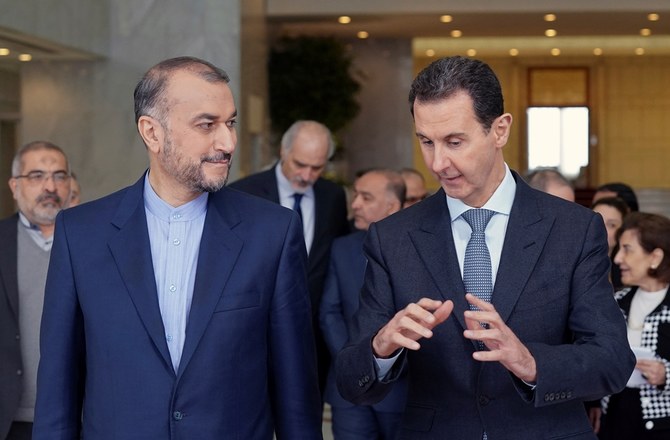
DAMASCUS: The foreign ministers of Iran and Syria, two allies of Russia, discussed the war in Ukraine and other developments during a meeting in Damascus on Wednesday. Syria’s top diplomat said Moscow is defending its people.
Faisal Mekdad spoke to reporters in Damascus after his Iranian counterpart, Hossein Amir-Abdollahian, held talks with President Bashar Assad, Mekdad and top security official Maj. Gen. Ali Mamlouk.
Amir-Abdollahian welcomed the reconciliation approach by the United Arab Emirates toward Syria. He added that Tehran is close to reaching an agreement on its nuclear program with world powers.
Iran is a strong ally of Assad and has sent thousands of Iran-backed fighters from around the region to bolster Syrian government forces against opponents in the 11-year Syrian conflict. Russia has also supported Assad militarily, turning the tide of the war in his favor. The Syria war has killed nearly half a million people and displaced half the country’s pre-war population of 23 million.
Speaking about Russia’s invasion of Ukraine, Mekdad said “Russia is defending its right in protecting its people (by pushing) away the NATO presence on its direct border.”
“Russia is defending us all and is defending its sovereignty,” Mekdad added.
State news agency SANA said that during Assad’s meeting with Amir-Abdollahian they discussed the conflict in Ukraine and they both agreed that “international balance should not be subjected to dangerous shocks through which Western countries threaten international peace and security.”
During his visit, Amir-Abdollahian discussed the latest developments in Iran’s negotiations to restore Tehran’s nuclear deal with world powers. He also discussed Assad’s visit to the United Arab Emirates last week, which marked his first to an Arab country since the Syria war broke out, and meetings of the constitutional committee in Geneva between the Syrian government and opposition.
“We welcome and we are satisfied with what some Arab countries are doing by normalizing relations with Syria,” Amir-Abdollahian said.
Amir-Abdollahian said in Farsi that strategic relations between Iran and Syria are at their best. He later made a rare comment in Arabic, saying: “We are in the same trench, and we support Syria’s leadership, government and people.”
Like Iran, Russia is a strong ally of Syria and joined the war in 2015, which helped Assad’s forces regain control of much of the country. Russia has hundreds of troops deployed in Syria and an air base on the Mediterranean coast.
Nuclear negotiations nearly reached completion earlier this month before Moscow demanded that its trade with Iran be exempted from Western sanctions over Ukraine, throwing the process into disarray. Negotiators have yet to reconvene in the Austrian capital, and it’s unclear exactly what hurdles lie ahead.
The Iranian official said he believes that Tehran is close to reaching an agreement over its nuclear program and put the blame for delays on the American side, which he said should take “a realistic stance.” He did not elaborate.
Amir-Abdollahian’s visit comes two weeks after two members of Iran’s Revolutionary Guard were killed in an Israeli strike near the capital Damascus.
Days later Iran claimed responsibility for a missile barrage that struck near a sprawling US consulate complex in northern Iraq, saying it was retaliation for repeated Israeli strikes in Syria. The Revolutionary Guard said it fired off 12 cruise missiles at what it described as a “strategic center” of the Israeli spy agency Mossad, a claim denied by Iraqi officials.


![]()

Iran welcomes Syria ties with Arabs, says nuclear deal close
Short Url
https://arab.news/mnccn
Iran welcomes Syria ties with Arabs, says nuclear deal close
- Amir-Abdollahian welcomed the reconciliation approach by the UAE toward Syria
- “Russia is defending us all and is defending its sovereignty,” Mekdad added


Latest updates


© 2026 SAUDI RESEARCH & PUBLISHING COMPANY, All Rights Reserved And subject to Terms of Use Agreement.