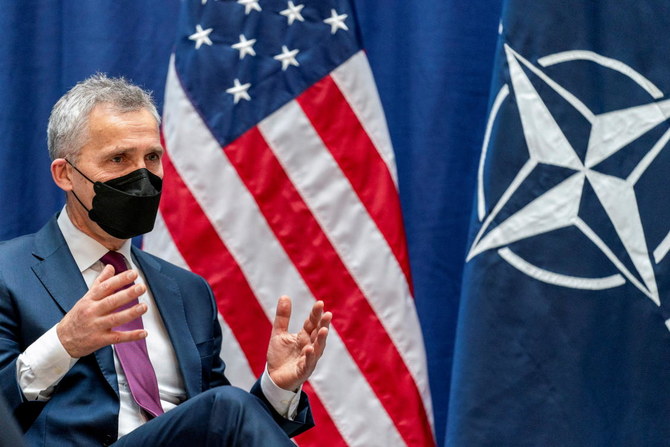
MUNICH: NATO Secretary-General Jens Stoltenberg said on Saturday he had sent a letter to Russian Foreign Minister Sergei Lavrov offering more talks to defuse a possible conflict in Ukraine but warned Moscow of the dangers of making impossible security demands.
Stoltenberg said he sent the letter on Thursday, urging Lavrov to agree to more talks in the format of the NATO-Russia Council, which met in January to formally discuss Moscow’s calls for allies to withdraw troops from eastern Europe.
He also told the Munich Security Conference that there were no signs of a Russian withdrawal from the borders of Ukraine — despite Russia’s assertion this week that it had begun withdrawing troops — and that the risk of a conflict was real as Moscow’s military build-up continued.
“I have invited Russia and all NATO allies to meetings in the NATO-Russia Council. And I reiterated my invitation in the letter that I sent to minister Lavrov on Thursday,” he said.
“We are extremely concerned because we see that they continue to build up, they continue to prepare. And we have never in Europe seen since the end of the Cold War, such a large concentration of combat-ready troops,” he said.
In a rare admission of the limits of diplomacy, Stoltenberg also told the conference that Moscow was putting forward security demands that the Kremlin knew NATO could never meet.
That concern was echoed by German Chancellor Olaf Scholz, who told the conference: “Russia has made the issue of Ukraine’s possible NATO membership a casus belli, which is a paradox because there is no decision on this on the agenda,” he said.
In the stand-off over Ukraine, Russia has sent tens of thousands of troops near the border with its neighbor while insisting it has no plans to invade. President Vladimir Putin is pressing security demands including a block on Ukraine ever joining NATO. NATO has said that, under UN treaties, every nation is free to choose its alliances.
“So that danger is now the combination of this massive military buildup, with the very threatening rhetoric, putting forward demands they know we cannot meet and say if we don’t meet them, they will be military consequences,” Stoltenberg said.
“We will differentiate clearly between untenable demands and legitimate security interests,” Scholz added.
Speaking alongside Stoltenberg, European Commission President Ursula von der Leyen said Moscow’s threats toward Ukraine could reshape the entire international system and would also cost Moscow economically.
“The world has been watching in disbelief as we face the largest build-up of troops on European soil since the darkest days of the Cold War, because the events of these days could reshape the entire international order,” von der Leyen said.


NATO urges more Russia talks to defuse Ukraine crisis
https://arab.news/gh94f
NATO urges more Russia talks to defuse Ukraine crisis

- NATO Secretary-General Jens Stoltenberg told the Munich Security Conference that there were no signs of a Russian withdrawal from the borders of Ukraine

Homeless Muslims in southern Philippines observe Ramadan as month of trial
- Thousands lost their homes when parts of Bongao in Tawi-Tawi were burnt to ashes
- Many trying to fully observe the fasting month say they are grateful to be alive
Manila: As Annalexis Abdulla Dabbang was looking forward to observing the month of Ramadan with her family, just days before it began they lost everything when an enormous fire tore through whole neighborhoods of their city in the southernmost province of the Philippines.
Bongao is the capital of Tawi-Tawi, an island province, forming part of the country’s Muslim minority heartland in the Bangsamoro region. The city experienced its worst fire in years in early February, when flames swept through the coastal community, leaving more than 5,000 people homeless.
“We were swimming for our lives. We had to swim to escape from the fire ... We swam in darkness, and (even) the sea was already hot because of the fire,” Dabbang, a 27-year-old teacher, told Arab News.
“Everything we owned was gone in just a few hours — our home, our memories, the things we worked hard for, everything turned to ashes.”
Trying to save their 2-year-old daughter and themselves, she and her husband left everything behind — as did hundreds of other families that together with them have since taken shelter at the Mindanao State University gymnasium — one of the evacuation centers.
Unable to secure a tent, Dabbang’s family has been sleeping on the bleachers, sharing a single mat as their bed. When Ramadan arrived a few days after they moved to the makeshift shelter, they welcomed it in a different, more solemn way. There is no family privacy for suhoor, no room or means to welcome guests for iftar.
“Ramadan feels different now. It’s painful but at the same time more real. When we lost our home, we began to understand what sacrifice really means. When you sleep in an evacuation center, you understand hunger, discomfort in a deeper way,” Dabbang said.
“We don’t prepare special dishes. We prepare our hearts.”
While she and thousands of others have lost everything they have ever owned, she has not lost her faith.
“Our dreams may have turned to ashes, but our prayers are still alive,” she said.
“This Ramadan my prayers are more emotional than ever. I pray for strength, not just for myself, but for my family and for every neighbor who also lost their family home. I pray for healing from the trauma of fire. I pray that Allah will replace what we lost with something better. I pray for the chance to rebuild not just our house, but our sense of security.”
Juraij Dayan Hussin, a volunteer helping the Bongao fire victims, observed that many of them were traumatized and the need to cleanse the heart and mind during Ramadan was what kept many of them going, because they are “thankful that even though they lost their property, they are still alive.”
But the religious observance related to the fasting month is not easy in a cramped shelter.
“It’s hard for Muslims to perform their prayers when they do not have their proper attire because they usually have specific clothes for prayer,” he said. “Sanitation in the area is also an issue ... when you fast and when you pray, cleanliness is essential.”
For Abdulkail Jani, who is staying at a basketball court with his brother and more than 70 other families, this Ramadan will be spent apart from their parents, whom they managed to move to relatives.
“The month of Ramadan this year is a month of trial ... there will be a huge change from how we observed Ramadan in the past, but we will adjust to it and try to comfort ourselves and our family. The most important thing is that we can perform the fasting,” he told Arab News.
“Despite our situation now, despite everything, as long as we’re alive, we will observe Ramadan. We’ll try to observe it well, without missing anything.”


