

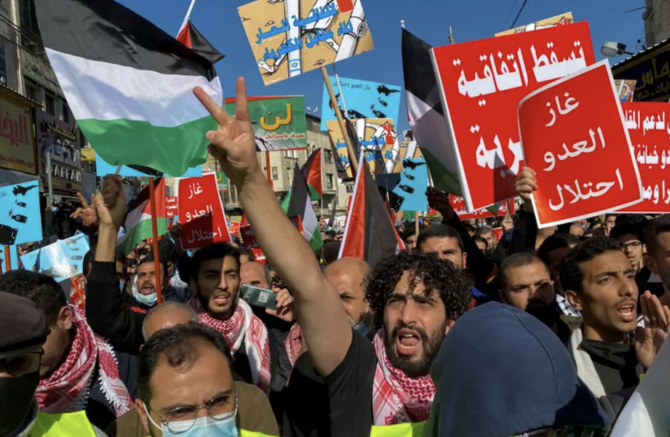

AMMAN: Several Jordanian MPs have joined activists, human rights groups and civil society organizations in calling for the release of 36 Jordanian students detained this week for reportedly taking part in a protest against Jordan’s signing of a declaration of intent with Israel to trade clean electricity for water.
MP Khalil Atiyeh told Arab News on Friday that he was “dismayed” the students had not yet been released.
Atiyeh led the signing of a petition by 30 MPs protesting the arrests, which have been criticized by human rights groups and civil society organizations.
“I spoke in parliament about the case calling for their immediate release and was promised that they would be released, but until now they haven’t been freed,” Atiyeh said.
Jamal Jeet, a member of the National Forum for the Defense of Freedom, told Arab News that the governor of Amman had ordered that the detained students should be held in prisons a long way from the capital as a way of punishing them and their families.
Jeet called the detention orders “illegal,” claiming they violate articles seven and eight of the Jordanian constitution, which guarantee citizens’ right to the freedoms of expression and assembly.
“They are being held according to laws that are intended to keep criminals away from the general public because they are dangerous,” he said.
Around 3,000 demonstrators gathered in downtown Amman on Friday to protest the deal with Israel. Many held signs bearing the names of the detained students.
A Jordanian official, who asked to remain anonymous, denied claims that authorities were targeting anyone expressing opposition to the agreement and pointed out that no students had been arrested for protesting on a university campus.
The 36 detained students had broken the law by protesting in Dakhiliyah (Interior) Circle, “a vital central area in the heart of Amman, where they blocked the movement of people and traffic,” the official said.
“Security officials asked the students several times to leave and demonstrate in another area to avoid jeopardizing road safety and disruption to traffic, people’s movement, and businesses, but they refused,” the official added. “Our regulations protect the right to demonstrate peacefully and guarantee the safety of participants, but when the law is violated, authorities are obliged to act.”
The official highlighted the fact that hundreds of citizens had demonstrated on Friday and stressed that no one would be arrested for protesting so long as they abided by the law.
“It is unfair and inaccurate to claim that we are targeting those who are opposed to the agreement,” said the official.
The semi-governmental Human Rights Center called the arrests “a violation of the right of expression and assembly and a clear violation of the constitution, which guarantees freedoms and considers it a crime for anyone to violate the freedom of Jordanians.”
Zaid O. Nabulsi, a member of the Royal Commission for the Modernization of Political Systems, told Arab News that the arrests send a “devastating message” to the younger generation, who have been told that that their voices will be heard.
“If you had intended to destroy the hard work of the Royal Committee over the past four months, you could not have achieved your purpose any better,” Nabulsi said.
Himam, a coalition of civil society organizations, issued a statement calling for students’ immediate release and stressed “the need to investigate if they were subject to beatings and ill-treatment which are considered a form of torture.”
Himam also called for the abolition of the law that “treats peaceful protesters as criminals.”
Muath Momani, legal advisor to the Jordanian-based Lawyers without Borders, told Arab News that what happened to the students is unacceptable.
“The penal law is being used to stop people from speaking out,” said Momani. “The political atmosphere should be more open to allowing people to express themselves.”
Ammar Borini, who monitors social media for the Amman Net website, told Arab News that the issue of the students’ arrest has been trending in Jordan.
“Many are expressing anger and quoting the king telling (young people) ‘We want to hear your voice.’ They are saying on social media, ‘Here (are young people) speaking out and they have ended up in jail.’”


