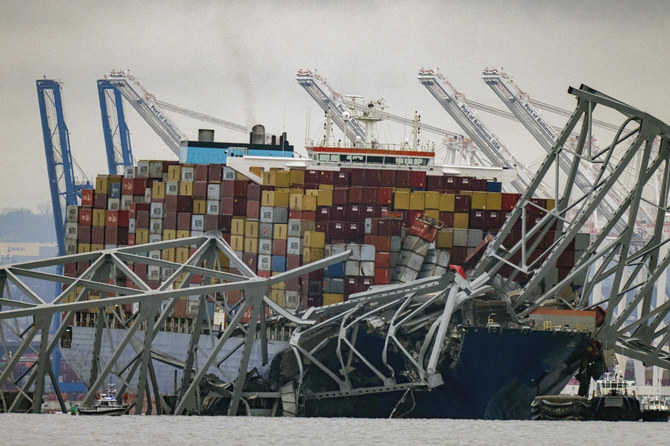
BALTIMORE: The container ship that caused the deadly collapse of Baltimore’s Francis Scott Key Bridge was refloated Monday and has begun slowly moving back to port.
The Dali has remained at the collapse site since it lost power and crashed into one of the bridge’s supporting columns on March 26, killing six construction workers and snarling traffic into Baltimore Harbor.
The ship appeared to start moving shortly after 6 a.m. as crews started to maneuver it out of the wreckage. It started and stopped a few times before slowly backing away from the collapse site.
Officials said it would move at about 1 mph on the roughly 2.5-mile (4-kilometer) trip, a fraction of the speed it was traveling when it lost power and crashed into the bridge. Pieces of the bridge’s steel trusses protruded from its bow, which remained covered in concrete from the collapsed roadway.
Officials have said they plan to unload the ship’s containers and complete some short-term repairs while it’s docked in Baltimore.
Monday morning’s high tide had been expected to bring the best conditions for crews to refloat and start moving the ship, according to a statement from the Key Bridge Response Unified Command.
Several tugboats were escorting the Dali on its path to the marine terminal. The work is expected to last at least 21 hours.
Crews conducted a controlled demolition on May 13 to break down the largest remaining span of the collapsed bridge.
The Dali experienced four electrical blackouts within about 10 hours before leaving the Port of Baltimore for Sri Lanka and hitting the bridge, according to a preliminary report issued by the National Transportation Safety Board.

Ship that caused deadly Baltimore bridge collapse has been refloated and is moving back to port
Short Url
https://arab.news/9hffs
Ship that caused deadly Baltimore bridge collapse has been refloated and is moving back to port
- The disaster killed six construction workers and snarled traffic into Baltimore Harbor
- Several tugboats are escorting the Dali on its 2.5-mile path to the marine terminal
Taiwan to send team to assess US rare earth deposits
TAIPEI: Taiwan plans to send officials to assess US rare earths deposits with a goal to have such minerals refined on the island, Economy Minister Kung Ming-hsin said on Wednesday.
President Donald Trump’s administration has stepped up efforts to secure US supplies of critical minerals after China rattled senior officials and global markets last year by withholding rare earths required by American automakers and other industrial manufacturers.
Trump last week launched a US strategic stockpile of critical minerals, called Project Vault, backed by $10 billion in seed funding from the US Export-Import Bank and $2 billion in private funding.
While semiconductor powerhouse Taiwan is not formally part of that scheme, it has previously held talks with the United States on how it can help, given Taipei’s concerns about over-reliance on a China-centric supply chain.
China views Taiwan as its own territory and has stepped up its military threats.
Speaking to reporters in Taipei, Kung said the ministry’s Geological Survey and Mining Management Agency would go to the United States to assess rare earths deposits there.
“Specifically, what rare-earth elements they contain and whether they are suitable. In other words, whether those are the rare earths we actually need. So we still need to investigate,” he said.
Given Taiwan does not mine such elements itself, it can instead play a role in refining the materials from other countries, Kung added.
“The technology is not an issue; the next step is scaling up,” he said.
Taiwan consumes 1,500 metric tons of rare earth annually, a figure projected to rise to 2,000 metric tons given economic growth, Kung added.
“Our goal is to expand production capacity to meet half of our demand by then, strengthening the supply chain.
President Donald Trump’s administration has stepped up efforts to secure US supplies of critical minerals after China rattled senior officials and global markets last year by withholding rare earths required by American automakers and other industrial manufacturers.
Trump last week launched a US strategic stockpile of critical minerals, called Project Vault, backed by $10 billion in seed funding from the US Export-Import Bank and $2 billion in private funding.
While semiconductor powerhouse Taiwan is not formally part of that scheme, it has previously held talks with the United States on how it can help, given Taipei’s concerns about over-reliance on a China-centric supply chain.
China views Taiwan as its own territory and has stepped up its military threats.
Speaking to reporters in Taipei, Kung said the ministry’s Geological Survey and Mining Management Agency would go to the United States to assess rare earths deposits there.
“Specifically, what rare-earth elements they contain and whether they are suitable. In other words, whether those are the rare earths we actually need. So we still need to investigate,” he said.
Given Taiwan does not mine such elements itself, it can instead play a role in refining the materials from other countries, Kung added.
“The technology is not an issue; the next step is scaling up,” he said.
Taiwan consumes 1,500 metric tons of rare earth annually, a figure projected to rise to 2,000 metric tons given economic growth, Kung added.
“Our goal is to expand production capacity to meet half of our demand by then, strengthening the supply chain.
© 2026 SAUDI RESEARCH & PUBLISHING COMPANY, All Rights Reserved And subject to Terms of Use Agreement.


