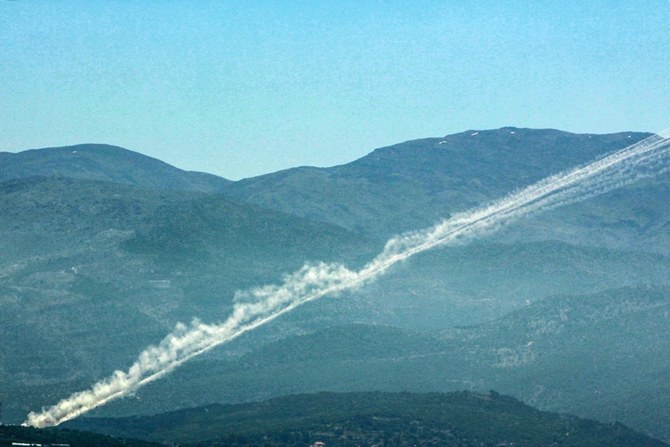
BEIRUT: Lebanon’s powerful armed group Hezbollah announced on Thursday it had used a drone capable of firing rockets at a military position in one of its latest attacks in northern Israel.
Israel and Hezbollah have been involved in near-daily exchanges of fire since the war between Israel and Hamas broke out on October 7.
Hezbollah announced it had used an “armed attack drone” equipped with two S-5 rockets on a military position in Metula in northern Israel.
The Iran-backed group published a video showing the drone heading toward the position, where tanks were stationed, with the footage showing the moment the two rockets were released followed by the drone exploding.
It was the first time they had announced the use of this type of weapon since the cross-border exchanges with Israel erupted in October.
The Israeli army said three soldiers were wounded in Thursday’s attack.
Hezbollah-affiliated media said that the drone’s warhead consisted of between 25 and 30 kilogrammes (55 and 66 pounds) of high explosive.
Military analyst Khalil Helou told AFP that the use of drones offers Hezbollah the ability to launch the attack from within Israeli territory, as they can fly at low altitudes, evading detection by radar.
Hezbollah also announced on Wednesday that it had launched a strike using “attack drones” on a base west of the northern Israeli town of Tiberias.
That attack was the group’s deepest into Israeli territory since fighting flared, analysts said.
In recent weeks, the Lebanese militant group has announced attacks that it has described as “complex,” using attack drones and missiles to hit military positions, as well as troops and vehicles.
It has also used guided and heavy missiles, such as Iran’s Burkan and Almas missiles, as well as the Jihad Mughniyeh missile, named after a Hezbollah leader killed by Israeli fire in Syria in 2015.
Helou, a retired general, said that depite its new weaponry, Hezbollah still relied primarily on Kornet anti-tank missiles with a range of just five to eight kilometers.
They also use the Konkurs anti-tank missile, which can penetrate Israel’s Iron Dome defense system.
Hezbollah has a large arsenal of weapons, that it has expanded significantly in recent years.
The group has said repeatedly that it has advanced weapons capable of striking deep inside Israeli territory.
Analysts have described the skirmishes between Israel and Hamas as a war of “attrition,” in which each side is testing the other, as well as their own tactics.
Hezbollah has expanded the range of its attacks in response to strikes targeting its munitions and infrastructure, or its military commanders.
One such Israeli strike on Wednesday targeted the village of Brital in Lebanon’s eastern Bekaa Valley, with the Israeli army later announcing it had hit a “terror target related to Hezbollah’s precision missile project.”
Helou said Hezbollah’s targeting of the base near Tiberias and its use of the rocket-equipped drone “can be interpreted as a response to the attack on Brital, but it remains a shy response compared to the group’s capabilities.”
He suggested that the Israeli strike likely hit a depot for Iranian missiles that had not yet been used by Hezbollah.
“Hezbollah does not wish to expand the circle of the conflict,” Helou said.
“What is happening is a war of attrition through which it is trying to distract the Israeli army” from Gaza and seeking to prevent it from “launching a wide-ranging attack on Lebanon.”


![]()

Hezbollah uses new weapons in Israel attacks
Short Url
https://arab.news/vp4pt
Hezbollah uses new weapons in Israel attacks
- The Israeli army said three soldiers were wounded in an attack on Thursday
- Hezbollah has a large arsenal of weapons, that it has expanded significantly in recent years
Latest updates


© 2026 SAUDI RESEARCH & PUBLISHING COMPANY, All Rights Reserved And subject to Terms of Use Agreement.