

Children among dead as Israeli forces widen attacks on Hezbollah

1 / 2
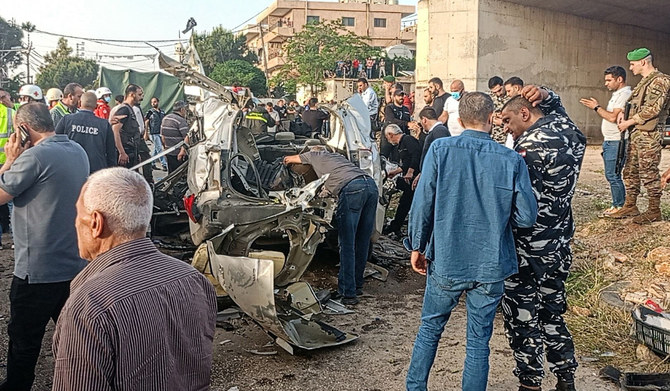
Lebanese army soldiers and onlookers gather around the carcasses of a car after it was hit by an Israeli strike, reportedly killing a local Hamas official, in Majd al-Jabal in Lebanon's Bekaa valley, on May 17, 2024. (AFP)
2 / 2
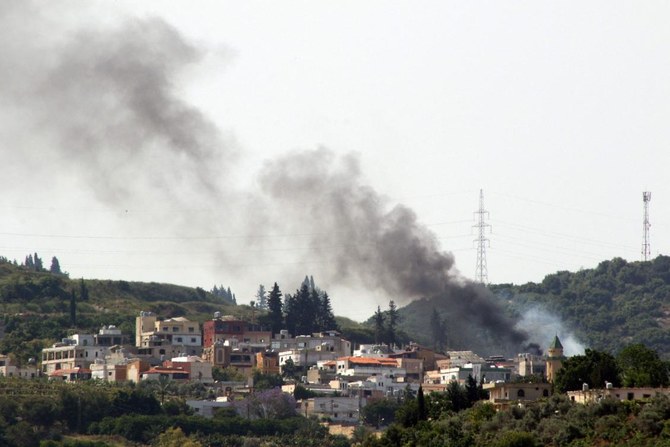
Smoke billows during Israeli bombardment over the Lebanese village of Al-Najjariyeh in southern Lebanon near the border with Israel. (AFP)
Short Url
Updated 17 May 2024
Follow

Children among dead as Israeli forces widen attacks on Hezbollah

  • Southern Lebanon faces ‘escalating violence,’ army veteran tells Arab News
  • US Embassy joins calls for a new Lebanese president to ‘unite the nation’

BEIRUT: Two children from a Syrian refugee family and a Hezbollah fighter were killed when Israeli airstrikes on Friday hit an area of southern Lebanon more than 30 km inside the border.

Israeli strikes targeted Najjariyeh and Addousiyeh, adjacent villages south of the coastal city of Sidon, killing the children and a Hezbollah fighter driving a pickup truck.

Hezbollah responded to the raids by firing dozens of rockets toward the upper Galilee, western Galilee, the Galilee panhandle, and the Golan.

Israeli media claimed that 140 rockets were fired toward the north of the country.

BACKGROUND

Hezbollah has traded cross-border fire with Israeli forces almost daily since the Oct. 7 Hamas attack on southern Israel that sparked the war in Gaza, now in its eighth month.

Israeli forces and Hezbollah have expanded their hostilities, with both launching drone attacks deep into Lebanese territory and northern Israel.

Retired Brig. Gen. Khaled Hamadeh of the Lebanese Army said that the situation in southern Lebanon is “escalating toward more violent attacks.”

Hezbollah insists on linking a ceasefire in southern Lebanon to an end to hostilities in Gaza.

Hamadeh said that no efforts were being made to stop the clashes between Israel and Hezbollah, unlike the situation in Gaza.

In a statement, Hezbollah said it targeted Israel’s Tsnobar logistics base in the Golan with 50 Katyusha rockets in response to the strike on Najjarieh.

According to Israeli media, rocket salvos were aimed at military bases in Katzrin and areas north of Lake Tiberias.

Two people were injured in rocket blasts in Karam bin Zamra in the upper Galilee, media added.

CCTV cameras installed outside homes in Najjarieh showed an Israeli drone following the pickup truck as the driver, named as Hussein Khodor Mehdi, attempted to flee.

The first missile launched by the drone missed its target, but a second that struck the truck, setting it on fire and killing the driver. Three onlookers were also injured.

Hezbollah said that Mehdi, 62, was “martyred on the road to Jerusalem.”

Israeli Army Radio said the victim was a senior commander in the Hezbollah air force.

It claimed that the army planes shelled Hezbollah’s infrastructure in Najjarieh.

The second airstrike targeted a congregation hall and a cement factory, wounding several members of a Syrian refugee family. Two children, Osama and Hani Al-Khaled, later died from their injuries.

Hezbollah said it targeted the Al-Raheb military site with artillery and Israeli positions in Al-Zaoura with a salvo of Katyusha rockets.

According to a security source, Hezbollah’s latest targets included surveillance balloons near Tiberias and Adamit in the Galilee.

Early on Friday, Hezbollah attacked the newly established headquarters of the 411th Artillery Battalion in Kibbutz Jaatoun, east of Nahariyya, with drones in response to the Israeli killing of two Hezbollah fighters, Ali Fawzi Ayoub, 26, and Mohammed Hassan Ali Fares, 34, the previous day.

In his Friday sermon, Sheikh Mohammed Yazbek, head of Hezbollah’s Shariah Council, said the group was “waging its fierce war on the north of Palestine, pursuing the enemy, blinding its espionage, and breaking what were once red lines, as well pursuing its soldiers in their hideouts until the war on Gaza stops.”

The US Embassy in Lebanon issued a warning over the conflict on the southern border and the presidential vacuum in the country.

Electing a president was crucial to ensuring Lebanon’s participation in regional discussions and future diplomatic agreements concerning its southern border, the embassy said.

Lebanon “needs and deserves a president who unites the nation, prioritizes the well-being of its citizens, and forms a broad and inclusive coalition to restore political stability and implement necessary economic reforms,” the statement added.

The ambassadors of Egypt, France, Qatar, Saudi Arabia, and the US to Lebanon issued a statement this week warning of “the critical situation facing the Lebanese people and the difficult-to-manage repercussions on Lebanon’s economy and social stability due to the delay of necessary reforms.”


Israeli strikes kill 3 people in Gaza, hospital says

Updated 10 February 2026
Follow

Israeli strikes kill 3 people in Gaza, hospital says

  • Shifa Hospital reported the deaths amid the months-old ceasefire that has seen continued fighting

DEIR AL-BALAH: Israeli military strikes on Monday killed three people west of Gaza City, according to the hospital where the casualties arrived.
Shifa Hospital reported the deaths amid the months-old ceasefire that has seen continued fighting. The Israeli army said Monday it is striking targets in response to Israeli troops coming under fire in the southern city of Rafah, which it says was a violation of the ceasefire. The army said it is striking targets “in a precise manner.”
The four-month-old U.S-backed ceasefire followed stalled negotiations and included Israel and Hamas accepting a 20-point plan proposed by US President Donald Trump aimed at ending the war unleashed by Hamas’ Oct. 7, 2023, attack into Israel. At the time, Trump said it would lead to a “Strong, Durable, and Everlasting Peace.”
Hamas freed all the living hostages it still held at the outset of the deal in exchange for thousands of Palestinian prisoners held by Israel and the remains of others.
But the larger issues the agreement sought to address, including the future governance of the strip, were met with reservations, and the US offered no firm timeline.
Top UN official concerned over Israel’s West Bank decision
The United Nations top official on Monday expressed concern about the Israeli security cabinet’s decision to deepen the country’s control over the occupied West Bank.
Secretary-General Antonio Guterres is “gravely concerned” and warned that the Israeli decision could erode the prospect of a two-state solution, spokesperson Stéphane Dujarric said in a statement.
“Such actions, including Israel’s continued presence in the Occupied Palestinian Territory are not only destabilizing but – as recalled by the International Court of Justice – unlawful,” he said.
Israel ‘s security cabinet on Sunday approved measures that aim to deepen Israeli control over the occupied West Bank and weaken the already limited powers of the Palestinian Authority.
Israel’s far-right Finance Minister Bezalel Smotrich said the measures would make it easier for Jewish settlers to force Palestinians to give up land, adding that “we will continue to bury the idea of a Palestinian state.”
Israel captured the West Bank, as well as Gaza and east Jerusalem, in the 1967 Mideast war. The Palestinians want all three territories for a future state.
Rafah crossing improving, official says
The Palestinian official set to oversee day-to-day affairs in Gaza said on Monday that passage through the Rafah crossing with Egypt is starting to improve after a chaotic first week of reopening marked by confusion, delays and a limited number of crossings.
Ali Shaath, head of the National Committee for the Administration of Gaza, told Egypt’s Al-Qahera News that operations at the crossing were improving on Sunday. He said 88 Palestinians were scheduled to travel through Rafah on Monday, more than have crossed in the initial days since reopening. Israel did not immediately confirm the figures.
The European Union border mission at the crossing said in a statement Sunday that 284 Palestinians had crossed since reopening. Travelers included people returning after having fled the war and medical evacuees and their escorts. In total, 53 medical evacuees departed during the first five days of operations.
That remains well below the agreed target of 50 medical evacuees exiting and 50 returnees entering daily, negotiated by Israeli, Egyptian, Palestinian and international officials.
Shaath and other members of the committee remain in Egypt, without Israeli authorization to enter the war-battered enclave.
The Rafah crossing opened last week for the first time since mid-2024, one of the main requirements for the ceasefire between Israel and Hamas. It was closed Friday and Saturday because of confusion around operations.
Palestinian officials say nearly 20,000 people are seeking to leave Gaza for medical care unavailable in its largely destroyed health system.
Palestinians who returned to Gaza in the first days after the crossing reopened described hourslong delays and invasive searches by Israeli authorities and an Israeli-backed Palestinian armed group, Abu Shabab. Israel denied mistreatment.
Gaza’s Health Ministry said on Monday that five people were killed over the previous 24 hours, bringing the death toll to 581 since the October ceasefire. The truce led to the return of the remaining hostages — both living captives and bodies — from the 251 abducted during the Oct. 7, 2023, attack that triggered the war.
Hamas-led militants killed around 1,200 people, mostly civilians, in the attack. Israel’s military offensive has since killed over 72,000 Palestinians, according to the ministry, which operates under the Hamas-run government and is staffed by medical professionals. The UN and independent experts consider it the most reliable source on war casualties.