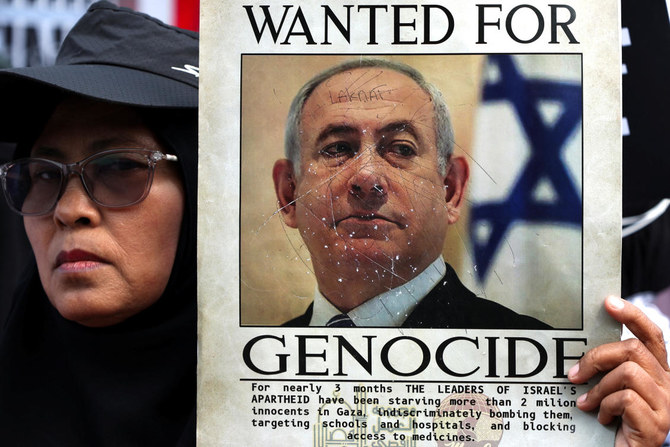

THE HAGUE, Netherlands: The chief prosecutor of the International Criminal Court said Monday he is seeking arrest warrants for Israeli and Hamas leaders, including Israeli Prime Minister Benjamin Netanyahu, in connection with their actions during the seven-month war between Israel and Hamas.
Karim Khan said that he believes Netanyahu, his defense minister Yoav Gallant and three Hamas leaders — Yehia Sinwar, Mohammed Deif and Ismail Haniyeh — are responsible for war crimes and crimes against humanity in the Gaza Strip and Israel.
The prosecutor must request the warrants from a pre-trial panel of three judges, who take on average two months to consider the evidence and determine if the proceedings can move forward.
Israel is not a member of the court, and even if the arrest warrants are issued, Netanyahu and Gallant do not face any immediate risk of prosecution. But Khan’s announcement deepens Israel’s isolation as it presses ahead with its war, and the threat of arrest could make it difficult for the Israeli leaders to travel abroad.
Both Sinwar and Deif are believed to be hiding in Gaza as Israel tries to hunt them down. But Haniyeh, the supreme leader of the Islamic militant group, is based in Qatar and frequently travels across the region.
There was no immediate comment from either side.
Opinion
This section contains relevant reference points, placed in (Opinion field)
Israel launched its war in response to an Oct. 7 cross-border attack by Hamas that killed some 1,200 people, mostly civilians, and took 250 others hostage. The Israeli offensive has killed over 35,000 Palestinians, at least half of them women and children, according to the latest estimates by Gaza health officials. The Israeli offensive has also triggered a humanitarian crisis in Gaza, displacing roughly 80 percent of the population and leaving hundreds of thousands of people on the brink of starvation, according to UN officials.
Speaking of the Israeli actions, Khan said in a statement that “the effects of the use of starvation as a method of warfare, together with other attacks and collective punishment against the civilian population of Gaza are acute, visible and widely known. ... They include malnutrition, dehydration, profound suffering and an increasing number of deaths among the Palestinian population, including babies, other children, and women.”
The United Nations and other aid agencies have repeatedly accused Israel of hindering aid deliveries throughout the war. Israel denies this, saying there are no restrictions on aid entering Gaza and accusing the United Nations of failing to distribute aid. The UN says aid workers have repeatedly come under Israeli fire, and also says ongoing fighting and a security vacuum have impeded deliveries.
Of the Hamas actions on Oct. 7, Khan, who visited the region in December, said that he saw for himself “the devastating scenes of these attacks and the profound impact of the unconscionable crimes charged in the applications filed today. Speaking with survivors, I heard how the love within a family, the deepest bonds between a parent and a child, were contorted to inflict unfathomable pain through calculated cruelty and extreme callousness. These acts demand accountability.”
After a brief period of international support for its war, Israel has faced increasing criticism as the war has dragged on and the death toll has climbed.
Israel is also facing a South African case in the International Court of Justice accusing Israel of genocide. Israel denies those charges.