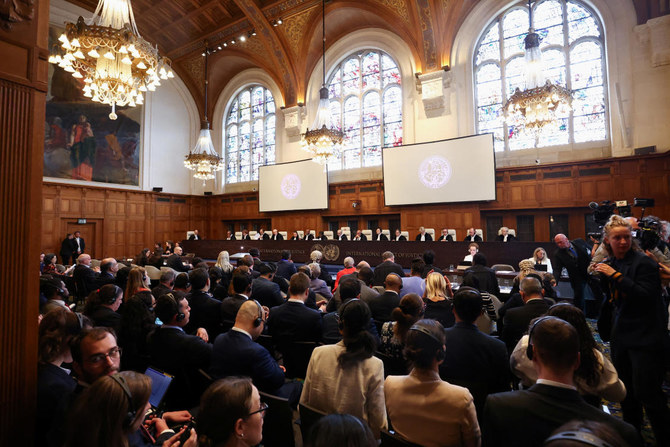
THE HAGUE: South Africa accused Israel Thursday at the top UN court of stepping up what it called a “genocide” in Gaza, urging judges to order a halt to the Israeli assault on Rafah.
The International Court of Justice (ICJ) heard a litany of allegations against Israel from lawyers representing Pretoria, including mass graves, torture, and deliberate withholding of humanitarian aid.
Israel will respond on Friday. It has previously stressed its “unwavering” commitment to international law and described South Africa’s case as “wholly unfounded” and “morally repugnant.”
“South Africa had hoped, when we last appeared before this court, to halt this genocidal process to preserve Palestine and its people,” said top lawyer Vusimuzi Madonsela.
“Instead, Israel’s genocide has continued apace and has just reached a new and horrific stage,” added Madonsela.
South Africa was kicking off two days of hearings at the Peace Palace in The Hague, home of the ICJ, imploring judges to order a ceasefire throughout Gaza.
In a ruling that made headlines around the world, the ICJ in January ordered Israel to do everything in its power to prevent genocidal acts and enable humanitarian aid to Gaza.
But the court stopped short of ordering a ceasefire and South Africa’s argument is that the situation on the ground — notably the operation in the crowded city of Rafah — requires fresh ICJ action.
The Rafah campaign is “the last step in the destruction of Gaza and its Palestinian people,” argued Vaughan Lowe, a lawyer for South Africa.
“It was Rafah that brought South Africa to the court. But it is all Palestinians as a national, ethnical and racial group who need the protection from genocide that the court can order,” he added.
The orders of the ICJ, which rules in disputes between states, are legally binding but it has little means to enforce them.
It has ordered Russia to halt its invasion of Ukraine, to no avail.
South Africa wants the ICJ to issue three emergency orders — “provisional measures” in court jargon — while it rules on the wider accusation that Israel is breaking the 1948 UN Genocide Convention.
First, it wants the court to order Israel to “immediately withdraw and cease its military offensive” in Rafah.
Second, Israel should take “all effective measures” to allow “unimpeded access” to Gaza for humanitarian aid workers, as well as journalists and investigators.
Lastly, Pretoria asked the court to ensure Israel reports back on its measures taken to adhere to the orders.
Prime Minister Benjamin Netanyahu ordered the Rafah offensive in defiance of US warnings that more than a million civilians sheltering there could be caught in the crossfire.
Netanyahu argued Wednesday that “we have to do what we have to do” and insisted that mass evacuations there had averted a much-feared “humanitarian catastrophe.”
Just minutes before the court hearings opened, Israel’s Defense Minister Yoav Gallant said the operation in Rafah “will continue as additional forces will enter” the area.
The United Nations agency for Palestinian refugees, UNRWA, said Wednesday that 600,000 people have fled Rafah since military operations intensified, amid battles and heavy Israeli bombardment in the area.
“As the primary humanitarian hub for humanitarian assistance in Gaza, if Rafah falls, so too does Gaza,” said South Africa in a written submission to the court.
“The thwarting of humanitarian aid cannot be seen as anything but the deliberate snuffing out of Palestinian lives. Starvation to the point of famine,” said lawyer Adila Hassim, her voice choking with emotion.
Pretoria stressed that the only way for the existing court orders to be implemented was a “permanent ceasefire in Gaza.”
Israel’s military operations in Gaza were launched in retaliation for Hamas’s unprecedented October 7 attack which resulted in the deaths of more than 1,170 people, mostly civilians, according to an AFP tally of official Israeli figures.
Militants also seized about 250 hostages, 128 of whom Israel estimates remain in Gaza, including 36 the military says are dead.
Israel’s military has conducted a relentless bombardment from the air and a ground offensive inside Gaza that has killed at least 35,233 people, mostly civilians, according to Gaza’s Hamas-run health ministry.


![]()

South Africa tells UN court Israel ‘genocide’ hit ‘new and horrific stage’
Short Url
https://arab.news/5aryk
South Africa tells UN court Israel ‘genocide’ hit ‘new and horrific stage’
- ICJ heard a litany of allegations against Israel from lawyers representing Pretoria, including mass graves, torture, and deliberate withholding of humanitarian aid
- Top lawyer Vusimuzi Madonsela said: “Israel’s genocide has continued apace and has just reached a new and horrific stage”


Latest updates


© 2026 SAUDI RESEARCH & PUBLISHING COMPANY, All Rights Reserved And subject to Terms of Use Agreement.