

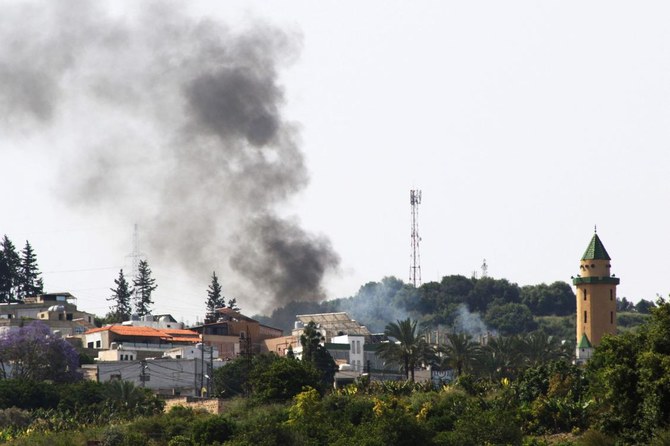

BEIRUT: Four members of Hezbollah were killed on Monday in south Lebanon as Israeli airstrikes targeted the border area in attacks that also reached the Syrian city of Al-Qusayr.
Lebanese civilians were also injured, and more homes in the towns facing the southern border were destroyed in the strikes. The attacks also reached a Lebanese army center.
Israeli drones carried out two successive raids on a residential neighborhood in the town of Naqoura, destroying two homes and causing severe damage to others.
A drone then targeted the vicinity of a civil defense team of the Islamic Health Organization, whose members were trying to remove rubble to rescue victims.
The Israeli army also targeted the outskirts of Naqoura with artillery shells, causing civilian casualties.
Israel’s airstrikes targeted Mais Al-Jabal, destroying several homes, while warplanes also raided Odaisseh and Hula.
Artillery shelling focused on the town of Khiam and the outskirts of Sarda, and the towns of Rachaya Al-Foukhar and Kfarchouba in the Hasbaya district.
The shelling also targeted Wadi Hunayn and the outskirts of the town of Markaba.
Israeli attacks included a mortar shell strike on a Lebanese army center in the outskirts of the town of Alma Al-Shaab, but no injuries were reported.
However, the Iran-backed Hezbollah mourned four of its members who had been killed in strikes, including one who was killed in a raid on Al-Qusayr, where the group has military facilities.
The deceased included Raef Abdel Nabi Meliji and Abbas Mahdi from Naqoura; Mohammed Abbas Abbas from Barish; and Hussein Ali Ali from Bednayel in the Bekaa.
Hezbollah said it had responded to “the targeting of villages, civilians, and their safe homes” by shelling Israeli military sites, some with Burkan missiles and others with drones.
It added that it had targeted and hit an Israeli army center with guided missiles at the eastern entrance to the village of Ghajar.
Hezbollah added it had also targeted “the headquarters of the 91st Division in the Pranit barracks, destroying a part of it, injuring several soldiers, and setting it on fire.”
The group said it had used “suitable weapons” to hit the sites. The Zabdin barracks in the occupied Lebanese Shebaa Farms was also attacked with artillery shells, while attacks were also launched on the Al-Malikiyah and Al-Marj sites.
Israeli media reported that two heavy rockets had been launched from Lebanon toward Upper Galilee.
An Israeli army spokesperson said on Sunday that its targets consisted of a Hezbollah observation point in Shihin town and military facilities in Blida town in the Marjayoun district.
Meanwhile, Lebanon’s Prime Minister Najib Mikati declared a three-day mourning period on Monday following the tragic helicopter crash that claimed the lives of Iranian President Ebrahim Raisi, Foreign Minister Hossein Amir-Abdollahian, and their companions on Sunday.
Former Prime Minister Fouad Siniora cabled Supreme Leader Ali Khamenei and offered his condolences on Raisi’s death.
Hezbollah described the tragedy as “painful.” Its statement praised President Raisi as a “strong supporter and defender of our causes and the nation’s causes, including Jerusalem and Palestine, protecting resistance movements and fighters in all the responsibilities he undertook.”
The statement also said Amir-Abdollahian was an “active and sacrificial person and the flag bearer in all political and diplomatic forums. He loved the resistance movements and dedicated himself to championing and supporting them.”


