
ATLANTA: President Joe Biden on Sunday offered his most direct recognition of US students’ anguish over the Israel-Hamas war, telling graduates of historically Black Morehouse College that he heard their voices of protest and that scenes from the conflict in Gaza break his heart, too.
“I support peaceful nonviolent protest,” he told students at the all-male college, some of whom wore Palestinian scarves known as keffiyehs around their shoulders on top of their black graduation gowns. “Your voices should be heard, and I promise you I hear them.”
Biden said there’s a humanitarian crisis in Gaza, “that’s why I’ve called for an immediate ceasefire to stop the fighting” and bring home hostages still being held by Hamas after its militants attacked Israel on Oct. 7. The president’s comments came near the end of a commencement address in which he also reflected on American democracy and his role in safeguarding it.
“It’s one of the hardest, most complicated problems in the world,” Biden said. “There’s nothing easy about it. I know it angers and frustrates many of you, including my family. But most of all I know it breaks your heart. It breaks mine as well.”
To date, Biden had limited his public comments around the protests on US college campuses to upholding the right to peaceful protest.
The speech — and a separate one he gave later Sunday in Detroit — are part of a burst of outreach to Black constituents by the Democratic president, whose support among these voters has softened since their strong backing helped put him in the Oval Office.
Biden spent much of the approximately 30-minute speech focused on the problems at home. He condemned Donald Trump’s rhetoric on immigrants and noted that the class of 2024 entered college during the COVID-19 pandemic and following the murder of George Floyd, a Black man killed by a Minneapolis police officer. Biden said it was natural for them, and others, to wonder whether the democracy “you hear about actually works for you.”
“If Black men are being killed in the street. What is democracy?” he asked. “The trail of broken promises that still leave Black communities behind. What is democracy? If you have to be 10 times better than anyone else to get a fair shot.”
Anti-war protests have roiled America’s college campuses. Columbia University canceled its main commencement ceremony. At Morehouse, the announcement that Biden would be the commencement speaker drew some backlash among the faculty and those who oppose the president’s handling of the war. Some Morehouse alumni circulated an online letter condemning administrators for inviting Biden and solicited signatures to pressure Morehouse President David Thomas to rescind it.
The letter claimed that Biden’s approach to Israel amounted to support of genocide in Gaza and was out of step with the pacifism expressed by Martin Luther King Jr., Morehouse’s most famous graduate.
The Hamas attack on southern Israel killed 1,200 people. Israel’s offensive has killed more than 35,000 Palestinians in Gaza, according to health officials in the territory.
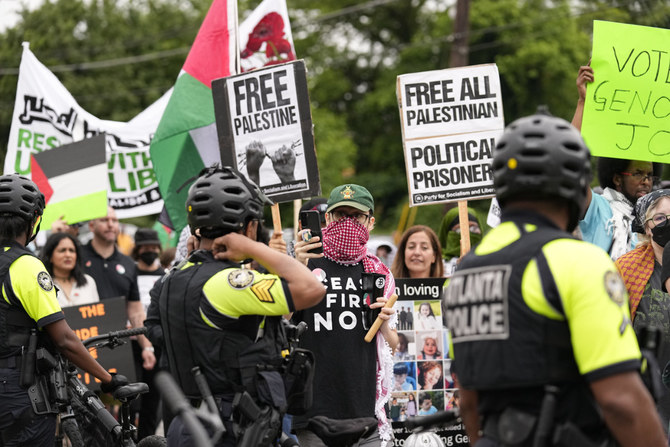
In the end, there were no disruptions of Morehouse’s commencement while applause for Biden mostly was subdued. At least seven graduates and one faculty member sat with their backs turned during Biden’s address, and another student draped himself in a Palestinian flag. Protesters near the ceremony carried signs that said “Free Palestine,” “Save the Children” and ”Ceasefire Now” as police on bikes kept watch.
On stage behind the president as he spoke, academics unfurled a Congolese flag. The African country has been mired in a civil war, and many racial justice advocates have called for greater attention to the conflict as well as American help in ending the violence.
During his speech, valedictorian DeAngelo Jeremiah Fletcher, of Chicago, said it was his duty to speak on the war in Gaza and recognize that both Palestinians and Israelis have suffered. He called for an “immediate and permanent ceasefire in the Gaza Strip.”
Graduate Kingsley John said, “the temperature on campus was expected given we had the president of the United States come and speak.” John said he stood “in solidarity” with his classmates and that Biden “seemed to be reflective and open to hear the feedback.”
Morehouse awarded Biden an honorary doctor of laws degree. After accepting the honor, he joked that, “I’m not going home” as chants of “four more years” broke out in the audience. Biden then flew to Detroit to address thousands attending the local NAACP chapter’s annual Freedom Fund dinner.
Georgia and Michigan are among a handful of states that will help decide November’s expected rematch between Biden and Trump. Biden narrowly won Georgia and Michigan in 2020 and he needs strong Black voter turnout in Atlanta and Detroit if he hopes to repeat in November.
Biden spent part of the past week reaching out to Black constituents. He highlighted key moments in the Civil Rights Movement, from the 70th anniversary of the landmark 1954 Supreme Court decision in the case of Brown v. Board of Education that outlawed racial segregation in public schools to the Little Rock Nine, who helped integrate a public school in Little Rock, Arkansas, in 1957. He also met with members of the “Divine Nine” Black fraternities and sororities.
At the NAACP dinner, Biden told a largely Black crowd that numbered into the thousands that Trump wants to pardon those who were convicted of crimes during the insurrection at the US Capitol on Jan. 6, 2021, and calls them “patriots.” He suggested that Trump would not have been so kind had they been people of color.
“Let me ask you, what do you think he would’ve done on Jan. 6 if Black Americans had stormed the Capitol?” Biden asked. “What do you think? I can only imagine.”
The speech gave Biden a chance to reach thousands of people in Wayne County, which historically has voted overwhelmingly Democratic but has shown signs of resistance to his reelection bid.
The county also holds one of the largest Arab American populations in the nation, predominantly in the city of Dearborn. Leaders there were at the forefront of an “uncommitted” effort that received over 100,000 votes in the state’s Democratic primary and spread across the country.
A protest rally and march against Biden’s visit took place in Dearborn in the afternoon.
In Detroit, guests at the NAACP dinner were met by over 200 pro-Palestinian protesters outside the entrance to the convention center. They waved Palestinian flags, held signs calling for a ceasefire and chanted “free, free Palestine.”
“Until Joe Biden listens to his key constituents, he’s risking handing the presidency to Donald Trump,” said Lexi Zeidan, a protest leader who help spearhead a protest effort that resulted in over 100,000 people voting “uncommitted” in February’s Democratic primary.