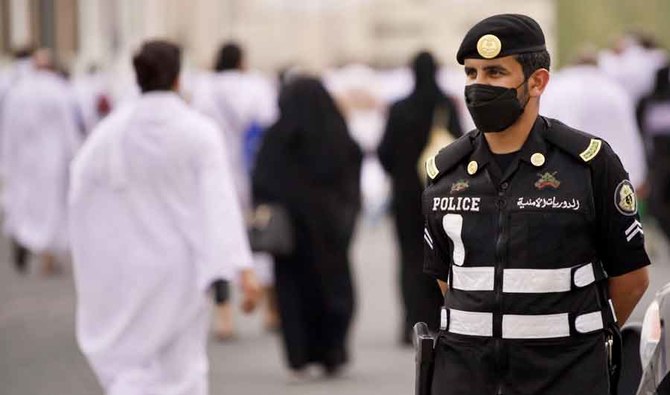
MAKKAH: Seventy-seven people were arrested for violating Hajj regulations on Tuesday after they failed to produce valid permits, Hajj Security Forces Command Brig. Gen. Sami Al-Shuwairekh said.
Legal measures were taken against them and they were issued with SR10,000 ($2,665) fines. Al-Shuwairekh called on all citizens and residents to abide by instructions for this year’s pilgrimage, adding that security personnel will bring forward legal measures against anyone who tries to reach the Grand Mosque in Makkah, the central surrounding area and the holy sites (Mina, Muzdalifah, Arafat) without a permit until July 23.
For the second consecutive year, the Hajj has been limited to pilgrims from inside Saudi Arabia. The decision was taken to protect them against the pandemic. Just 60,000 of 500,000 Hajj applicants were chosen to participate in the religious event.
Those selected for this year’s Hajj had to meet a number of specific requirements which included having been fully jabbed against COVID-19 with any of the Pfizer, AstraZeneca, Moderna, or Johnson & Johnson vaccines.

Saudi authorities arrest 77 for violating Hajj permit rules
https://arab.news/ngyrr
Saudi authorities arrest 77 for violating Hajj permit rules
- Legal measures were taken against them and they were issued with SR10,000 ($2,665) fines
Amr Moussa: Saudi Arabia and Egypt must lead Arabs for true peace
RIYADH: Amr Moussa, former Arab League secretary-general, has called for the establishment of an effective Arab leadership led by Saudi Arabia and Egypt, in partnership with Jordan, to unify regional positions and negotiate on the Palestinian cause and broader regional future.
During a panel discussion at the King Fahd National Library in Riyadh on Thursday evening, Moussa stressed this was “both vital and achievable” and emphasized the primary goal should be the establishment of a fully sovereign and effective Palestinian state: “True peace is only that which protects all parties … we need genuine peace, not a facade or a superficial justification,” he said.
Such a state must be “responsible for security and peace in the Middle East alongside its neighbors,” rather than a fragile entity, he added.
Moussa underlined that achieving this objective first requires the Arab world to demonstrate the capacity for unified and decisive action. “Are we as Arabs truly capable of being ‘we,’ or has that moment passed?” he asked.
He said the firm positions taken by Saudi Arabia and Egypt in rejecting forced displacement and calling for an end to aggression “underscore that it is possible to assert ‘no’ when the Arab stance is justified.”
Warning of the severe consequences of maintaining the status quo, he added: “If things continue this way … there will inevitably be something akin to October 7 again, because injustice breeds resistance.”
He placed full responsibility on Israel, saying it “bears complete responsibility for the chaos and destruction.”
On a practical mechanism to implement a unified Arab stance, Moussa proposed that Saudi Arabia and Egypt take the lead in establishing a diplomatic baseline, representing their “yeses and noes” in consultation with other Arab states. This framework, he said, would counter any attempts to impose unjust solutions under labels such as the new international “Peace Council,” which might “demand Palestinian concessions on Palestinian land.”
On whether peace was possible with the current Israeli government, which he described as “not committed to peace,” Moussa said: “There are other Israelis who speak the language of peace.” He urged efforts to “identify and support them to create a political alternative within Israel.”
He said the first thing Palestinians should do is hold comprehensive Palestinian elections as soon as possible, utilizing technology to ensure all Palestinians took part, including those in Jerusalem, to select a new leadership “with strong negotiating legitimacy.”
Moussa also warned that the challenges “are not limited to Palestine,” saying the Arab world faces interconnected crises in Syria, Yemen, Sudan, Lebanon and Libya, alongside shifts in the international order and the race for space.
“The issue of our future (requires) reviving a new Arab world,” capable of actively shaping that future rather than being marginalized, the former secretary-general concluded.