

Syrian government says it controls prison in Raqqa with Daesh-linked detainees

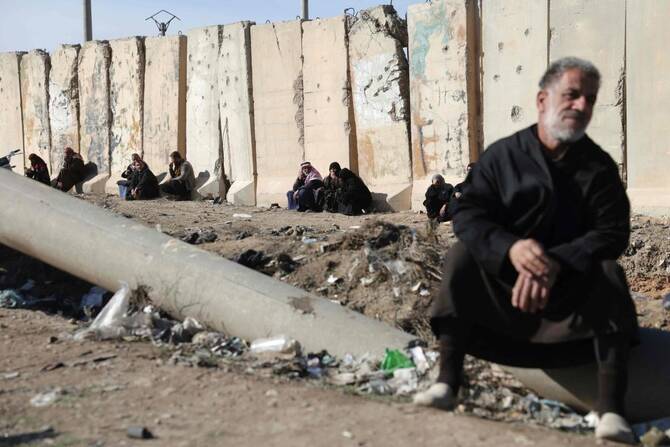
Family members of detainees in Al-Aqtan prison on the outskirts of Raqqa wait outside the facility as they try to have news about their detained relatives on Jan.y 21, 2026.(AFP)
Short Url
Updated 23 January 2026
Follow

Syrian government says it controls prison in Raqqa with Daesh-linked detainees

  • Prison holds detainees linked to Daesh, and witnessed ⁠clashes in its vicinity between advancing Syrian government forces and Kurdish fighters

Syria’s Interior Ministry said on Friday it had taken over Al-Aktan prison in the city of Raqqa ​in northeastern Syria, a facility that was formerly under the control of Kurdish-led Syrian Democratic Forces (SDF).

The prison has been holding detainees linked to the militant group Daesh, and witnessed clashes in its vicinity this week between advancing Syrian government forces and the SDF.

It ‌was not ‌immediately clear how many ‌Daesh ⁠detainees ​remain in Al-Aktan ‌prison as the US military has started transferring up to 7,000 prisoners linked to the militant Islamist group from Syrian jails to neighboring Iraq. US officials say the detainees are citizens of many countries, including in Europe.

“Specialized teams were ⁠formed from the counter-terrorism department and other relevant authorities to ‌take over the tasks of guarding ‍and securing the prison ‍and controlling the security situation inside it,” ‍the Interior Ministry said in a statement.

Under a sweeping integration deal agreed on Sunday, responsibility for prisons housing Daesh detainees was meant to be transferred to ​the Syrian government.

The SDF said on Monday it was battling Syrian government forces near ⁠Al-Aktan and that the seizure of the prison by the government forces “could have serious security repercussions that threaten stability and pave the way for a return to chaos and terrorism.”

The US transfer of Daesh prisoners follows the rapid collapse of Kurdish-led forces in northeast Syria. Concerns over prison security intensified after the escape on Tuesday of roughly 200 low-level Daesh fighters from Syria’s ‌Shaddadi prison. Syrian government forces later recaptured many of them.


Jordanian king, Egyptian president discuss Gaza in Cairo meeting

Updated 3 sec ago
Follow

Jordanian king, Egyptian president discuss Gaza in Cairo meeting

  • Talks emphasize need to enhance joint Arab efforts to restore stability in region, including Palestinian coastal enclave
  • Jordan, Egypt firmly reject any attempts to displace Palestinians from West Bank, condemn Israeli violations

LONDON: King Abdullah II of Jordan and Egyptian President Abdel Fattah El-Sisi emphasized the importance of implementing the ceasefire agreement for the Gaza Strip during their meeting at Al-Ittihadiya Palace in Cairo.

The meeting stressed the need to enhance joint Arab efforts to restore stability in the region, including the Palestinian coastal enclave of Gaza, according to the Jordan News Agency.

The two leaders emphasized the need to fully implement the Gaza ceasefire, allow unhindered humanitarian aid, and accelerate recovery efforts in the territory.

Jordan and Egypt also firmly rejected any attempts to displace Palestinians from the West Bank and condemned all violations and arbitrary actions against them.

King Abdullah cautioned against the repeated attacks on holy sites in Jerusalem, both Muslim and Christian, which have reportedly been perpetrated by Israeli authorities or settlers.

The parties emphasized the importance of de-escalation and the peaceful resolution of regional crises while respecting national sovereignty, unity, and territorial integrity.

Jordan’s Deputy Prime Minister and Foreign Minister Ayman Safadi, along with Director of the Office of His Majesty Alaa Batayneh, also attended the meeting.

Israel announced on Sunday the limited reopening of the Rafah crossing between Gaza and Egypt. The crossing, which is considered a vital gateway for both civilians and aid, had remained closed since Israeli forces seized control of it in May 2024 during the conflict in Gaza, aside from a brief reopening in early 2025.