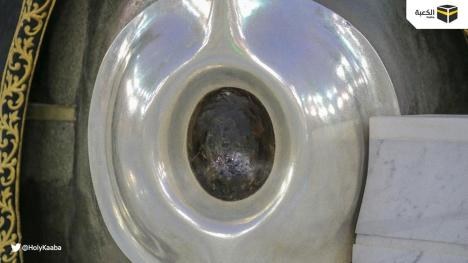

The Black Stone is a rock set in an oval-shaped silver frame on the southeast corner of the Kaaba. It stands about 1.5 meters above the ground.
Only eight pieces of the Black Stone can be seen, and the largest of them is the size of a date, while the rest of the rock is inside the structure of the Kaaba.
It is revered by Muslims as an Islamic relic that dates back to the time of Adam and Eve. It fell from heaven to guide Adam and Eve to build an altar that became the first temple on earth.
The Black Stone has a significant meaning to Muslims, as it was witnessed in the Kaaba by the Prophet Muhammad five years before his prophethood.
Muslims do not worship the Stone, but they raise their hands towards it while repeating Takbir (Allah is the Greatest) during the tawaf ritual, and touch it and/or kiss it, if able, following what the Prophet Muhammad used to do. The act is also considered an expiation for sins.
The Black Stone was subjected to repeated desecration and damage over time throughout history. It was struck and smashed to pieces by a stone fired from a catapult, but the fragments were rejoined using a silver ligament.
It was also stolen multiple times, and was broke into seven pieces the last time it was stolen. The pieces were put together by a pair of goldsmiths from Makkah, who built a silver frame to surround it, and it has since been enclosed in a similar frame and covered in a paste made of wax, musk and amber.
Authorities in Saudi Arabia recently released new specially processed images of the most important Islamic and archaeological sites in the Grand Mosque in Makkah.
The General Presidency for the Affairs of the Two Holy Mosque captured 1,050 photographs of the Black Stone and the shrine of Ibrahim using Fox Stack Panorama technology, which combines images with varying degrees of clarity to produce a single accurate high-resolution picture of the Black Stone, known as Hajar Aswad in Arabic.
The 49,000-megapixel images were taken over seven hours and required a week to edit. It is the first time the authority has been able to show the Black Stone in such detail.