

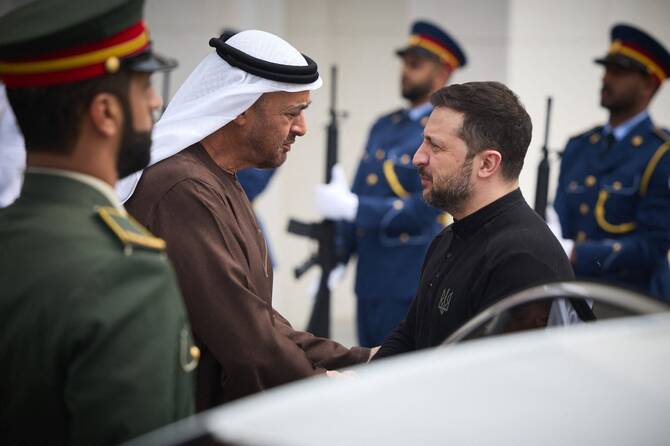

MOSCOW: Ukrainian, US and Russian officials will hold security talks in the United Arab Emirates on Friday, the Kremlin said, following a meeting of top US negotiators with President Vladimir Putin in Moscow on a US-drafted plan to end the Ukraine war.
Diplomatic efforts to end Europe’s deadliest conflict since World War II have gained pace in recent months, though Moscow and Kyiv remain at odds over the key issue of territory in a post-war settlement.
The Kremlin on Friday repeated its demand that Kyiv must withdraw its forces from the eastern Donbas region for the war to end, showing it had not dropped its maximalist demands ahead of trilateral talks.
“Russia’s position is well known on the fact that Ukraine, the Ukrainian armed forces, have to leave the territory of the Donbas. They must be withdrawn from there,” Kremlin spokesman Dmitry Peskov said, adding: “This is a very important condition.”
US negotiators, led by envoy Steve Witkoff, talked with the Russian leader in Moscow into the early hours of Friday, according to a Kremlin statement.
Kremlin diplomatic adviser Yuri Ushakov told reporters their discussions had been “useful in every respect.”
Witkoff and the US team are next flying to Abu Dhabi, where talks are expected to continue.
A Russian delegation, headed by General Igor Kostyukov, director of Russia’s GRU military intelligence agency, will also head there “in the coming hours,” according to Ushakov.
“It was agreed that the first meeting of a trilateral working group on security issues will take place today in Abu Dhabi,” Ushakov added.
“We are genuinely interested in resolving (the conflict) through political and diplomatic means,” he said, but added: “Until that happens, Russia will continue to achieve its objectives... on the battlefield.”
Witkoff previously said he believed the two sides were “down to one issue,” without elaborating.
Video published by the Kremlin showed a smiling Putin shaking hands with Witkoff, US President Donald Trump’s son-in-law Jared Kushner and White House adviser Josh Gruenbaum.
The high-stakes meeting came just hours after Ukrainian President Volodymyr Zelensky said a draft deal was “nearly, nearly ready” and that he and Trump had agreed on the issue of post-war security guarantees.
He also said the UK and France had already committed to forces on the ground.
Zelensky said Ukraine’s delegation at the UAE meeting would be led by Secretary of the National Security and Defense Council, Rustem Umerov, and would include Lt. Gen. Andriy Gnatov, the chief of staff of Ukrainian armed forces.
Russia, which occupies around 20 percent of Ukraine, is pushing for full control of the country’s eastern Donbas region as part of a deal.
But Kyiv has warned that ceding ground will embolden Moscow and says it will not sign a peace deal that fails to deter Russia from launching a renewed assault.
Europe ‘fragmented’
The full details of the upcoming talks in the United Arab Emirates have not been released, and it is not clear whether the Russian and Ukrainian officials will meet face-to-face.
Zelensky said these talks would last two days.
Trump repeated on Wednesday his oft-stated belief that Putin and Zelensky were close to a deal.
“I believe they’re at a point now where they can come together and get a deal done. And if they don’t, they’re stupid — that goes for both of them,” he said after delivering a speech at Davos.
Zelensky, at his address in Davos, blasted the EU’s lack of “political will” in countering Putin in a fiery address.
“Instead of becoming a truly global power, Europe remains a beautiful but fragmented kaleidoscope of small and middle powers,” he said.
Trump’s dramatic foreign policy pivots including a recent bid to take over Greenland — an autonomous Danish territory — have stirred worries in Europe about whether Washington can be trusted as a reliable security partner.
In his speech, Zelensky criticized Europe for pinning hopes on the United States defending them in case of aggression.
“Europe looks lost trying to convince the US President to change,” Zelensky said.
Russian strikes this week have left most of Kyiv without electricity, with residents of 4,000 buildings without heat in sub-zero temperatures.
Russia, which launched its Ukraine offensive in February 2022, says its strikes are aimed at energy infrastructure fueling Ukraine’s “military-industrial complex.”
Kyiv says the strikes are a war crime designed to wear down its civilian population.


