

New co-chairs of UK Parliament Palestine group urge settlement goods boycott

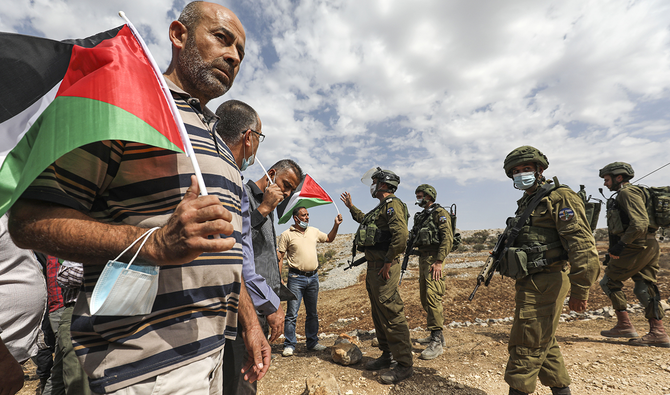
Palestinian protesters with flags, some mask-clad due to the COVID-19 coronavirus pandemic, confront Israeli soldiers during a demonstration against Jewish settlements in the town of Asira Shamaliya in the occupied West Bank near Nablus on October 9, 2020. (AFP)
Short Url
Updated 27 October 2020
Follow

New co-chairs of UK Parliament Palestine group urge settlement goods boycott

  • Julie Elliot: ‘It’s time that the British government stood up for international law’
  • Baroness Sayeeda Warsi: ‘Palestinian rights must be continually raised in the UK Parliament’

LONDON: The two new co-chairs of the Britain-Palestine All-Party Parliamentary Group (APPG) have urged the UK government to “stand up for international law” by banning all imports from illegal Israeli settlements.

Julie Elliot, a member of the UK’s main opposition Labour Party and one of the two new co-chairs, also said Britain should recognize Palestine as a state.

In a message released online to mark her election to the APPG, she said: “It’s time that the British government stood up for international law, sought action against products from the settlements — ban them in this country — and also move towards helping to end the blockade on Gaza, which has brought such dreadful, dreadful suffering to the people of Gaza.” She added: “It’s time for the British government to recognize Palestine. The time is now.”

Baroness Sayeeda Warsi, the other new co-chair and former co-chair of the governing Conservative Party, said: “Palestinian rights must be continually raised in the UK Parliament. It’s vital that we continue to pressure the UK government to act to end the occupation and to stand up for international law.” 

APPGs are groups in UK politics convened across party lines that meet to discuss, campaign on and promote a certain issue. They are often effective parts of wider parliamentary campaigns.

Chris Doyle, director of the Council for Arab-British Understanding, welcomed the election of Elliot and Warsi as the APPG’s new co-chairs. 

“They’re two politicians who understand the Palestinian issue, and it’s really important to push things, as they both have, such as British recognition of a Palestinian state along the 1967 lines with Jerusalem as its capital,” he told Arab News.

“The Palestine APPG is one of the best supported in Parliament — that’s a sign of the interest in the issue.”

But Doyle said they may have their work cut out in getting their message on Palestine across. “The challenge right now is to give airtime to any issue that isn’t COVID-19 or the American elections,” he added.

“The conflict issues in the Middle East are starved of the sort of attention they need because of the pandemic.”


Two Tunisia columnists handed over three years in prison

Updated 23 January 2026
Follow

Two Tunisia columnists handed over three years in prison

  • Mourad Zeghidi and Borhen Bsaies have already been in detention for almost two years
  • They were due to be released in January 2025 but have remained in custody on charges of money laundering

TUNIS: Two prominent Tunisian columnists were sentenced on Thursday to three and a half years in prison each for money laundering and tax evasion, according to a relative and local media.
The two men, Mourad Zeghidi and Borhen Bsaies, have already been in detention for almost two years for statements considered critical of President Kais Saied’s government, made on radio, television programs and social media.
They were due to be released in January 2025 but have remained in custody on charges of money laundering and tax evasion.
“Three and a half years for Mourad and Borhen,” Zeghidi’s sister, Meriem Zeghidi Adda, wrote on Facebook on Thursday.
Since Saied’s power grab, which granted him sweeping powers on July 25, 2021, local and international NGOs have denounced a regression of rights and freedoms in Tunisia.
Dozens of opposition figures and civil society activists are being prosecuted under a presidential decree officially aimed at combatting “fake news” but subject to a very broad interpretation denounced by human rights defenders.
Others, including opposition leaders, have been sentenced to heavy prison terms in a mega-trial of “conspiracy against state security.”
In 2025, Tunisia fell 11 places in media watchdog Reporters Without Borders’ (RSF) World Press Freedom Index, dropping from 118th to 129th out of 180 countries.