UNITED NATIONS, New York: Palestinian President Mahmoud Abbas has called for an international conference early next year to “launch a genuine peace process” while criticizing the recent decision of two Arab countries to normalize relations with Israel.
In an address before the UN General Assembly on Friday, Abbas seemed to acknowledge the growing international weariness with the decades-old conflict, saying “I wonder what more I can say after all I’ve said on countless occasions.”
The Palestinians have rejected President Donald Trump’s proposal to end the conflict that overwhelmingly favors Israel, and have officially cut off contacts with both the US and Israel. Instead, they have called for a multilateral peace process based on UN resolutions and past agreements.
They have also rejected the decision of the UAE and Bahrain to normalize ties with Israel, viewing it as a betrayal of the longstanding Arab consensus that recognition of Israel should only come in exchange for territorial concessions.
In his speech, Abbas said the agreements, signed at the White House earlier this month, are a “violation” of the “principles of a just and lasting solution under international law.”
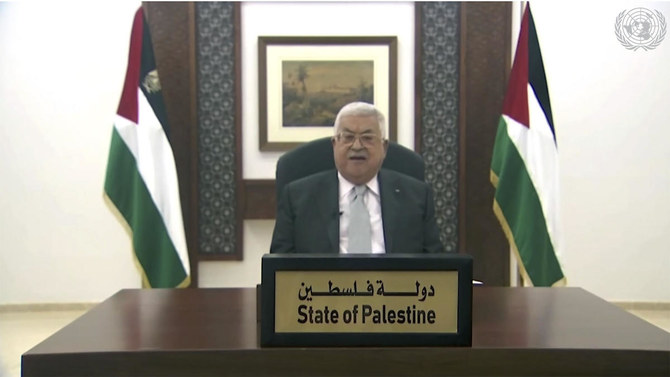
Abbas spoke before a large plaque reading “State of Palestine.” The Palestinians upgraded their status to “observer state” at the UN in 2012.
Abbas closed by saying “there can be no peace, no security, no stability, no coexistence in our region without an end to the occupation.”
“We will not bow down. We will not surrender. We will not compromise. And we shall triumph,” he said.

Palestine’s Mahmoud Abbas asks UN for international peace conference next year
https://arab.news/cseqa
Palestine’s Mahmoud Abbas asks UN for international peace conference next year
- Abbas spoke before a large plaque reading “State of Palestine”
- Abbas seemed to acknowledge the growing international weariness with the decades-old conflict
Arab League chief ‘deeply concerned’ over Yemen tensions
- Secretary-General Ahmed Aboul Gheit calls for solidarity among Yemen’s supporters, condemns southern separatist’s military operations
LONDON: The head of the Arab League on Tuesday said he is deeply concerned over escalating tensions in Yemen and called for solidarity among countries supporting Yemen’s internationally recognized government.
His comments came after the military coalition that backs Yemen’s Presidential Leadership Council carried out a “limited airstrike” targeting weapons and military vehicles it said were destined for southern separatist forces.
The shipments arrived in the Yemeni port of Mukalla on board two vessels from Fujairah in the UAE.
Saudi Arabia, a key member of the military coalition, criticized the UAE over its support for the separatists, known as the Southern Transitional Council.
The Kingdom said that any threat to its national security was a red line and that the UAE should follow the Yemeni government’s request to remove its forces from the country within 24 hours.
The UAE later announced it would withdraw its remaining counter-terrorism units from Yemen.
Arab League Secretary-General Ahmed Aboul Gheit expressed deep concern over the “serious and rapidly unfolding developments in Yemen.”
He called for solidarity among all countries supporting the Yemeni government and to exercise restraint.
He also condemned any military action aimed at “forcibly entrenching a secessionist reality on the ground, in a manner that threatens Yemen’s territorial unity.”
The STC, which wants a separate state in southern Yemen, seized large areas of territory in Hadramout and Al-Mahara provinces in recent weeks.
The STC is meant to be part of a coalition with the Yemeni government opposed to Houthi militants that control the north of the country.
Aboul Gheit said the southern Yemen issue must be addressed through dialogue.
The measures taken by Saudi Arabia and the military coalition were “vital to ensuring peace, security, and the unity of the Yemeni people under their internationally recognized leadership,” said Muslim World League Secretary-General Dr. Mohammed bin Abdulkarim Al-Issa.
“Supporting illegitimate practices only deepens internal divisions and serves those who do not have Yemen’s best interests at heart,” he said.


