


BRUSSELS: European Union leaders on Thursday welcomed US President Donald Trump’s decision to drop his tariff threats over Greenland but expressed reservations about getting involved in his Board of Peace project.
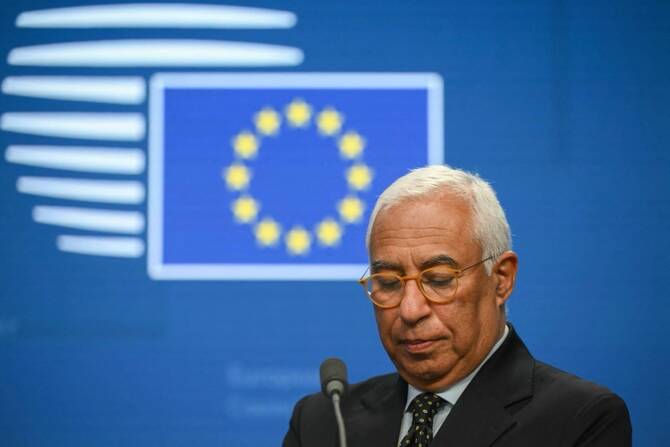
After chairing an emergency summit called to reassess troubled ties with the Trump administration, EU Council President António Costa underlined that the leaders believe “it’s very important to preserve and cherish our transatlantic partnership.”
Striking a measured tone after days of high rhetoric over Trump’s threats to annex Greenland, Costa said the priority must now be to put in place the EU-US trade deal agreed last July. “The goal remains the effective stability of the trade relations,” he told reporters.
That said, Costa did affirm that the 27-nation trading bloc “will continue to stand up for its interests and will defend itself, its member states, its citizens and its companies against any form of coercion.”
His remarks contrasted sharply with the more aggressive stance of French President Emmanuel Macron.
“Europe can make itself be respected, and that’s a very good thing,” Macron told reporters, as he arrived for the meeting in Brussels. “When we use the tools that we have at our disposal we get respect and that’s what happened this week.”
On the eve of the EU meeting, Trump had dramatically backed away from his insistence on “acquiring” Greenland, a semiautonomous territory of Denmark. For the first time, he said that he would not use force to seize the island. Trump also dropped his threat of slapping tariffs on European nations that support Denmark.
Yet nothing suggests that the unpredictable US leader won’t change his mind again.
Trump’s threats force a rethink
Before backing down, Trump had urged Denmark and the rest of NATO to stand aside and let him have Greenland, adding an ominous warning: “You can say yes, and we will be very appreciative. Or you can say no, and we will remember.”
Polish Prime Minister Donald Tusk underlined that “the United States are absolutely the most important partner when it comes to our security.” But Tusk said that it’s important “to understand the difference between domination and leadership. Leadership is okay.”
No details of the hastily agreed “framework” deal that sparked Trump’s extraordinary reversal have been made public, and doubts about it persist. Danish Prime Minister Mette Frederiksen insists that her country will not bargain over its sovereignty.
“We are sovereign state and we cannot negotiate about that, because it’s a part of the very basic democratic values. But of course, we can discuss with us how we can strengthen our common cooperation on security in the Arctic region,” she told reporters.
Frederiksen called for “a permanent presence from NATO in the Arctic region, including around Greenland.” Macron said that French troops would take part in military exercises that NATO is organizing.
Asked on Thursday whether NATO is planning a future operation to improve security in the Arctic, the alliance’s top military officer, US Lt. Gen Alexus Grynkewich said: “We’ve done no planning yet. We have not received political guidance to move out.”
European Commission President Ursula von der Leyen emphasized the need to build the EU’s ties with Greenland. She said her team “will soon put forward a substantive package of investments,” without elaborating.
Board of Peace doubts
The leaders were less keen on Trump’s proposed “Board of Peace,” which was initially envisioned as a small group of world leaders overseeing the Gaza ceasefire but has grown into something far more ambitious. Trump has spoken about the board replacing some of the functions of the United Nations.
Some European countries have declined invitations to join. Norway, Slovenia and Sweden said they won’t take part. Told that Macron was unlikely to take up the offer, Trump said: “I’ll put a 200 percent tariff on his wines and champagnes and he’ll join.”
Germany has offered a guarded and noncommittal response to Trump’s invitation, but Hungary and Bulgaria accepted.
We are ready to work together with the United States on the implementation of the Comprehensive Peace Plan for Gaza, with a Board of Peace carrying out its mission as a transitional administration in accordance with the United Nations Security Council Resolution 2803.
Costa said the majority of the leaders “have serious doubts about a number of elements in the charter of the Board of Peace related to its scope, its governance and its compatibility with the UN Charter.”
Europe’s prime security concern
As the leaders converged on Brussels, Ukrainian President Volodymyr Zelensky blasted his European allies for what he portrayed as their slow, fragmented and inadequate response to Russia’s invasion nearly four years ago and its continued international aggression.
At the World Economic Forum in Switzerland, Zelensky listed a litany of grievances and criticisms of Europe that he said have left Ukraine at the mercy of Russian President Vladimir Putin amid an ongoing US push to end the war.
“Europe looks lost,” he said, and he urged the continent to become a global force. Shining a light on Europe’s dependence on America, he contrasted its response with Washington’s bold steps in Venezuela and Iran.
Von der Leyen pointed out that the EU has spent more 193 billion euros on Ukraine over four years of war, and that the bloc intends to provide a further 90 billion euros over the next two years to help meet most of its economic and military needs.
“We know that we will never match the sacrifice of the Ukrainian people, but what we can do is stand by their side. And I think the figures speak for themselves,” she said.


