



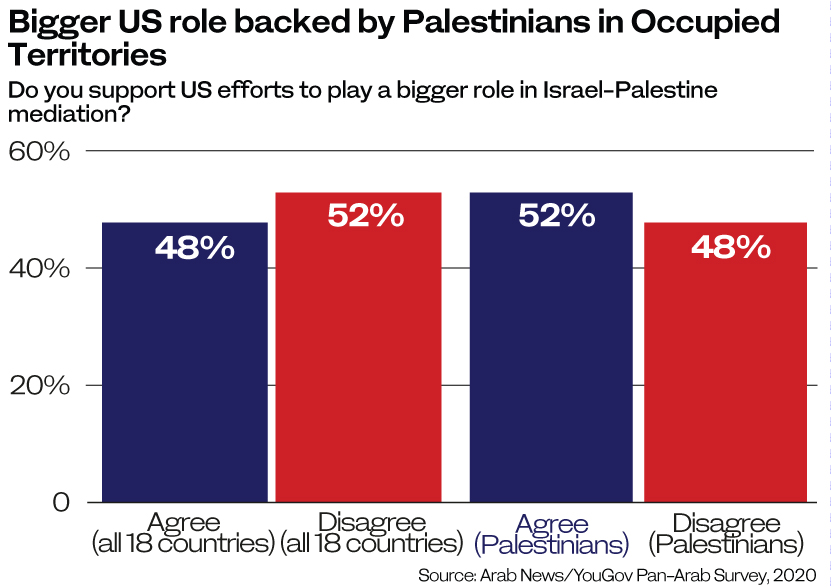
DUBAI, ERBIL: Palestinians in the occupied territories back US efforts to play a bigger role in mediation with Israel, according to the Arab News/YouGov pan-Arab survey, putting their view at odds with what a majority of Arabs across the wider region think is best for them.
Of the 2,192 respondents polled across 18 Arab countries ahead of the Nov. 3 presidential election, 52 percent said they are against the US playing a bigger role in mediating between Israelis and Palestinians.
Younger people across the region appear especially hostile to a bigger US peace-broker role, with 67 percent of 18-24-year-olds against. By contrast, 61 percent of people over the age of 45 support a bigger role for Washington, indicating a stark generational divide.
Opinions also appear to diverge based on marital status, with 62 percent of unmarried people rejecting more US involvement, while 56 percent of people who are married with children voice their support.
By contrast with the Arab region as a whole, 52 percent of Palestinians in the occupied territories support US efforts to play a bigger role in mediating between Israelis and Palestinians, with the remaining 48 percent against.
“One of the reasons why you see the Palestinians looking for US involvement is because they believe the US is one of the few countries in the world that has influence over Israel and can help pressure it in the context of the peace process,” Will Wechsler, director of Middle East programs at the Atlantic Council, told Arab News in response to the findings.
READ: The methodology behind the Arab News/YouGov Pan-Arab Survey
Many observers in the Arab world appear to blame the Palestinian leadership for the lack of progress, accusing them of failing to take advantage of opportunities when presented.
“The Palestinian leadership itself is also becoming less and less positively viewed, not just by the leaders in the Arab world, but by the Palestinians themselves,” Wechsler said.
“If you look at recent polls in Israel, what you see is widespread disillusionment with the peace process. Similarly, with the Palestinians and the rest of the Arab world, there’s not a lot of hope that the process will improve anytime in the near future.”
In a three-part interview that he recently gave to Al Arabiya, Prince Bandar bin Sultan, the former Saudi ambassador to the US, blamed the Palestinian leadership for a catalogue of failures and wasted opportunities through the decades, especially between 1978 and 2015.
One reason why wider Arab publics do not support US efforts to play a bigger role in Israeli-Palestinian mediation could well be President Donald Trump’s decision in 2018 to move the US Embassy from Tel Aviv to Jerusalem.
Some 89 percent of respondents in the survey opposed the embassy move, while just 11 percent approved.
The decision was widely seen as a blow to the Palestinian vision of establishing their own capital in East Jerusalem. Furthermore, the Trump administration has not explicitly condemned the construction of additional units in illegal Israeli settlements in the occupied West Bank, regarded by many as counterproductive to the goal of establishing a viable, independent Palestinian state.
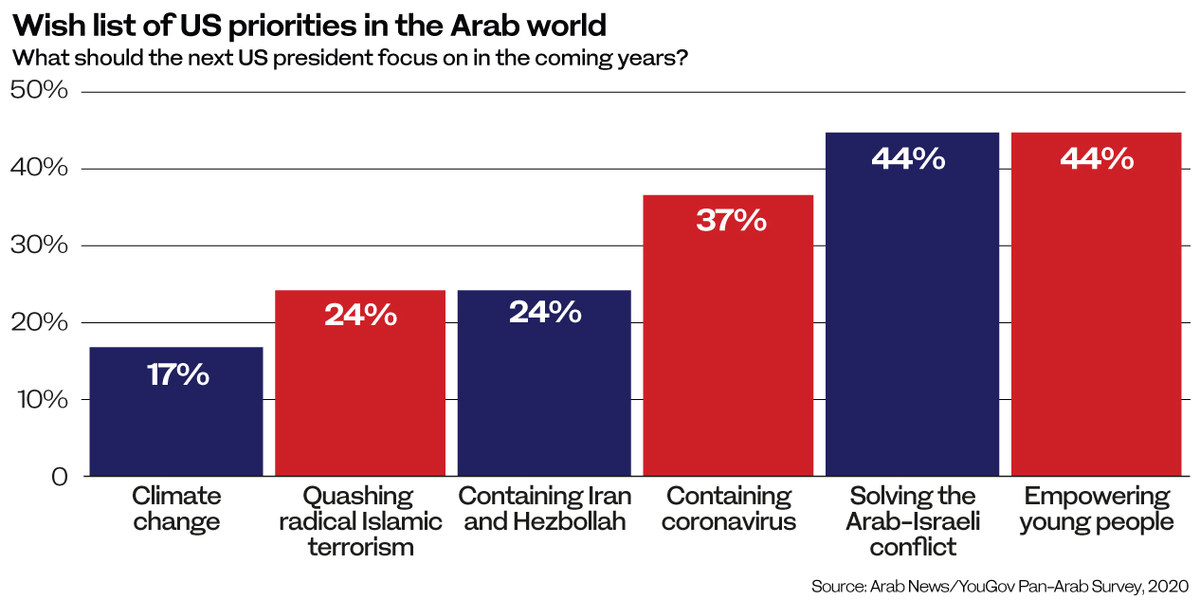
Despite their apparent frustration with the glacial pace of mediation, a large proportion of those surveyed still believe the next US administration should consider finding a solution to the Arab-Israeli conflict a high priority.
Equal numbers of respondents (44 percent) across the region said solving the Israel-Palestinian conflict and empowering young people should be the focus of the next US president.
These feelings were especially pronounced in North Africa, where 48 percent placed the Palestinian question at the top of their wish list of priorities for the next administration.
Nadim Shehadi, an associate fellow at Chatham House, said there is a strong appetite for peace, but not without “some form of justice” for the Palestinians. “It can be achieved very easily because a two-state solution is one step away,” he added.
“A state of Palestine can be achieved very easily if there’s no US veto, with preparation for some minimal negotiations with Israel. The state of Palestine already exists; it was declared in 1988 and recognized by 139 countries. Kosovo was admitted into the (UN) General Assembly with a lot less.”
Shehadi said the prospects for peace will depend on what is actually on offer — not on who sits in the White House or which party forms the next administration, as both the Democrats and Republicans have a “bad track record” on Palestine.
“The Trump administration achieved a huge step, but it will be wasted if it’s not followed up with an initiative that gives a sense of overall solution,” Shehadi added. “The key is the Arab Peace Initiative. It’s within reach.”
The Arab Peace Initiative, drafted by Saudi Arabia in 2002, offered the establishment of diplomatic ties in exchange for Israel making a statehood deal with the Palestinians and withdrawing to the pre-1967 borders.
Twitter: @CalineMalek


