

Lebanese social entrepreneur Omar Itani recognized by Schwab Foundation

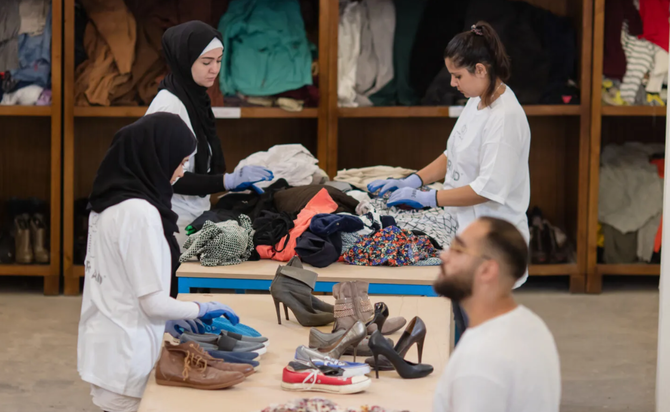
Lebanon’s Omar Itani, who won an innovation award at the World Economic Forum, is the co-founder of social enterprise FabricAID, which aims to “eradicate symptoms of poverty” by collecting and sanitizing secondhand clothing before placing items in stores in “extremely marginalized areas.” (Supplied/FabricAID)
Short Url
Updated 23 January 2026
Follow

Lebanese social entrepreneur Omar Itani recognized by Schwab Foundation

  • FabricAID co-founder among 21 global recipients recognized for social innovation

DAVOS: Lebanon’s Omar Itani is one of 21 recipients of the Social Entrepreneurs and Innovators of the Year Award by the Schwab Foundation for Social Entrepreneurship.

Itani is the co-founder of social enterprise FabricAID, which aims to “eradicate symptoms of poverty” by collecting and sanitizing secondhand clothing before placing items in stores in “extremely marginalized areas,” he told Arab News on the sidelines of the World Economic Forum in Davos, Switzerland.

With prices ranging from $0.25 to $4, the goal is for people to have a “dignified shopping experience” at affordable prices, he added.

FabricAID operates a network of clothing collection bins across key locations in Lebanon and Jordan, allowing people to donate pre-loved items. The garments are cleaned and sorted before being sold through the organization’s stores, while items that cannot be resold due to damage or heavy wear are repurposed for other uses, including corporate merchandise.

Since its launch, FabricAID has sold more than 1 million items, reached 200,000 beneficiaries and is preparing to expand into the Egyptian market.

Amid uncertainty in the Middle East, Itani advised young entrepreneurs to reframe challenges as opportunities.

“In Lebanon and the Arab world, we complain a lot,” he said. Understandably so, as “there are a lot of issues” in the region, resulting in people feeling frustrated and wanting to move away. But, he added, “a good portion of the challenges” facing the Middle East are “great economic and commercial opportunities.”

Over the past year, social innovators raised a combined $970 million in funding and secured a further $89 million in non-cash contributions, according to the Schwab Foundation’s recent report, “Built to Last: Social Innovation in Transition.”

This is particularly significant in an environment of geopolitical uncertainty and at a time when 82 percent report being affected by shrinking resources, triggering delays in program rollout (70 percent) and disruptions to scaling plans (72 percent).

Francois Bonnici, director of the Schwab Foundation for Social Entrepreneurship and a member of the World Economic Forum’s Executive Committee, said: “The next decade must move the models of social innovation decisively from the margins to the mainstream, transforming not only markets but mindsets.”

Award recipients take part in a structured three-year engagement with the Schwab Foundation, after which they join its global network as lifelong members. The program connects social entrepreneurs with international peers, collaborative initiatives, and capacity-building support aimed at strengthening and scaling their work.


Egypt defies African FDI trend with inflows of $11bn in 2025: UNCTAD 

Updated 4 sec ago
Follow

Egypt defies African FDI trend with inflows of $11bn in 2025: UNCTAD 

RIYADH: Egypt emerged as Africa’s top destination for foreign direct investment in 2025, attracting an estimated $11 billion in inflows in a year marked by declining investment across the continent. 

According to UNCTAD’s latest Global Investment Trends Monitor, the North African country ranked ahead of other major African economies despite a sharp regional slowdown. 

The performance underscores Egypt’s relative resilience at a time when foreign investment into Africa has normalized following an unusually strong 2024, which UNCTAD said was inflated by a single large project. As a result, the 2025 data reflects a return to more typical investment levels across the continent. 

“Among African economies, inflows to Angola reached an estimated $3 billion, marking a return to positive values after nine consecutive years of net divestments,” the report stated. 

It added: “Egypt, with inflows of $11 billion, remained the largest FDI host country in Africa.”  

While Egypt solidified its position as Africa’s leading FDI host, other notable movements on the continent included Mozambique, where inflows surged 80 percent to $6 billion, driven by renewed activity in major liquified natural gas projects.  

Angola also saw a positive shift, recording an estimated $3 billion in FDI after nine consecutive years of net divestments. 

UNCTAD noted that Egypt’s strength extended beyond headline inflows, with the country also contributing to an increase in greenfield investment activity across Africa. While the number of greenfield projects fell globally and across most lower-income economies, Africa recorded a 5 percent increase in project numbers in 2025, supported in part by growth in Egypt and Côte d’Ivoire. 

Globally, FDI flows rose by 14 percent in 2025 to approximately $1.6 trillion, though growth was heavily concentrated in developed economies, which saw a 43 percent increase.  

In contrast, flows to developing economies declined by 2 percent, with the least developed countries particularly affected; three-quarters experienced stagnant or falling investment. 

The report highlighted that new project announcements remained weak globally amid elevated policy uncertainty, with international project finance declining for the fourth consecutive year.  

Looking ahead, UNCTAD warned that geopolitical tensions, regional conflicts, and economic fragmentation could continue to suppress real investment activity in 2026, even as financing conditions are expected to ease.  

For Africa, sustaining FDI inflows will require navigating persistent challenges such as financing constraints, risk perceptions, and structural vulnerabilities.