MINNEAPOLIS: A prominent civil rights attorney and at least two other people involved in an anti-immigration enforcement protest that disrupted a service at a Minnesota church have been arrested, Trump administration officials said Thursday, even as a judge rebuffed related charges against journalist Don Lemon.
Vice President JD Vance, speaking in Minneapolis, urged state and local law enforcement to collaborate with federal officials and said protesters must stop getting in their way.
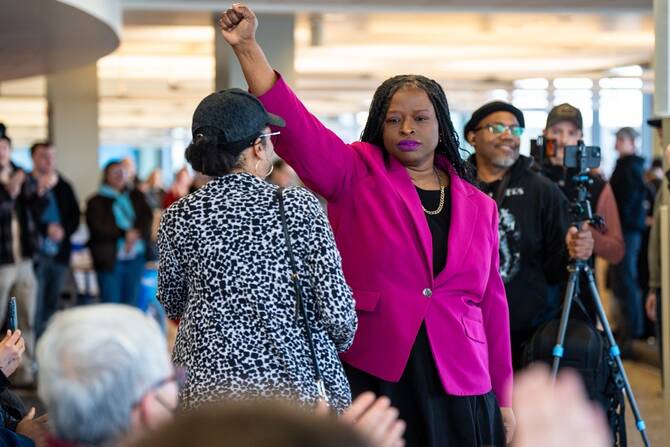
Attorney General Pam Bondi posted online that Nekima Levy Armstrong had been arrested. On Sunday, protesters entered the Cities Church in St. Paul, where an US Immigration and Customs Enforcement official serves as a pastor. Bondi later posted that a second person had been arrested, and FBI Director Kash Patel announced a third.
The Justice Department quickly opened a civil rights investigation after the group interrupted services by chanting “ICE out” and “Justice for Renee Good,” referring to the 37-year-old mother of three who was fatally shot by an ICE officer in Minneapolis earlier this month.
“Listen loud and clear: WE DO NOT TOLERATE ATTACKS ON PLACES OF WORSHIP,” the attorney general wrote on X.
Cities Church belongs to the Southern Baptist Convention and lists one of its pastors as David Easterwood, who leads an ICE field office. Many Baptist churches have pastors who also work other jobs.
Church lawyers praise the arrests
Prominent leaders of the Southern Baptist Convention have argued that compassion for migrant families cannot justify violating a sacred space during worship.
Attorneys representing the church hailed the arrests.
“The US Department of Justice acted decisively by arresting those who coordinated and carried out the terrible crime,” Doug Wardlow, director of litigation for True North Legal, said in a statement.
The St. Paul-based nonprofit law firm has taken on religious freedom cases, including filing an amicus brief to the US Supreme Court supporting a Christian counselor who challenged bans on LGBTQ+ “conversion therapy” for kids as a violation of her First Amendment rights.
Levy Armstrong, an attorney and longtime activist, had called for the pastor affiliated with ICE to resign, saying his dual role poses a “fundamental moral conflict.”
“You cannot lead a congregation while directing an agency whose actions have cost lives and inflicted fear in our communities,” she said Tuesday. “When officials protect armed agents, repeatedly refuse meaningful investigation into killings like Renee Good’s, and signal they may pursue peaceful protesters and journalists, that is not justice — it is intimidation.”
Vance wants local law enforcement to assist federal officers
State and local elected officials have opposed the crackdown that has become a major focus of Department of Homeland Security sweeps.
Vance arrived in the state less than a month after Renee Good was killed. He has called Good’s death a “tragedy of her own making.”
Before his Minnesota visit, Vance warned the church protesters: “Those people are going to be sent to prison so long as we have the power to do so.”
Later in Minneapolis, he urged state and city law enforcement to help federal immigration officers.
“We’re doing everything that we can to lower the temperature,” Vance said, adding that he wants “state and local officials to meet us halfway.”
Greg Bovino, a US Border Patrol official, said Minneapolis police failed to help federal agents Wednesday who were surrounded by protesters at a gas station. Minneapolis police responded later that they hadn’t received any requests from federal agents for assistance on Wednesday.
Protesters appear in court
Levy Armstrong has helped lead protests after the high-profile police-involved killings of Black Americans, including George Floyd, Philando Castile and Jamar Clark. She is a former president of the NAACP’s Minneapolis branch.
Homeland Security Secretary Kristi Noem posted a photo on X of Levy Armstrong with her arms behind her back next to a person wearing a badge. Noem said she faces a charge under a statute that bars threatening or intimidating someone exercising a right.
Patel posted on X that Chauntyll Louisa Allen, the second person Bondi said was arrested, is charged under a law that prohibits physically obstructing or using the threat of force to intimidate or interfere with a person seeking to participate in a service at a house of worship. Patel said William Kelly has also been arrested.
Levy Armstrong, Kelly and Allen have all been booked about 35 miles north of Minneapolis in Sherburne County Jail, where people in federal custody are usually held.
A message seeking comment was sent to Allen’s and Kelly’s attorney.
Saint Paul Public Schools, where Allen is a board of education member, said it is aware of her arrest but will not comment on pending legal matters.
Allen and Levy Armstrong are part of a community of Black Minnesota activists.
Kelly has defended the protest and criticized the church for associating with a pastor who works for ICE.
In court Thursday, federal magistrate judge Doug Micko granted the women bond and restricted them from traveling outside Minnesota or from going near the church. The government said it would appeal and the women remained in federal custody Thursday afternoon.
Levy Armstrong’s attorney, Jordan Kushner, said he offered for her to turn herself in peacefully, but the Trump administration insisted on arresting her.
“They wanted a spectacle,” Levy Armstrong’s husband, Marques Armstrong, said, recalling around 50 agents came to detain her.
Arrests follow a DOJ civil rights investigation
The Justice Department investigated the church protest swiftly, but found no basis for a civil rights investigation into Good’s death.
Administration officials have said the officer acted in self-defense and that the driver of the Honda was engaging in “an act of domestic terrorism” when she pulled toward him. Past administrations, however, have moved quickly to probe shootings of civilians by law enforcement officials.
The Justice Department has separately opened an investigation into whether Minnesota officials impeded or obstructed federal immigration enforcement though their public statements. Prosecutors this week sent subpoenas to the offices of Gov. Tim Walz, Attorney General Keith Ellison, Minneapolis Mayor Jacob Frey, St. Paul Mayor Kaohly Her and officials in Ramsey and Hennepin counties, according to a person familiar with the matter.
Judge rejects charges against Lemon
A magistrate judge rejected federal prosecutors’ bid to charge journalist Don Lemon related to the church protest, said Kushner, Levy Armstrong’s attorney.
Lemon has said he was at the church as a journalist and not a protester.
“Once the protest started in the church we did an act of journalism which was report on it and talk to the people involved, including the pastor, members of the church and members of the organization,” Lemon said in a video posted on social media. “That’s it. That’s called journalism.”
Lemon’s attorney, Abbe Lowell, said in a statement that the judge’s action confirms Lemon’s work as a reporter was protected by the First Amendment.
It wasn’t immediately clear what the Justice Department would do after the judge’s decision. Authorities could return to a magistrate judge to again seek a criminal complaint or an indictment against Lemon before a grand jury.
CNN, which fired Lemon in 2023, first reported the ruling.


![]()

Anti-ICE protest at Minnesota church leads to arrests but no charges for journalist Don Lemon
Short Url
https://arab.news/8xb37
Anti-ICE protest at Minnesota church leads to arrests but no charges for journalist Don Lemon
Latest updates


© 2026 SAUDI RESEARCH & PUBLISHING COMPANY, All Rights Reserved And subject to Terms of Use Agreement.