

Armenia says Turkey seeks to continue genocide in Nagorno-Karabakh

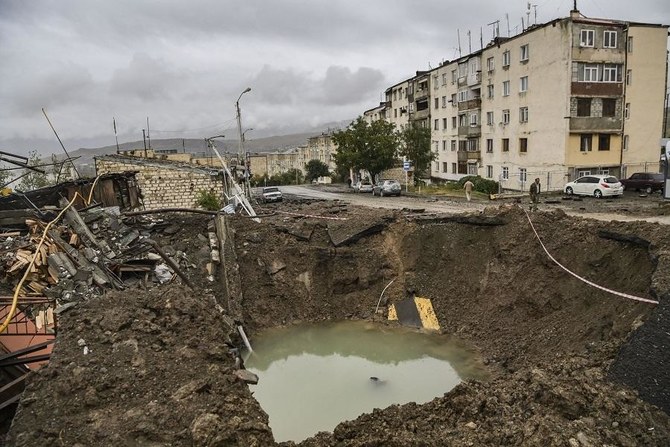
The Armenian genocide refers to the killing of 1.5 million Armenians by the Ottoman Empire from 1915 to 1923. (File/AFP)
Short Url
Updated 07 October 2020
Follow

Armenia says Turkey seeks to continue genocide in Nagorno-Karabakh

  • “What we are facing is an Azeri-Turkish international terroristic attack,” the Armenian PM said
  • Talks are to be held in Geneva and Moscow to try to convince the warring sides to agree to negotiate a ceasefire

LONDON: Armenian Prime Minister Nikol Pashinyan said the actions of Turkey and Azerbaijan amounted to a “terroristic attack” over Nagorno-Karabakh that formed part of the continuation of Armenian genocide.
“What we are facing is an Azeri-Turkish international terroristic attack,” Pashinyan told Sky News. “To me there is no doubt that this is a policy of continuing the Armenian genocide and a policy of reinstating the Turkish empire.”
The Armenian genocide refers to the killing of 1.5 million Armenians by the Ottoman Empire from 1915 to 1923.
Turkey accepts that many Armenians living in the Ottoman Empire were killed in clashes with Ottoman forces during World War One, but contests the figures and denies that the killings were systematically orchestrated and constitute a genocide.

Meanwhile, France's foreign minister said on Wednesday that talks would be held in Geneva on Thursday and Moscow on Monday to try to convince the warring sides in the Nagorno-Karabakh conflict to agree to negotiate a ceasefire.
Jean-Yves Le Drian told parliament's foreign affairs committee that France, Russia and the United States would hold those talks to start a dialogue that needed to take place without preconditions.


Turkiye edges toward curbing social media access to minors amid global push

Updated 4 sec ago
Follow

Turkiye edges toward curbing social media access to minors amid global push

ISTANBUL: Turkiye is laying the groundwork to restrict social ​media access for minors with a parliamentary report this week calling for broad measures including age verification and content filtering, joining a growing list of countries seeking tighter controls.
President Tayyip Erdogan’s ruling AK Party is expected to submit a draft law on the issue soon and Family and Social Services Minister Mahinur Ozdemir Goktas told reporters after a cabinet meeting last month that the bill would include a social media ban for minors and compel service providers to build content-filtering systems.
The wide-ranging recommendations in this ‌week’s commission report also ‌include the removal of content without notice and the ‌monitoring ⁠of ​kids’ video ‌games or toys with AI functionality for harmful content.
Australia in December became the world’s first country to ban social media for children under 16, blocking them from platforms including TikTok, Alphabet’s GOOGL.O YouTube and Meta’s META.O Instagram and Facebook.
Spain wants to prohibit social media for under-16s, while Greece and Slovenia are working on a similar ban amid mounting concerns over its impact on children’s health and safety. France, Britain and Germany are also considering restrictions for minors.

REPORT ⁠RECOMMENDS NIGHT-TIME RESTRICTIONS
The Turkish parliamentary report further recommends night-time Internet restrictions for devices used by minors under 18, mandatory ‌content filtration on social media until aged 18 and a ‍social media ban until aged 16.
“We ‍need to protect our kids from moral erosion. We aim to protect our ‍children from all types of addictions, including digital ones,” Harun Mertoglu, senior AKP lawmaker and a member of parliament’s human rights enquiry committee, told Reuters.
Some parents echo the sentiment. Shopkeeper Belma Kececioglu said her 10-year-old spends hours on social media and playing games.
“It is like all the kids ​are social media addicts. We are already troubled by this and it gets even worse with harmful content,” Kececioglu said, as her son played ⁠a game on his phone after school.
Social media companies have warned that bans on minors risk being undermined by weak age-verification technology and could push children onto unregulated platforms.
Turkiye already regulates social media companies heavily and is quick to impose takedowns and access bans. It currently bans access to 1.2 million web pages and social media posts as of end-2024, according to a report by local censorship watchdog IFOD.
Current regulations require companies to process official or user requests within two days, leaving little room for due process, and compel operators to conform to almost all takedown requests. Social media companies that don’t conform to regulations may face advertisement bans, bandwidth reduction and fines up to 3 percent of global revenues.
Gaming platform Roblox, ‌Discord and story-sharing site Wattpad have been banned in Turkiye since 2024. Turkiye had also banned Wikipedia for around three years.