

Europe explores deporting Afghans back to Taliban-controlled nation

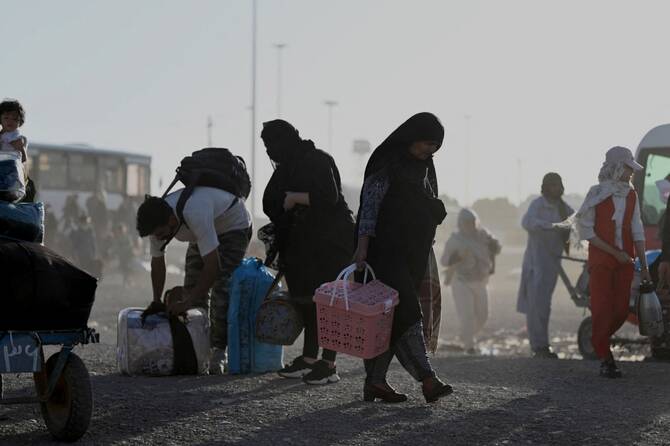
Afghan refugees carrying their belongings as they arrive at the zero point of the Islam Qala border crossing between Afghanistan and Iran. (AFP)
Short Url
Updated 06 February 2026
Follow

Europe explores deporting Afghans back to Taliban-controlled nation

  • Stepping up deportations has become a common refrain among EU nations, as fewer than 20 percent of people ordered to leave the bloc are currently returned to their country of origin

BRUSSELS: The European Union is pushing ahead with plans to deport Afghans with no right to stay in the bloc back to their country, raising practical challenges and concerns from the UN refugee agency.
Under pressure from member states to crack down on irregular migration, Brussels has initiated contacts with the Taliban government in Kabul to assess the feasibility of returns.
EU officials carried out two “technical missions” to the country — the latest in January — to “explore the structuring of the work on readmission and possible organization of return operations,” Markus Lammert, a European Commission spokesman, said this week.
Returns would have been unthinkable only a few years ago and are fraught with legal and ethical concerns. Human Rights Watch this week warned the Taliban authorities “increased their repression” last year, citing new rules curbing media freedom and restrictions on women and girls.
But the issue of returns is now being pushed by a majority of the EU’s 27 nations following a souring of public opinion on migration that has fueled right-wing electoral gains across the bloc.
“There has been a shift... where there’s much more talk about this,” said Arafat Jamal, the United Nations refugee agency’s representative in Afghanistan.
“It is extremely worrying because it seems like a policy based on emotion and reaction, but not on actual wisdom.”
Stepping up deportations has become a common refrain among EU nations, as fewer than 20 percent of people ordered to leave the bloc are currently returned to their country of origin, according to official data.
EU countries received about a million asylum applications filed by Afghans between 2013 and 2024, according to the bloc’s data agency. About half as many were approved over the same period.
In 2025, Afghans represented the largest group of applicants, followed by Venezuelans and Syrians.
Italy, Poland and Sweden are among 20 EU countries that backed Belgium in October in urging the commission to enable voluntary and forced returns of those whose applications were rejected, with some lamenting that even convicted criminals could not be expelled.
Freddy Roosemont, director general of the Belgian Immigration Office, told AFP his government was “currently working” with the EU executive and like-minded partners “to find a solution to this problem.”

- ‘Mass deportation’ -

Meanwhile some have pushed ahead.
Germany has deported more than 100 Afghans since 2024, via charter flights facilitated by Qatar.
Attitudes in the country have been hardened by a string of deadly attacks by Afghans in recent years, including a car-ramming in Munich last year and a 2024 stabbing spree in Mannheim.
Austria has followed, deporting the first Afghan man since 2021 in October.
Others, like France, have aired reservations.
Returns to Afghanistan “pose challenges,” admitted Lammert.
The country is in the midst of a humanitarian crisis, compounded by drought and huge cuts in foreign aid, rights groups say.
Generations of Afghans who fled to neighboring Pakistan and Iran over decades of successive wars are being forcibly pushed back.
More than five million Afghans have returned since 2023 and, often unable to find jobs, most live in poverty.
Talking to the Taliban authorities to arrange returns poses challenges of its own.
European governments shut their embassies in Kabul when the Taliban authorities returned to power in 2021 and imposed their strict interpretation of Islamic law.
The EU has maintained a diplomatic presence in the country but contacts have been limited to certain areas and Brussels has stressed that the engagement “does not bestow any legitimacy” on the Taliban government.
Conversely, the Taliban authorities do not recognize the legitimacy of some of Afghanistan’s diplomatic missions abroad, because of their ties to the previous government.
This poses a host of logistical issues, such as how to issue valid passports to returnees.
The EU’s exploratory missions to Afghanistan focused on these and other practical concerns, according to a source directly involved in the discussions.
“They’re looking at the planes, what is the capacity at the airport, they’re talking with the Taliban about what would happen to the people” who are returned, said the source.
“They’re testing the waters, they want to see if they can implement a mass deportation system.”
If that becomes a reality it should at the very least be accompanied by a significant increase in European aid flowing to the country, warned Jamal, the UN refugee agency’s representative.
“Returning people to Afghanistan without increasing assistance is incoherent, and is bound to create a risky imbalance,” he said.


Crash course: Vietnam’s crypto boom goes bust

Updated 2 sec ago
Follow

Crash course: Vietnam’s crypto boom goes bust

HANOI: As a first-year computer science student in Hanoi, Hoang Le started trading crypto from his university dorm room, egged on by his gamer friends who were making a killing.
At one point his digital holdings swelled to $200,000 — around 50 times the average annual income in Vietnam.
But they crashed to zero when the bottom fell out of bitcoin and other cryptocurrencies in recent months.
Getting wiped out “hurt a lot,” he told AFP, but he also learned a valuable lesson: he has come to think of the losses as “tuition fees.”
“When profits were high, everyone became greedy,” said Le, now 23, adding that “it was too good to be true.”
Unlike neighboring China which has banned cryptocurrencies outright, communist Vietnam has allowed blockchain technology to develop in a legal grey area — barring its use for payments but letting people speculate unimpeded.
As a result the young-and-upwardly mobile country of 100 million has been at the forefront of crypto adoption, with an estimated 17 million people owning digital assets.
Only India, the United States and Pakistan have seen more widespread usage, according to a 2025 ranking by the consultancy Chainalysis.
But what once looked like first-mover advantage increasingly looks like a liability as investors stare down a crypto winter.
The price of bitcoin has almost halved since hitting a record high above $126,000 in October, and other digital tokens have slid even further.
Vietnamese crypto startups hawking everything from NFTs to blockchain-based lending and trading services have been hammered, with bankruptcies and layoffs roiling the industry.

$100 billion market

“Many companies have shut down because of this crisis,” said Tran Xuan Tien, head of Ho Chi Minh City’s blockchain association.
He added that others are “downsizing and conserving capital to extend their runway.”
Nguyen The Vinh, co-founder of blockchain firm Ninety Eight, told AFP his company has laid off nearly one-third of its staff since last year.
There was more “restructuring” to come, he added, given the gloomy outlook.
“The market will likely remain difficult for years, not just months, so we need backup plans.”
Until recently, Vietnam’s crypto scene was a wild west, with highly speculative ventures and outright Ponzi schemes flourishing alongside startups offering legitimate products.
The government warned about the dangers of crypto and broke up several huge scam operations, including one that allegedly swindled nearly $400 million from thousands of investors.
But it did not move to crush the industry as Beijing did, instead opening “a window for domestic businesses to experiment,” according to Tien.
Under top leader To Lam, who has pursued sweeping growth-oriented reforms, Vietnam has formally embraced the blockchain industry and is gradually asserting control over the estimated $100 billion market.
Last year it passed a law recognizing digital currencies, bringing them under a regulatory framework for the first time.
It came into effect last month but investors have questions about how it will be implemented.
Hanoi has also announced a five-year crypto trading pilot program, which will allow Vietnamese firms to issue digital assets.
But lingering regulatory ambiguity has kept many firms based in the country from formally registering there, opting instead to file paperwork in places such as Singapore and Dubai.
‘Downhill badly’

Vinh says some firms are folding and others downsizing or pivoting because of both the “prolonged downturn and an unclear legal framework.”
And new entities are struggling to gain traction as investor sentiment sours.
Huu, 24, said fundraising for his crypto-product startup has suddenly become much harder, and asked that only his first name be used for fear of hurting his business.
Foreign investors were once enticed by promises of 400 and 500 percent returns, he said, but were now discovering they “might lose everything.”
“Over the past few months, things have gone downhill badly.”
Founders including Huu and Vinh said the current downturn is part of a natural business cycle, and stronger firms would eventually emerge offering better products.
But that is cold comfort for the nearly 55 percent of individual Vietnamese crypto investors who according to one market analysis reported losses last year.
“In Vietnam, a lot of people trade crypto,” Huu said.
“When prices fall, people complain about losses and the overall mood becomes very gloomy.”