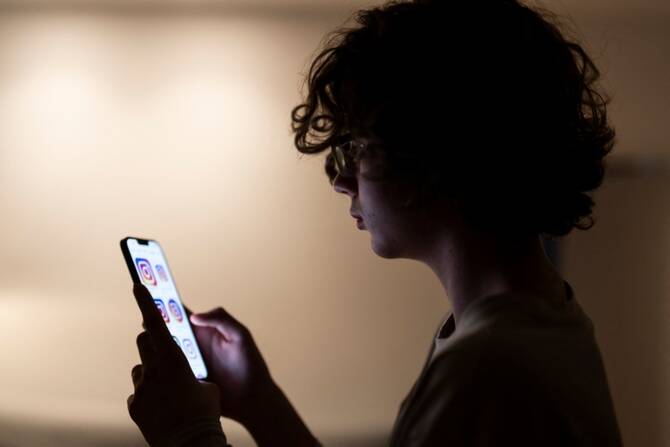
ISTANBUL: Turkiye is laying the groundwork to restrict social media access for minors with a parliamentary report this week calling for broad measures including age verification and content filtering, joining a growing list of countries seeking tighter controls.
President Tayyip Erdogan’s ruling AK Party is expected to submit a draft law on the issue soon and Family and Social Services Minister Mahinur Ozdemir Goktas told reporters after a cabinet meeting last month that the bill would include a social media ban for minors and compel service providers to build content-filtering systems.
The wide-ranging recommendations in this week’s commission report also include the removal of content without notice and the monitoring of kids’ video games or toys with AI functionality for harmful content.
Australia in December became the world’s first country to ban social media for children under 16, blocking them from platforms including TikTok, Alphabet’s GOOGL.O YouTube and Meta’s META.O Instagram and Facebook.
Spain wants to prohibit social media for under-16s, while Greece and Slovenia are working on a similar ban amid mounting concerns over its impact on children’s health and safety. France, Britain and Germany are also considering restrictions for minors.
Report recommends night-time restrictions
The Turkish parliamentary report further recommends night-time Internet restrictions for devices used by minors under 18, mandatory content filtration on social media until aged 18 and a social media ban until aged 16.
“We need to protect our kids from moral erosion. We aim to protect our children from all types of addictions, including digital ones,” Harun Mertoglu, senior AKP lawmaker and a member of parliament’s human rights enquiry committee, told Reuters.
Some parents echo the sentiment. Shopkeeper Belma Kececioglu said her 10-year-old spends hours on social media and playing games.
“It is like all the kids are social media addicts. We are already troubled by this and it gets even worse with harmful content,” Kececioglu said, as her son played a game on his phone after school.
Social media companies have warned that bans on minors risk being undermined by weak age-verification technology and could push children onto unregulated platforms.
Turkiye already regulates social media companies heavily and is quick to impose takedowns and access bans. It currently bans access to 1.2 million web pages and social media posts as of end-2024, according to a report by local censorship watchdog IFOD.
Current regulations require companies to process official or user requests within two days, leaving little room for due process, and compel operators to conform to almost all takedown requests. Social media companies that don’t conform to regulations may face advertisement bans, bandwidth reduction and fines up to 3 percent of global revenues.
Gaming platform Roblox, Discord and story-sharing site Wattpad have been banned in Turkiye since 2024. Turkiye had also banned Wikipedia for around three years.


Turkiye edges toward curbing social media access to minors amid global push
https://arab.news/wh32f
Turkiye edges toward curbing social media access to minors amid global push

- The Turkish parliamentary report further recommends night-time Internet restrictions for devices used by minors under 18


Western media refute Trump’s claims Iran possesses Tomahawk missiles
- Speaking to journalists, Trump suggested Tehran used US-made cruise missile in school attack that killed over 170, calling the weapon ‘very generic’
- CNN, Sky News and analysts said that ‘neither Israel nor Iran use Tomahawk missiles,’ urged accurate identification to ensure credibility in public discourse
LONDON: Western media outlets and defense analysts have pushed back against claims by US President Donald Trump that Iran possesses Tomahawk cruise missiles, after he raised the possibility while discussing a recent strike on an Iranian school that has drawn international scrutiny.
Speaking to reporters on Monday, Trump suggested Iran may have used Tomahawks in the attack, calling the weapon “very generic” and implying that multiple countries, including Iran, could have access to the system.
However, journalists and weapons experts swiftly disputed that assertion. They noted that Tomahawk missiles are US-manufactured cruise missile systems that Washington supplies only to a small number of close allies, primarily the UK and Australia. There is no credible evidence that Iran has ever obtained the weapon.
CNN anchor Erin Burnett referenced an investigation by correspondent Isobel Yeong that concluded “neither Israel nor Iran use Tomahawk missiles, according to experts.” Sky News and other Western outlets also challenged Trump’s remarks.
Analysts pointed out that Iran has developed its own domestic cruise missile systems, such as the Soumar and Hoveyzeh, which are believed to be based partly on older Soviet-era designs.
While these systems resemble cruise missiles in concept, experts say they differ significantly from the Tomahawk in design, propulsion configuration and operational characteristics.
While Iran has made substantial advances in ballistic and domestically produced cruise missiles over the past two decades, defense analysts said there is no verified evidence that Tehran holds the American-made system.
The episode reflects a broader pattern in which statements about military technology are rapidly scrutinized by open-source investigators and defense experts.
Experts say the distinction is important: accurately identifying the type of missile used in a strike can provide clues about the likely actor responsible, the launch platform involved and the broader geopolitical consequences of a strike.
Analysts also say that accurate identification of military systems remains essential for avoiding misinformation and for maintaining credibility in public discourse surrounding regional security.
Despite the growing body of evidence, the precise circumstances of the school attack nonetheless remain unclear, with investigators hampered by a lack of weapons fragments and limited access to the site.
Norway-based rights group Hengaw said the school was holding its morning session at the time of the reported attack and had at least 168 children and 14 teachers.
Trump said the US was continuing to investigate the incident. “Whatever the report shows, I’m willing to live with that report,” he said.


