

UN to approve sanction exemptions on North Korea aid projects: sources

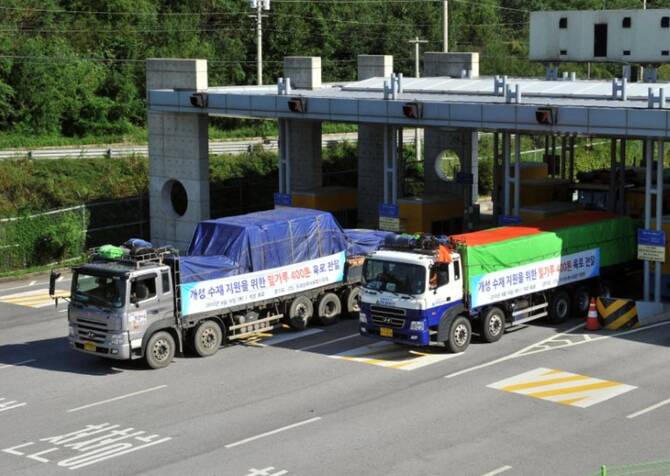
South Korea's trucks carrying 530 tons of flour for North Korean flood victims drive through the South 's inter-Korean transit gate in Paju in 2010. (AFP)
Short Url
Updated 06 February 2026
Follow

UN to approve sanction exemptions on North Korea aid projects: sources

  • Analysts say the move would allow those groups to provide humanitarian aid, such as nutritional supplements, medical equipment and water purification systems, to North Korea

SEOUL: The UN Security Council sanctions committee on North Korea is to give exemptions for humanitarian aid projects in the impoverished country, diplomatic sources in Seoul told AFP on Friday.
The nuclear-armed country is under multiple sets of sanctions over its weapons programs and has long struggled with its moribund state-managed economy and chronic food shortages.
The 17 humanitarian assistance projects are all being implemented by major international organizations such as UNICEF, or by NGOs from South Korea and the United States, the sources said.
Analysts say the move would allow those groups to provide humanitarian aid, such as nutritional supplements, medical equipment and water purification systems, to North Korea.
A foreign ministry official said Seoul has made “various efforts” to ensure that humanitarian aid reaches the North, regardless of politics.
“We hope that North Korea will respond positively to our government’s efforts for peaceful coexistence on the Korean Peninsula,” the official said.
The sources spoke hours after a senior South Korean official said “new progress” on North Korea could come within days.
The foreign ministry official’s comments came while discussing US President Donald Trump’s scheduled trip to China in April.
Trump made repeated overtures to Pyongyang’s leader Kim Jong Un during a barnstorming tour of Asia last year, saying he was “100 percent” open to a meeting.
He even bucked decades of US policy by conceding that North Korea was “sort of a nuclear power.”
North Korea did not respond to Trump’s offer, and has repeatedly said it will never give up its nuclear weapons.
Trump met North Korea’s Kim three times during his first term, once famously declaring that they were “in love,” in an effort to reach a denuclearization deal.

- Landmark congress -

However, a planned summit in Hanoi in 2019 fell through over differences about what Pyongyang would get in return for giving up its nuclear weapons, and no progress has been made between the two countries since then.
Seoul and Washington reaffirmed their commitment this week to North Korea’s “complete denuclearization” and cooperation on Seoul’s nuclear-powered submarine plan, a move that has previously drawn an angry response from the North.
Pyongyang has also drawn much closer to Moscow, with its deployment of troops to aid Russia’s war against Ukraine.
It has sent thousands of troops to fight for Moscow and analysts say Russia is giving North Korea military technology, food and energy supplies in return, allowing it to sidestep tough international sanctions.
North Korea is set to hold a landmark congress of its ruling party soon, its first in five years.
Kim ordered the “expansion” and modernization of the North’s missile production ahead of the gathering.


Militants kill 6 officers and a civilian in ambushes on police vehicles in northwest Pakistan

Updated 2 sec ago
Follow

Militants kill 6 officers and a civilian in ambushes on police vehicles in northwest Pakistan

  • Assailants ambushed a police vehicle and killed one officer in Kohat — When police reinforcements arrived minutes later, they launched another attack and killed five more officers and a civilian
  • No group claimed responsibility for this week’s attacks, but suspicion may fall on the Pakistani Taliban, also known as Tehrik-e-Taliban Pakistan, or the TTP
PESHAWAR, Pakistan: A pair of attacks on police vehicles by suspected militants killed at least six police officers and a civilian in northwest Pakistan on Tuesday, authorities said.
The assailants ambushed a police vehicle and killed one officer in Kohat, a district in Khyber Pakhtunkhwa province. When police reinforcements arrived minutes later, they launched another attack and killed five more officers and a civilian, police official Kamran Khan said.
Separately on Tuesday, a suicide bomber detonated explosives at a police post in Bukkur, a district in eastern Punjab province, killing two officers and wounding four others, police official Shahzad Rafiq said.
He provided no further details and only said officers were still investigating.
No group immediately claimed responsibility for the attacks, which have increased across the country in recent months.
President Asif Ali Zardari condemned the attacks in Kohat and Bukkur and offered condolences to the victims’ families.
The latest violence followed an attack on a paramilitary post in Karak on Monday, when a drone loaded with explosives wounded several officers. The attackers later ambushed two ambulances transporting the wounded, killing three officers and burning their bodies before fleeing. The driver of the second ambulance transported several wounded officers despite suffering burn injuries and authorities recovered the remains of the three officers.
No group claimed responsibility for this week’s attacks, but suspicion may fall on the Pakistani Taliban, also known as Tehrik-e-Taliban Pakistan, or the TTP. The TTP is separate from, but closely allied with, Afghanistan’s Taliban. Islamabad has accused the group of operating from inside Afghanistan, a claim the TTP and Kabul deny.
Pakistan’s military said it killed at least 70 militants on Sunday in strikes along the Afghan border, targeting hideouts of Pakistani militants blamed for recent attacks inside the country.
