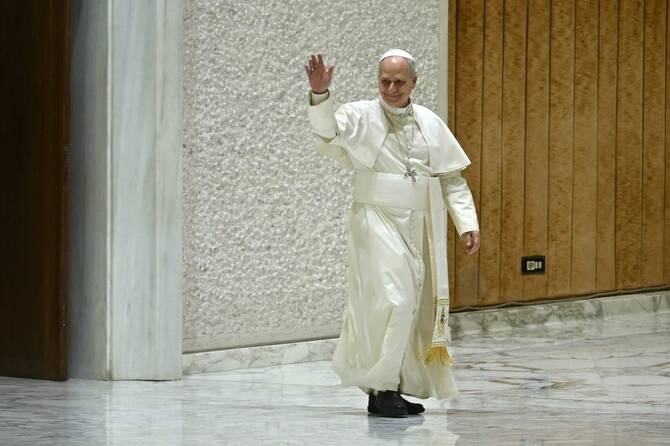
ROME: Pope Leo XIV, an avid tennis player and sports fan, marked the start of the Winter Games on Friday by extolling the positive values of sport and fair play while warning that the pursuit of profits and performance risked corrupting sport entirely.
In a message entitled “Life in Abundance” issued on the same day as the Milan Cortina opening ceremony, Leo traced the history of Christian philosophers and popes who identified sports and leisure activity as beneficial for both physical and spiritual development.
And he repeated his call for world leaders to respect the ancient tradition of an Olympic truce.
But drawing on his own experience as an athlete, Leo delved into a nuanced exploration of the value of sports and the risk when the “dictatorship of performance” posed by doping, match-fixing and other forms of corruption win out over fair play.
“Such dishonesty not only corrupts sporting activities themselves, but also demoralizes the general public and undermines the positive contribution of sport to society as a whole,” he warned.
He called for sport to be accessible, to both poor people and women especially, and for fans to refrain from turning sport into a fanatical religion. Athletes, too, he said, must refrain from narcissism and becoming obsessed with their image and success.
“The cult of image and performance, amplified by media and digital platforms, risks fragmenting the person, separating body from mind and spirit,” he warned.
True sport, he said, calls for a “shared ethical accord” between competitors, where the rules of the game are accepted and the integrity of the contest is respected.
“Accepting the limits of one’s body, the limits of time and fatigue, and respecting the established rules means recognizing that success comes from discipline, perseverance and loyalty,” he said.
A sporty pope
Popes have a long history of engaging the sporting world to promote values of peace, solidarity, and friendship, with the Olympics offering them regular opportunities to recall the ancient tradition of an Olympic truce.
On Sunday, Leo called for an Olympic truce to accompany the Games, urging especially world leaders to take the opportunity of the Games to “make concrete gestures of detente and dialogue.”
Leo, 70, is famously sporty: He religiously plays tennis and swims at his country house where he escapes from Monday to Tuesday each week, and is a longtime fan of the Chicago White Socks baseball team.
Before becoming pope, then-Cardinal Robert Prevost would also work out at the Vatican-area Omega gym two to three times a week, with hourlong sessions focusing especially on posture and cardiovascular health, according to his personal trainer at the time. Prevost’s workouts, described as suitable for a man in his 50s, would last up to an hour and focus especially on the treadmill and exercise bike, trainer Valerio Masella told The Associated Press last year.
When Leo was elected, the Italian Open was underway and one of Leo’s first audiences was with former No. 1 tennis player Jannik Sinner of Italy, who gave him a racket.
Leo drew on his experience as a tennis player in his message Friday, noting the cultural and spiritual benefits of the so-called “flow experience,” of being challenged beyond one’s level, that both fans and players alike can experience in a prolonged tennis rally.
“The reason this is one of the most enjoyable parts of a match is that each player pushes the other to the limit of his or her skill level,” Leo wrote. “The experience is exhilarating, and the two players challenge each other to improve; this is as true for two ten-year-olds as it is for two professional champions.”
A history of popes engaged in sport
But Leo's athleticism and attention to the spiritual and social values of sport is nothing new.
St. John Paul II, who was elected pope at the age of 58, was an avid skier and mountain trekker.
Pope Benedict XVI preferred solitary walks in the mountains. Pope Francis wasn’t athletic at all – he was known as “hard foot” as a child because of his poor soccer skills — but he was a lifelong fan and member of the Argentine soccer club San Lorenzo.
Francis also spoke out frequently a bout the positive values of teamwork and camaraderie in sport, especially for young people, and during his pontificate the Holy See began fielding track and cycling athletes in international competitions as team Atletica Vaticana.
Last year, on the occasion of the 2025 Holy Year, the Giro d’Italia passed through the Vatican.
Francis also warned of the downside of sport, especially at the professional level, often calling out doping, match-fixing and corruption that he said had tarnished people’s trust in fair play.

Pope, an avid athlete, extols physical and spiritual benefits of sport in Olympic message
Short Url
https://arab.news/5h9he
Pope, an avid athlete, extols physical and spiritual benefits of sport in Olympic message
I want answers from my ex-husband, Gisele Pelicot tells AFP
- Gisele Pelicot, the French woman who became a symbol in the global fight against sexual violence, told AFP why she wants to visit her ex-husband in jail and her joy at finding love again
PARIS: Gisele Pelicot, the French woman who became a symbol in the global fight against sexual violence, told AFP why she wants to visit her ex-husband in jail and her joy at finding love again.
In an interview ahead of the publication of her memoirs on Tuesday, she also said she hopes to inspire other rape victims to believe in a brighter future — and to change attitudes along the way.
Her book, titled “A Hymn to Life,” covers the full arc of her 50-year marriage which ended when she discovered that her husband had been repeatedly drugging her and inviting strangers over to their house to rape her.
It will be published in 22 languages.
The title of your book in French is “And the joy of living.” Have you found joy again?
“I’m doing better. After the trial (of her husband and 50 other men in 2024), I took stock of my life and today I am trying to rebuild on this field of ruins.
Despite all these ordeals, even in the darkest periods, I have always sought flashes of joy; I am looking toward the future, toward joy. I know this may surprise some who expect to see me in tatters, but I am determined to remain standing and dignified.”
Some describe you as an icon. Do you embrace that status?
“I do not use that word. I think my story has become a symbol. I know where I come from and who I am. It seems to me that we do not suspect the strength we have inside us until we are forced to draw on it, and that is also what I would like to say to victims.”
Why did you write this book?
“I needed to bear witness to my life journey, to address all those who supported me; it was a way of responding to them. Writing this book with (French author) Judith Perrignon, in whom I had complete trust, was both painful and fascinating.
Beyond the case itself, it retraces my life, the journey of three generations of women: my grandmother, my mother and myself. Their example explains my strength because I experienced tragedies very young. When you lose your mother at age nine, you grow up faster than others.”
Have you had professional psychological help to overcome your trauma?
“Of course, I could not get through this alone. How do you sort through 50 years of memories tainted by this series of crimes? I lived for half a century with Mr. Pelicot and I have no memory of the rapes, only the memory of happy days.
I cannot throw my whole life in the bin and tell myself that those years were nothing but a lie. If I did that, I’d collapse.”
At the end of the book, you announce your intention to visit Mr.Pelicot in prison. Why?
“I would like to do it for myself. That visit would be a stage in my reconstruction, an opportunity, for the first time since his arrest in November 2020, to confront him face to face.
How could he have done this to me? How could he have put our entire family through hell? What did he do to (our daughter) Caroline? He may not answer my questions, but I need to ask them.
For the moment, no date has been set for the visit. I do not think it will take place before the end of the year.”
In the book, you speak about your relationships with your three children. Where do they stand?
“It is wrong to think that such a tragedy brings a family together. It is impossible. Each of my children is now trying to rebuild as best they can.
Caroline’s suffering devastates me. She is in a state of anger that I do not share. And there is this doubt (about whether she was raped by her father) that condemns her to a perpetual hell.
I do not question her word, but I do not have the answers. Today, our relationship is calmer and I am happy about that. I will try to support her as best I can.”
Do you intend to remain a public figure?
“I am in my 74th year. I long for calm. I am not a radical feminist; I am a feminist in my own way. I know there is still a long way to go, despite progress on consent. I leave it to the younger generations to change this patriarchal society.
We can pass all the laws we want, but if we do not change mindsets, we will not succeed. That therefore begins above all with the education of our children. Parents must get involved.”
You are about to begin a tour to present your book. With what message?
“A message of hope. After hardship, you can once again allow yourself happiness and be happy. That is what I am doing. I am lucky enough to love again — it is magnificent. I think a life without love is a life without sunshine.”
In an interview ahead of the publication of her memoirs on Tuesday, she also said she hopes to inspire other rape victims to believe in a brighter future — and to change attitudes along the way.
Her book, titled “A Hymn to Life,” covers the full arc of her 50-year marriage which ended when she discovered that her husband had been repeatedly drugging her and inviting strangers over to their house to rape her.
It will be published in 22 languages.
The title of your book in French is “And the joy of living.” Have you found joy again?
“I’m doing better. After the trial (of her husband and 50 other men in 2024), I took stock of my life and today I am trying to rebuild on this field of ruins.
Despite all these ordeals, even in the darkest periods, I have always sought flashes of joy; I am looking toward the future, toward joy. I know this may surprise some who expect to see me in tatters, but I am determined to remain standing and dignified.”
Some describe you as an icon. Do you embrace that status?
“I do not use that word. I think my story has become a symbol. I know where I come from and who I am. It seems to me that we do not suspect the strength we have inside us until we are forced to draw on it, and that is also what I would like to say to victims.”
Why did you write this book?
“I needed to bear witness to my life journey, to address all those who supported me; it was a way of responding to them. Writing this book with (French author) Judith Perrignon, in whom I had complete trust, was both painful and fascinating.
Beyond the case itself, it retraces my life, the journey of three generations of women: my grandmother, my mother and myself. Their example explains my strength because I experienced tragedies very young. When you lose your mother at age nine, you grow up faster than others.”
Have you had professional psychological help to overcome your trauma?
“Of course, I could not get through this alone. How do you sort through 50 years of memories tainted by this series of crimes? I lived for half a century with Mr. Pelicot and I have no memory of the rapes, only the memory of happy days.
I cannot throw my whole life in the bin and tell myself that those years were nothing but a lie. If I did that, I’d collapse.”
At the end of the book, you announce your intention to visit Mr.Pelicot in prison. Why?
“I would like to do it for myself. That visit would be a stage in my reconstruction, an opportunity, for the first time since his arrest in November 2020, to confront him face to face.
How could he have done this to me? How could he have put our entire family through hell? What did he do to (our daughter) Caroline? He may not answer my questions, but I need to ask them.
For the moment, no date has been set for the visit. I do not think it will take place before the end of the year.”
In the book, you speak about your relationships with your three children. Where do they stand?
“It is wrong to think that such a tragedy brings a family together. It is impossible. Each of my children is now trying to rebuild as best they can.
Caroline’s suffering devastates me. She is in a state of anger that I do not share. And there is this doubt (about whether she was raped by her father) that condemns her to a perpetual hell.
I do not question her word, but I do not have the answers. Today, our relationship is calmer and I am happy about that. I will try to support her as best I can.”
Do you intend to remain a public figure?
“I am in my 74th year. I long for calm. I am not a radical feminist; I am a feminist in my own way. I know there is still a long way to go, despite progress on consent. I leave it to the younger generations to change this patriarchal society.
We can pass all the laws we want, but if we do not change mindsets, we will not succeed. That therefore begins above all with the education of our children. Parents must get involved.”
You are about to begin a tour to present your book. With what message?
“A message of hope. After hardship, you can once again allow yourself happiness and be happy. That is what I am doing. I am lucky enough to love again — it is magnificent. I think a life without love is a life without sunshine.”
© 2026 SAUDI RESEARCH & PUBLISHING COMPANY, All Rights Reserved And subject to Terms of Use Agreement.