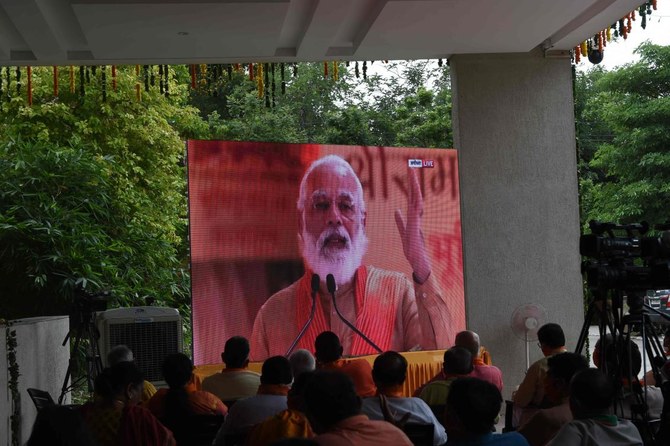
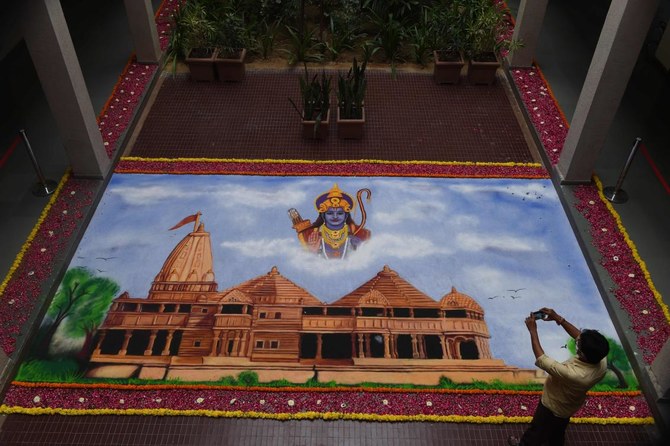

NEW DELHI: In a highly provocative speech following the groundbreaking ceremony to kick off the construction of a Hindu temple at a controversial site that has been contested by Muslims for decades, Prime Minister Narendra Modi marked the “beginning of a golden era” for the country.
“It’s the beginning of a golden era. The wait of centuries is ending,” Modi said after the event on Wednesday, launching the construction of the Ram temple in Ayodhya, in the north Indian state of Uttar Pradesh.
Until 1992, the site was home to the Babri Mosque, which was razed to the ground by a Hindu mob who believed the place was a holy site for them long before Muslim rulers built the structure there in 1528.
The demolition resulted in some of India’s bloodiest communal violence, in which about 2,000 people, mostly Muslims, were killed.
“See the amazing power of Lord Ram. Buildings were destroyed, there was a lot of effort to eradicate his existence, but Ram remains in our mind even today,” the premier added.
The move follows a concerted and divisive political campaign by the ruling Bharatiya Janata Party (BJP) in the 1980s and 90s, which led to polarization in the country and catapulted the party to the forefront of national consciousness, with the group becoming a major political force.
After the demolition of the Babri Mosque, the matter went to court and, in a controversial judgement in November of last year, the Supreme Court allocated 2.7 acres of land to Hindu petitioners and a separate 5 acres to Muslims to construct a structure of their choice.
In his speech on Wednesday, Modi compared the event to India’s independence on Aug. 15.
“Like Aug. 15, today’s day holds a similar significance for (the multitudes) of people who devoted and sacrificed their lives for the cause of Ram temple. Today Ram’s birthplace stands liberated,” he said.
Professor Shiv Visvanathan of Sonipat-based O.P. Jindal Global University termed the move “a sad moment in the history of India.”
“It is not only majoritarianism. I think the old dream of constitutional India, which was plural, open-ended and tolerant of minorities, is declining completely,” Visvanathan told Arab News.
In preparation for the event, Ayodhya was decorated in festive colors on Wednesday. Due to the coronavirus disease (COVID-19) pandemic, however, the government had extended invitations to a select few, with a majority of the 175 guests belonging to the BJP, its patron Rashtriya Swayamsevak Sangh and hardcore Hindu groups.
Two Muslims, Iqbal Ansari and Mohammed Sharif, were also invited.
“I am happy to have been invited to the event. It’s time to forget the past and move on. The court has given the verdict, and we should accept it,” Ayodhya-based Ansari, who was the original litigant and had fought the disputed site’s case on behalf of Muslims, told Arab News.
“Hindus and Muslims have always lived together, and we should maintain that tradition despite our differences,” he added.
Sharif, on the other hand, was honored for his selfless service after cremating the victims of the religious riots in 1992.
“It was a good gesture by the administration to invite me,” he told Arab News.
Meanwhile, Modi’s decision to inaugurate the temple has drawn sharp criticism from liberal and secular sections of society.
On Wednesday, a group of 300 individuals, including activists, lawyers and members of the National Federation of Indian Women, appealed to Modi to uphold the secular values of the country and not attend the ceremony.
“The prime minister going to Ayodhya to lay the foundation of the temple undermines our secular framework and endorses the majoritarian Hindutva agenda, despite his claims of building an inclusive India. It implies the negation of the Constitutional values,” the signatories said in a statement.
Political experts see the decision as a “major milestone” in the evolution of India as a majoritarian state.
“The problem with Modi is that he is always exclusionary in his politics. India has been turning majoritarian for a long time. Wednesday’s event marks a major milestone in the evolution of India as a Hindu supremacist state,” New Delhi-based political analyst and author of several books Nilanjan Mukhopadhyay told Arab News.
He added that there was a “deliberate design” to choosing Aug. 5 as the day for the ceremony, as it coincides with the first anniversary of the abrogation of Article 370 in Kashmir.
“Kashmir is also part of the Hindu nationalistic agenda. Defining religion and nationalism on the twin heads of religious-cultural nationalism is the basic definition of the Hindu majoritarian party. Modi deliberately chose Aug. 5 as a snub to the people of Kashmir; he is deliberately putting a finger in the wounds and asking ‘Is it still painful?’” Mukhopadhyay, who wrote the book “Narendra Modi: The Man, The Times,” added.
Professor Shiv Visvanathan of Sonipat-based O.P. Jindal Global University termed the move “a sad moment in the history of India.”
“It is not only majoritarianism. I think the old dream of constitutional India, which was plural, open-ended and tolerant of minorities, is declining completely,” Visvanathan told Arab News.
Meanwhile, Dr. Satish Mishra of the New Delhi-based think-tank Observer Research Foundation said the move was “a triumph of the Hindu majoritarian project.”
“Aug. 5 marks the success of the Hindu majoritarian project launched in the 1980s by BJP leader Lal Krishna Advani,” Mishra told Arab News.
He warned that the BJP would continue using religiously divisive issues to divert the attention of the people from core problems relating to the economy and governance.
“Religious topics will keep on dominating the political discourse. The BJP and other Hindu groups will pick up other religiously contentious issues to keep the focus of the people away from larger issues, like employment and other necessities of life,” Mishra added.