

Lockdown-hit Indian farmers take protest over state capital relocation plan online

1 / 3
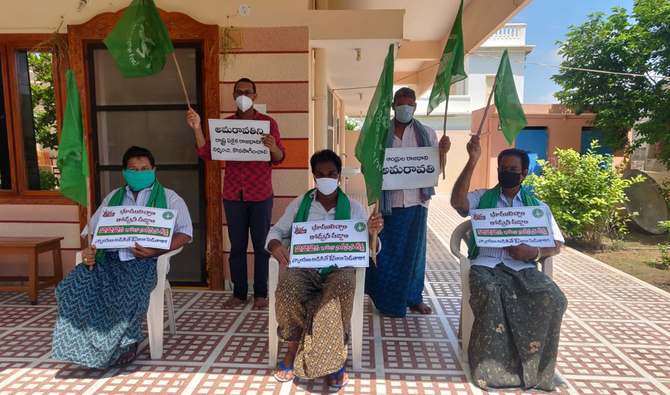
Farmers protesting in small group to avoid the spread of coronavirus. Many farmers have donated their lands in the hope of reaping the gains of having a high tech capital in their midst but now they are facing existential crisis. (Supplied)
2 / 3
Farmers sit whole day long outside their houses demanding the restoration of Amaravati as the capital of Andhra Pradesh. (Supplied)
3 / 3
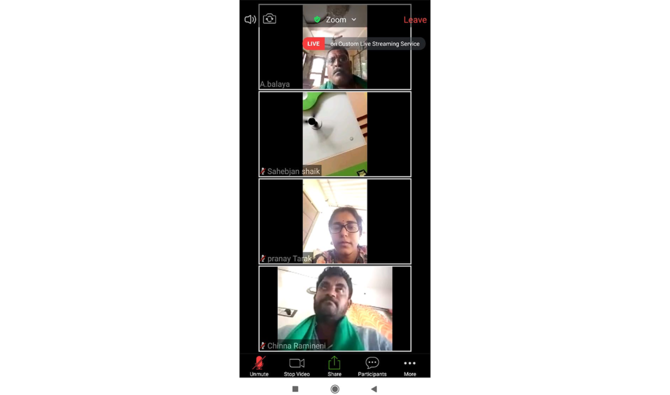
The farmers’ protests have taken a new virtual shape with majority of the illiterate farmers have learnt the tricks of social media and are using Zoom sessions to connect with around 30,000 farmers who donated lands for the new capital of Andhra Pradesh. On the completion of 200th day of protest farmers connected through Zoom sessions not only with their local fellows but also with more than 100,000 non resident fellow Telugu settled in 35 countries. (Supplied)
Short Url
Updated 27 July 2020
Follow

Lockdown-hit Indian farmers take protest over state capital relocation plan online

  • Andhra Pradesh growers, many of them illiterate, use power of social media to rally global support during virus pandemic

NEW DELHI: Nearly 30,000 Indian farmers, the majority of them illiterate, have taken to social media to protest against relocation plans for the state capital of Andhra Pradesh (AP).

Due to the coronavirus disease (COVID-19) outbreak and social-distancing measures, thousands of growers from the southeast Indian state have had no choice but to go online, many for the first time, in order to continue their demonstrations.

Using Facebook and Twitter, they have been rallying global support for their objection to proposals for a decentralized three-city capital for the state instead of original plans to build a new high-tech center in Amaravati.

“Circumstances forced us to weaponize our mobile phones and social media sites and use them to protest against the AP government’s decision to shift the capital from Amaravati,” said P. Bava Sudhakar, of the Amaravati farmers’ joint action committee (JAC).

He told Arab News that farmers from 29 villages in AP’s Amaravati district had been protesting for the past 223 days against the local government’s decision. Up until March they had been organizing sit-in demonstrations and rallies to press for their demands but had to rethink their protest strategy after a nationwide lockdown was imposed on March 25 over the COVID-19 pandemic.

Villagers had learnt to use video communication apps such as Zoom to organize conferences and share grievances with supporters around the world.

In 2014, AP was divided into two separate states – Telangana and Andhra Pradesh – with a plan for Telangana to keep Hyderabad as its capital while AP would have a new capital by 2024.

AP’s previous local government zeroed in on centrally located Amaravati and thousands of farmers donated their land for the construction of the new capital which would have been built with the support of Singapore companies.

However, Chief Minister Y. S. Jagan Mohan Reddy, who was elected to office last May, decided to cancel the project calling it “too ambitious and an unnecessary expense for a debt-ridden state.”

In December, Reddy instead announced plans to create three capitals, with the coastal city of Vishakapatnam to be the executive capital with all government offices, Kurnool to become the judicial capital, with courts, and Amaravati to be the legislative capital.

“The earlier government pegged the estimated cost of building Amaravati’s basic infrastructure at 1,090 billion rupees ($14.5 billion), while the spending capacity of any state government is only 5 billion rupees. At 10 percent of the estimated cost, we can develop places that already have basic infrastructure into capitals,” he had said in the assembly in December.

Since then, thousands of farmers have been demanding a rollback of the decision.

One of them, Pudota Sneha, 22, of Pedaparimi village, near Amaravati was helping her illiterate mother master the use of social media.

“We had three acres of land, and we gave two acres for the building of the capital with the hope that we would be part of the development of the new high-tech city. Now my family is left with just one acre of land, which is not adequate to live and earn,” she told Arab News.

Sneha said her mom had joined countless others on the 200th day of the protests when farmers held a Zoom session with expatriate Telugus in 35 other countries.

Another protester, Sudhakar, who donated 12 acres of land, said: “The idea is to organize opinion of fellow Telugus worldwide and put together a joint campaign against the AP government’s decision to annul the capital project.

“We have at least 100 million Telugu speakers worldwide, and they are all emotionally attached to their motherland. They are also unhappy with the government’s decision.”

The opposition Telugu Desam Party (TDP) of AP has described the chief minister’s move as “vendetta politics.”

TDP spokesperson, Pattabhi Ram Kommareddy, told Arab News: “The decision to make Amaravati the capital was taken after the recommendation of a committee and after proper survey. People came out openly to support the project and gave their land without any dispute. But the chief minister (Reddy) is guided by narrow political vision.”

Analysts said that the issue had now become more complicated. “Political rivalry has got in the way of the development of a new capital,” AP-based political analyst, Sreedharan Jayaram, told Arab News.

“The farmers gave their lands in the larger interests of the nation, but politics has put paid to their hopes. The livelihoods of many farmers are now at stake. This is not good for the development of the state and its people,” he added.


Starmer arrives in China to defend ‘pragmatic’ partnership

Updated 28 January 2026
Follow

Starmer arrives in China to defend ‘pragmatic’ partnership

  • British Prime Minister Keir Starmer arrived in Beijing on Wednesday to meet with Chinese leader Xi Jinping, hoping to restore long fraught relations

BEIJING: British Prime Minister Keir Starmer arrived in Beijing on Wednesday to meet with Chinese leader Xi Jinping, hoping to restore long fraught relations.
It is the first visit to China by a UK prime minister since 2018 and follows a string of Western leaders courting Beijing in recent weeks, pivoting from a mercurial United States.
Starmer, who is also expected to visit Shanghai on Friday, will later make a brief stop in Japan to meet with Prime Minister Sanae Takaichi.
For Xi, the trip is an opportunity to show Beijing can be a reliable partner at a time when President Donald Trump’s policies have rattled historic ties between Washington and its Western allies.
Starmer is battling record low popularity polls and hopes the visit can boost Britain’s beleaguered economy.
The trip has been lauded by Downing Street as a chance to boost trade and investment ties while raising thorny issues such as national security and human rights.
Starmer will meet with Xi for lunch on Thursday, followed by a meeting with Premier Li Qiang.
The British leader said on Wednesday this visit to China was “going to be a really important trip for us,” vowing to make “some real progress.”
There are “opportunities” to deepen bilateral relations, Starmer told reporters traveling with him on the plane to China.
“It doesn’t make sense to stick our head in the ground and bury in the sand when it comes to China, it’s in our interests to engage and not compromise on national security,” he added.
China, for its part, “is willing to take this visit as an opportunity to enhance political mutual trust,” foreign ministry spokesman Guo Jiakun reiterated Wednesday during a news briefing.
Starmer is the latest Western leader to be hosted by Beijing in recent months, following visits by Canadian Prime Minister Mark Carney and French President Emmanuel Macron.
Faced with Trump’s threats to impose tariffs on Canada for signing a trade agreement with China, and the US president’s attempts to create a new international institution with his “Board of Peace,” Beijing has been affirming its support for the United Nations to visiting leaders.
Reset ties 
UK-China relations plummeted in 2020 after Beijing imposed a sweeping national security law on Hong Kong, which severely curtailed freedoms in the former British colony.
They soured further since with both powers exchanging accusations of spying.
Starmer, however, was quick to deny fresh claims of Chinese spying after the Telegraph newspaper reported Monday that China had hacked the mobile phones of senior officials in Downing Street for several years.
“There’s no evidence of that. We’ve got robust schemes, security measures in place as you’d expect,” he told reporters on Wednesday.
Since taking the helm in 2024, Starmer has been at pains to reset ties with the world’s second-largest economy and Britain’s third-biggest trade partner.
In China, he will be accompanied by around 60 business leaders from the finance, pharmaceutical, automobile and other sectors, and cultural representatives as he tries to balance attracting vital investment and appearing firm on national security concerns.
The Labour leader also spoke to Xi on the sidelines of the G20 summit in Brazil in November 2024.
Jimmy Lai
The prime minister is also expected to raise the case of Hong Kong media mogul and democracy supporter Jimmy Lai, 78, a British national facing years in prison after being found guilty of collusion charges in December.
When asked by reporters about his plans to discuss Lai’s case, Starmer avoided specifics, but said engaging with Beijing was to ensure that “issues where we disagree can be discussed.”
“You know my practice, which is to raise issues that need to be raised,” added Starmer, who has been accused by the Conservative opposition of being too soft in his approach to Beijing.
Reporters Without Borders urged Starmer in a letter to secure Lai’s release during his visit.
The British government has also faced fierce domestic opposition after it approved this month contentious plans for a new Chinese mega-embassy in London, which critics say could be used to spy on and harass dissidents.
At the end of last year, Starmer acknowledged that China posed a “national security threat” to the UK, drawing flak from Chinese officials.
The countries also disagree on key issues including China’s close ties with Russian President Vladimir Putin amid the war in Ukraine, and accusations of human rights abuses in China.