BEIJING: China’s Huawei has overtaken Samsung to become the number-one smartphone seller worldwide in the second quarter on the back of strong domestic demand, industry tracker Canalys said Thursday.
Canalys said the embattled firm, which is facing US sanctions and falling overseas sales, shipped 55.8 million devices — overtaking Samsung for the first time, which shifted 53.7 million units.
The findings marked the first quarter in nine years that a company other than Samsung or Apple has led the market, Canalys said.
US sanctions had “stifled” Huawei’s business outside mainland China, the research group added, but it had grown to dominate its substantial home market.
More than 70 percent of Huawei smartphones are now sold in the country, Canalys said, where Samsung has a very small share of the market.
Huawei said in a statement it was a sign of “exceptional resilience.”
Overseas shipments, however, fell nearly a third in the second quarter and Canalys analyst Mo Jia warned that strength in China alone “will not be enough to sustain Huawei at the top once the global economy starts to recover.”
“Its major channel partners in key regions, such as Europe, are increasingly wary of ranging Huawei devices, taking on fewer models, and bringing in new brands to reduce risk,” Mo said.
Huawei — the world’s top producer of telecoms networking equipment — has become a pivotal issue in the geopolitical standoff between Beijing and Washington, which claims the firm poses a significant cybersecurity threat.
Washington has essentially barred Huawei from the US market and waged a global campaign to isolate the company.
The British government bowed to growing US pressure and pledged earlier this month to remove Huawei from its 5G network by 2027, despite warnings of retaliation from Beijing.
The politically-fraught change requires companies to stop buying new 5G equipment from Huawei starting next year and strip out existing gear by the end of 2027.
On Wednesday the US ambassador in Brasilia warned of “consequences” if Brazil chooses Huawei for the project to develop the next generation of telecommunications technology in Latin America’s most populous country.
Australia and Japan have taken steps to block or restrict the Chinese company’s participation in their 5G rollouts, and European telecoms operators including Norway’s Telenor and Sweden’s Telia have passed over Huawei as a supplier.
The US has also requested the extradition of Huawei executive Meng Wanzhou on fraud charges, further damaging relations between China and Canada, where she is under house arrest.
Meng, the Chinese telecom giant’s chief financial officer, was arrested on a US warrant in December 2018 during a stopover in Vancouver and has been fighting extradition ever since.


Huawei overtakes Samsung as top smartphone seller

https://arab.news/58cep
Huawei overtakes Samsung as top smartphone seller

- Canalys said Huawei, which is facing US sanctions and falling overseas sales, shipped 55.8 million devices
- Huawei has become a pivotal issue in the geopolitical standoff between Beijing and Washington


Education spending surges 251% as students return from autumn break: SAMA
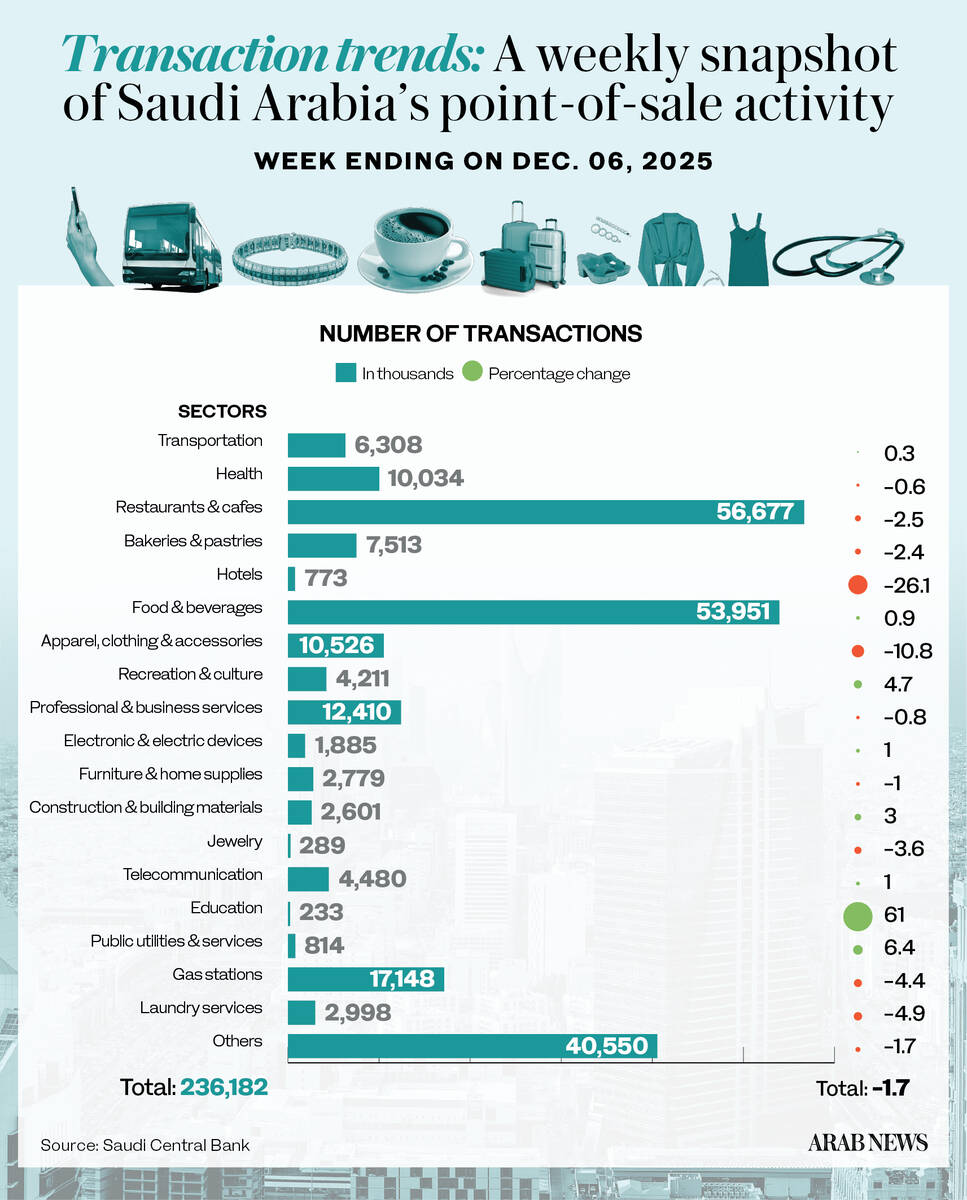
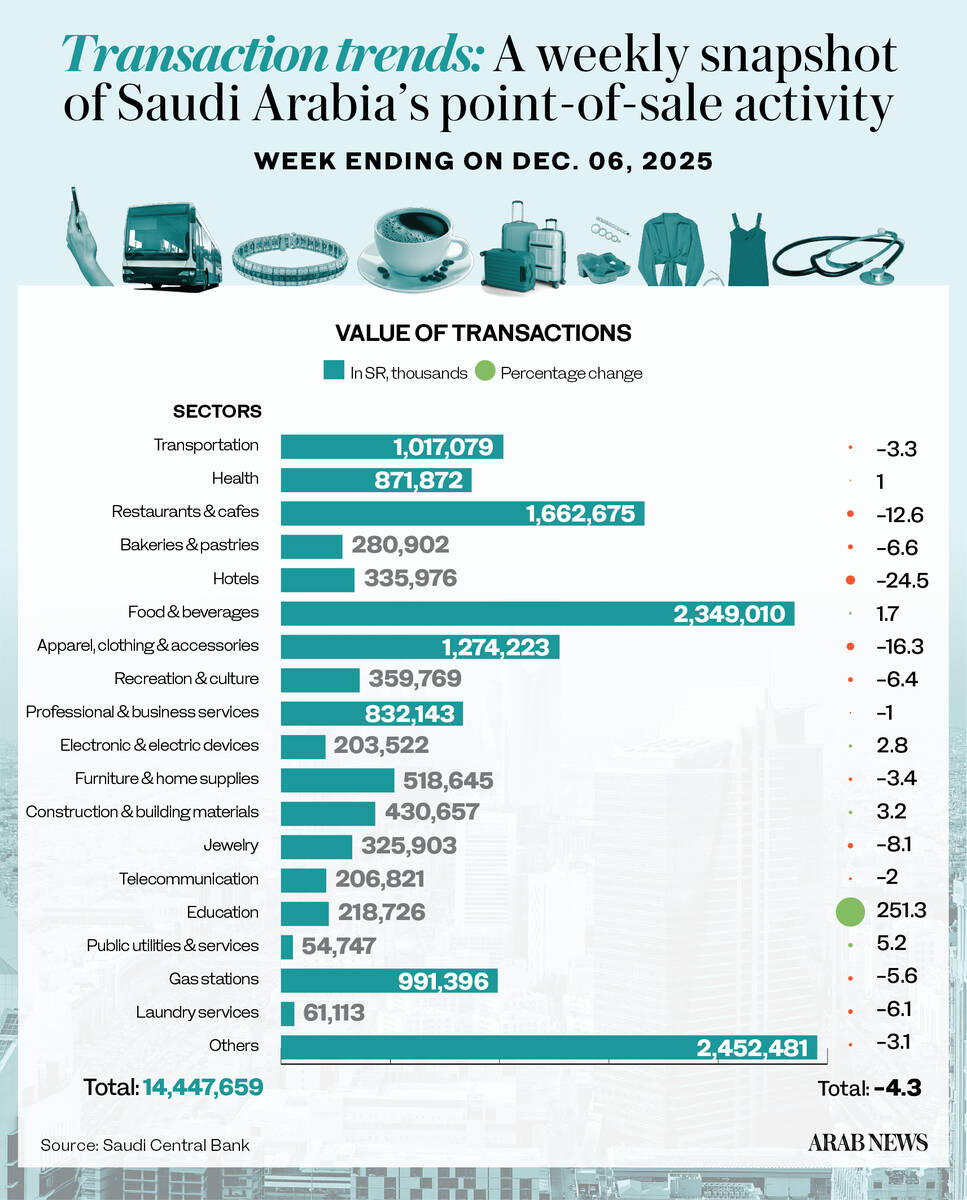
RIYADH: Education spending in Saudi Arabia surged 251.3 percent in the week ending Dec. 6, reflecting the sharp uptick in purchases as students returned from the autumn break.
According to the latest data from the Saudi Central Bank, expenditure in the sector reached SR218.73 million ($58.2 million), with the number of transactions increasing by 61 percent to 233,000.
Despite this surge, overall point-of-sale spending fell 4.3 percent to SR14.45 billion, while the number of transactions dipped 1.7 percent to 236.18 million week on week.
The week saw mixed changes between the sectors. Spending on freight transport, postal and courier services saw the second-biggest uptick at 33.3 percent to SR60.93 million, followed by medical services, which saw an 8.1 percent increase to SR505.35 million.
Expenditure on apparel and clothing saw a decrease of 16.3 percent, followed by a 2 percent reduction in spending on telecommunication.
Jewelry outlays witnessed an 8.1 percent decline to reach SR325.90 million. Data revealed decreases across many other sectors, led by hotels, which saw the largest dip at 24.5 percent to reach SR335.98 million.
Spending on car rentals in the Kingdom fell by 12.6 percent, while airlines saw a 3.7 percent increase to SR46.28 million.
Expenditure on food and beverages saw a 1.7 percent increase to SR2.35 billion, claiming the largest share of the POS. Restaurants and cafes retained the second position despite a 12.6 percent dip to SR1.66 billion.
Saudi Arabia’s key urban centers mirrored the national decline. Riyadh, which accounted for the largest share of total POS spending, saw a 3.9 percent dip to SR4.89 billion, down from SR5.08 billion the previous week.
The number of transactions in the capital settled at 74.16 million, down 1.4 percent week on week.
In Jeddah, transaction values decreased by 5.9 percent to SR1.91 billion, while Dammam reported a 0.8 percent surge to SR713.71 million.
POS data, tracked weekly by SAMA, provides an indicator of consumer spending trends and the ongoing growth of digital payments in Saudi Arabia.
The data also highlights the expanding reach of POS infrastructure, extending beyond major retail hubs to smaller cities and service sectors, supporting broader digital inclusion initiatives.
The growth of digital payment technologies aligns with the Kingdom’s Vision 2030 objectives, promoting electronic transactions and contributing to the nation’s broader digital economy.