

Education spending surges 251% as students return from autumn break: SAMA

The number of transactions in the education sector increased by 61 percent across the week. Getty
Short Url
Updated 12 December 2025
Follow

Education spending surges 251% as students return from autumn break: SAMA

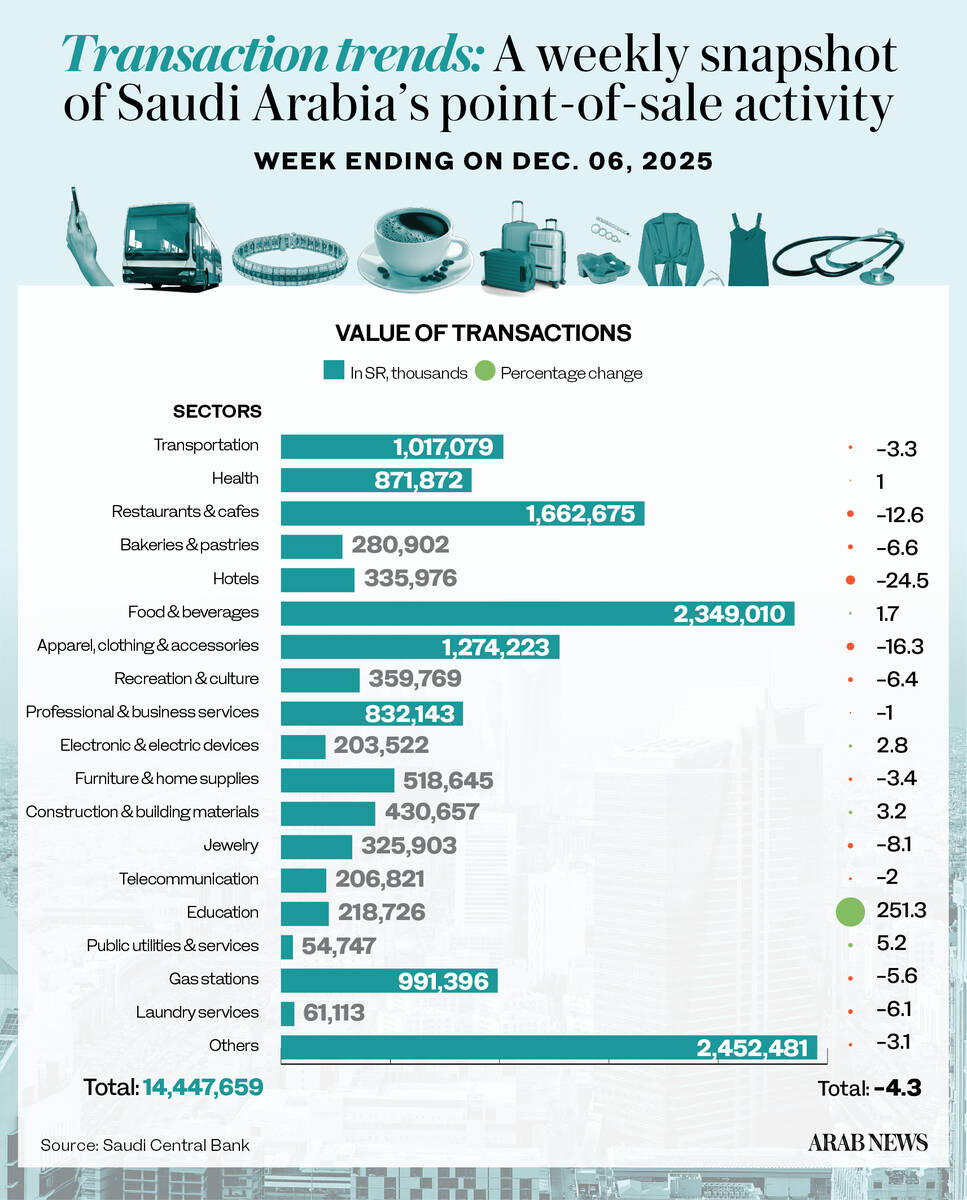
RIYADH: Education spending in Saudi Arabia surged 251.3 percent in the week ending Dec. 6, reflecting the sharp uptick in purchases as students returned from the autumn break.

According to the latest data from the Saudi Central Bank, expenditure in the sector reached SR218.73 million ($58.2 million), with the number of transactions increasing by 61 percent to 233,000.

Despite this surge, overall point-of-sale spending fell 4.3 percent to SR14.45 billion, while the number of transactions dipped 1.7 percent to 236.18 million week on week.
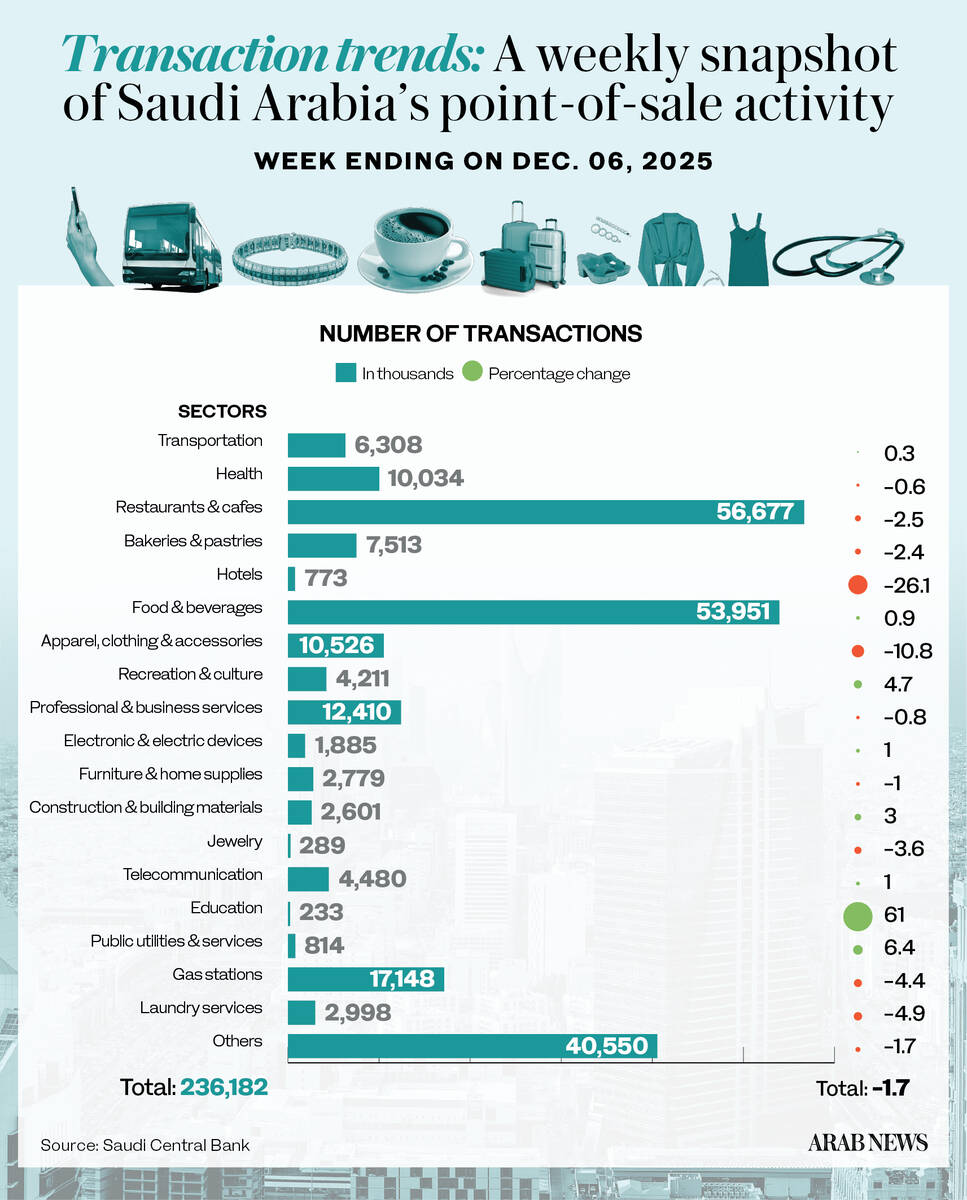
The week saw mixed changes between the sectors. Spending on freight transport, postal and courier services saw the second-biggest uptick at 33.3 percent to SR60.93 million, followed by medical services, which saw an 8.1 percent increase to SR505.35 million.

Expenditure on apparel and clothing saw a decrease of 16.3 percent, followed by a 2 percent reduction in spending on telecommunication.

Jewelry outlays witnessed an 8.1 percent decline to reach SR325.90 million. Data revealed decreases across many other sectors, led by hotels, which saw the largest dip at 24.5 percent to reach SR335.98 million. 

Spending on car rentals in the Kingdom fell by 12.6 percent, while airlines saw a 3.7 percent increase to SR46.28 million.

Expenditure on food and beverages saw a 1.7 percent increase to SR2.35 billion, claiming the largest share of the POS. Restaurants and cafes retained the second position despite a 12.6 percent dip to SR1.66 billion.

Saudi Arabia’s key urban centers mirrored the national decline. Riyadh, which accounted for the largest share of total POS spending, saw a 3.9 percent dip to SR4.89 billion, down from SR5.08 billion the previous week.

The number of transactions in the capital settled at 74.16 million, down 1.4 percent week on week.
In Jeddah, transaction values decreased by 5.9 percent to SR1.91 billion, while Dammam reported a 0.8 percent surge to SR713.71 million.

POS data, tracked weekly by SAMA, provides an indicator of consumer spending trends and the ongoing growth of digital payments in Saudi Arabia. 

The data also highlights the expanding reach of POS infrastructure, extending beyond major retail hubs to smaller cities and service sectors, supporting broader digital inclusion initiatives. 

The growth of digital payment technologies aligns with the Kingdom’s Vision 2030 objectives, promoting electronic transactions and contributing to the nation’s broader digital economy. 


Saudi carrier flyadeal expects 20–25% capacity growth on fleet expansion

Updated 10 sec ago
Follow

Saudi carrier flyadeal expects 20–25% capacity growth on fleet expansion

RIYADH: Saudi low-cost carrier flyadeal expects its capacity to grow by 20 to 25 percent next year as it expands its fleet, aiming for an “operational leap” with a total of 98 aircraft, CEO Steven Greenway told Al-Eqtisadiah. 

The company’s historic expansion is set to begin in 2027, with a new aircraft delivery scheduled each month until 2029 to reach the planned fleet size. 

The airline carried 11 million passengers this year, with projections of 12 to 13 million passengers next year as the expansion takes effect. 

It reported a 35 percent year-on-year increase in capacity this December, according to Greenway. The growth plan includes the addition of new aircraft types, notably the wide-body A330neo, which can carry 420 passengers. 

International route restructuring 

The wide-body aircraft, joining flyadeal’s fleet for the first time, will be capable of connecting Saudi airports on long-haul routes spanning from Western Europe to Southeast Asia. 

This will allow the airline to significantly expand its international network and develop a transcontinental operational structure to meet rising demand for travel to and from the Kingdom. 

In line with this, flyadeal plans to restructure its operations over the next two years to achieve a balanced mix of domestic and international flights. 

This mix represents a significant shift from the current operational structure, which relies on an 80 percent domestic and 20 percent international flight model. Greenway said the new structure shows a clear vision to support Saudi Arabia’s growing tourism openness and strengthen the Kingdom’s global connectivity. 

44th aircraft arrives by year-end 

The airline closed last year with a fleet of 36 aircraft, adding eight more this year. By the end of 2025, flyadeal will have 44 aircraft, with one final delivery expected next week, Greenway said. 

The short-term plan includes adding four new aircraft next year, bringing the fleet to 48, comprising traditional A320s, fuel-efficient A320neos, and A321s with 240 seats. 

Saudi aviation market 

The Kingdom’s aviation sector recorded notable growth last year, with passenger numbers exceeding 128 million, a 15 percent year-on-year increase. 

The General Authority of Civil Aviation reported more than 905,000 flights, up 11 percent from 2024, while air connectivity grew 16 percent to over 170 destinations worldwide. 

Air cargo also posted exceptional growth, rising 34 percent to 1.2 million tonnes. The four main airports in Riyadh, Jeddah, Dammam, and Madinah accounted for 82 percent of total air traffic last year.