VILNIUS: The United States says it is lifting sanctions on Belarusian potash in the latest sign of a thaw between Washington and the isolated autocracy.
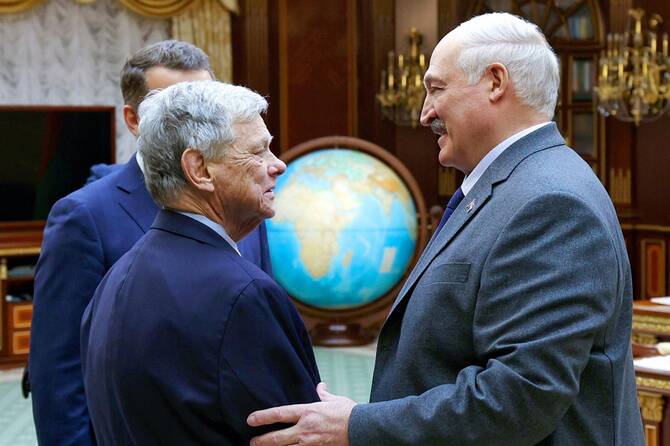
John Coale, the US special envoy for Belarus, made the announcement after meeting the country’s authoritarian leader Alexander Lukashenko in the Belarusian capital of Minsk on Friday and Saturday.
A close ally of Russia, Minsk has faced Western isolation and sanctions for years. Lukashenko has ruled the nation of 9.5 million with an iron fist for more than three decades, and the country has been repeatedly sanctioned by Western countries both for its crackdown on human rights and for allowing Moscow to use its territory in the invasion of Ukraine in 2022.
Speaking with journalists, Coale described the two-day talks as “very productive,” Belarus’ state news agency Belta reported Saturday.
The US envoy said that normalizing relations between Washington and Minsk was “our goal.”
“We’re lifting sanctions, releasing prisoners. We’re constantly talking to each other,” he said, according to Belta. He also said that the relationship between the countries was moving from “baby steps to more confident steps” as they increased dialogue.
The last time US officials met with Lukashenko in September 2025, Washington announced easing some of the sanctions against Belarus while Mink released more than 50 political prisoners into Lithuania. Overall, Belarus released more than 430 political prisoners since July 2024, in what was widely seen as an effort at a rapprochement with the West.
Belarusian opposition leader Sviatlana Tsikhanouskaya told The Associated Press on Saturday that sanctions relief was part of a deal between Minsk and Washington, in which another large group of political prisoners in Belarus were expected to be released.
“The freeing of political prisoners means that Lukashenko understands the pain of Western sanctions and is seeking to ease them,” Tsikhanouskaya said.
She added: “But let’s not be naive: Lukashenko hasn’t changed his policies, his crackdown continues and he keeps on supporting Russia’s war against Ukraine. That’s why we need to be extremely cautious with any talk of sanctions relief, so that we don’t reinforce Russia’s war machine and encourage continued repressions.”
Tsikhnouskaya also described European Union sanctions against Belarusian potash fertilizers as far more painful for Minsk that those imposed by the U.S, saying that while easing US sanctions could lead to the release of political prisoners, European sanctions should push for longterm, systemic changes in Belarus and the end of Russia’s war in Ukraine.
The latest round discussions also touched on Venezuela, as well as Russia’s ongoing invasion of Ukraine, Belta said.
Coale told reporters that Lukashenko had given “good advice” on how to address the conflict, saying that Lukashenko and Russian President Vladimir Putin were “longtime friends” with “the necessary level of relationship to discuss such issues.”
“Naturally, President Putin may accept some advice and not others,” Coale said.


US says it will lift some trade sanctions on Russia’s ally Belarus
https://arab.news/4zhn8
US says it will lift some trade sanctions on Russia’s ally Belarus

- A close ally of Russia, Minsk has faced Western isolation and sanctions for years
- Coale described the two-day talks as “very productive”


Lawsuit challenges Trump administration’s ending of protections for Somalis
- The lawsuit cites a series of statements Trump has made describing Somalis as “garbage” and “low IQ people” who “contribute nothing.”
BOSTON: Immigrant rights advocates filed a lawsuit on Monday seeking to stop US President Donald Trump’s administration from next week ending legal protections that allow nearly 1,100 Somalis to live and work in the United States. The lawsuit, brought by four Somalis and two advocacy groups, challenges the US Department of Homeland Security’s decision to end Temporary Protected Status for Somali immigrants, whom Trump has derided in public remarks. Outgoing Homeland Security Secretary Kristi Noem in January announced that TPS for Somalis would end on March 17, arguing that Somalia’s conditions had improved, despite fighting continuing between Somali forces and Al-Shabab militants. The plaintiffs, who include the groups African Communities Together and Partnership for the Advancement of New Americans, in the lawsuit filed in Boston federal court argue the move was procedurally flawed and driven by a discriminatory, predetermined agenda.
The lawsuit cites a series of statements Trump has made describing Somalis as “garbage” and “low IQ people” who “contribute nothing.”
The plaintiffs said the administration is ending TPS for Somalia and other countries due to unconstitutional bias against non-white immigrants, not based on objective assessments of country conditions.
“The termination of TPS for Somalia is racism masking as immigration policy,” Omar Farah, executive director at the legal group Muslim Advocates, said in a statement.
DHS did not respond to a request for comment. It has previously said TPS was “never intended to be a de facto amnesty program.”
TPS is a form of humanitarian immigration protection that shields eligible migrants from deportation and allows them to work. Under Noem, DHS has moved to end TPS for a dozen countries, sparking legal challenges. The administration on Saturday announced plans to pursue an appeal at the US Supreme Court in order to end TPS for over 350,000 Haitians. It also wants the high court to allow it to end TPS for about 6,000 Syrians.
SOMALI COMMUNITY TARGETED
Somalia was first designated for TPS in 1991, with its latest extension in 2024. About 1,082 Somalis currently hold TPS, and 1,383 more have pending applications, according to DHS. Somalis in Minnesota in recent months had become a target of Trump’s immigration crackdown, with officials pointing to a fraud scandal in which many people charged come from the state’s large Somali community. The Trump administration cited those fraud allegations as a basis for a months-long immigration enforcement surge in Democratic-led Minnesota, during which about 3,000 immigration agents were deployed, spurring protests and leading to the killing of two US citizens by federal agents.
In November, Trump announced he would end TPS for Somalis in Minnesota, and a month later said he wanted them sent “back to where they came from.”
The US Department of State advises against traveling to Somalia, citing crime and civil unrest among numerous factors.