

Cambodia shuts Thailand border crossings over deadly fighting

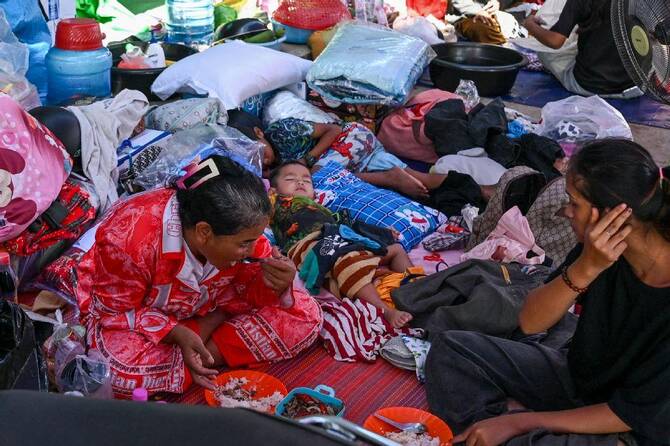
Displaced people rest at a temporary camp in Banteay Meanchey province on Dec. 13, 2025, amid clashes along the Cambodia-Thailand border. (AFP)
Short Url
Updated 13 December 2025
Follow

Cambodia shuts Thailand border crossings over deadly fighting

  • Thai Prime Minister Anutin Charnvirakul said Trump “didn’t mention whether we should make a ceasefire” during their Friday phone call
  • Across the border, a Cambodian evacuee said she was “sad” the fighting hadn’t stopped despite Trump’s intervention

BANGKOK: Cambodia shut its border crossings with Thailand on Saturday, after Bangkok denied US President Donald Trump’s claim that a truce had been agreed to end days of deadly fighting.
Violence between the Southeast Asian neighbors, which stems from a long-running dispute over the colonial-era demarcation of their 800-kilometer (500-mile) border, has displaced around half a million people on both sides.
At least 25 people have died this week, including four Thai soldiers the defense ministry said were killed in the border area on Saturday.
The latest fatalities were followed by Phnom Penh announcing it would immediately “suspend all entry and exit movements at all Cambodia-Thailand border crossings,” the interior ministry said.
Each side blamed the other for reigniting the conflict, before Trump said a truce had been agreed.
Thai Prime Minister Anutin Charnvirakul said Trump “didn’t mention whether we should make a ceasefire” during their Friday phone call.
The two leaders “didn’t discuss” the issue, Anutin told journalists on Saturday.
Trump had hailed his “very good conversation” with Anutin and Cambodian Prime Minister Hun Manet on Friday.
“They have agreed to CEASE all shooting effective this evening, and go back to the original Peace Accord” agreed in July, Trump wrote on his Truth Social platform.
The United States, China and Malaysia, as chair of the regional bloc ASEAN, brokered a ceasefire in July after an initial five-day spate of violence.
In October, Trump backed a follow-on joint declaration between Thailand and Cambodia, touting new trade deals after they agreed to prolong their truce.
But Thailand suspended the agreement the following month after Thai soldiers were wounded by land mines at the border.
In Thailand, evacuee Kanyapat Saopria said she doesn’t “trust Cambodia anymore.”
“The last round of peace efforts didn’t work out... I don’t know if this one will either,” the 39-year-old told AFP.
Across the border, a Cambodian evacuee said she was “sad” the fighting hadn’t stopped despite Trump’s intervention.
“I am not happy with brutal acts,” said Vy Rina, 43.

- Trading blame over civilians -

Bangkok and Phnom Penh have traded accusations of attacks against civilians, with the Thai army reporting six wounded on Saturday by Cambodian rockets.
Cambodia’s information minister, Neth Pheaktra, meanwhile said Thai forces had “expanded their attacks to include civilian infrastructure and Cambodian civilians.”
A Thai navy spokesman said the air force “successfully destroyed” two Cambodian bridges used to transport weapons to the conflict zone.
Malaysian Prime Minister Anwar Ibrahim on Saturday urged both sides to “cease all forms of hostilities and refrain from any further military actions.”
Thailand has reported 14 soldiers killed and seven civilian deaths, while Cambodia said four civilians were killed earlier this week.
At a camp in Thailand’s Buriram, AFP journalists saw displaced residents calling relatives near the border who reported that fighting was ongoing.
Thailand’s prime minister has vowed to “continue to perform military actions until we feel no more harm and threats to our land and people.”
After the call with Trump, Anutin said “the one who violated the agreement needs to fix (the situation).”
Cambodia’s Hun Manet, meanwhile, said his country “has always been adhering to peaceful means for dispute resolutions.”


WHO chief says reasons US gave for withdrawing ‘untrue’

Updated 25 January 2026
Follow

WHO chief says reasons US gave for withdrawing ‘untrue’

  • US Secretary of State Marco Rubio and US Health Secretary Robert F. Kennedy Jr. announced in a joint statement Thursday that Washington had formally withdrawn from the WHO
  • And in a post on X, Tedros added: “Unfortunately, the reasons cited for the US decision to withdraw from WHO are untrue”

GENEVA: The head of the UN’s health agency on Saturday pushed back against Washington’s stated reasons for withdrawing from the World Health Organization, dismissing US criticism of the WHO as “untrue.”
Tedros Adhanom Ghebreyesus warned that US announcement this week that it had formally withdrawn from the WHO “makes both the US and the world less safe.”
And in a post on X, he added: “Unfortunately, the reasons cited for the US decision to withdraw from WHO are untrue.”
He insisted: “WHO has always engaged with the US, and all Member States, with full respect for their sovereignty.”
US Secretary of State Marco Rubio and US Health Secretary Robert F. Kennedy Jr. announced in a joint statement Thursday that Washington had formally withdrawn from the WHO.
They accused the agency, of numerous “failures during the Covid-19 pandemic” and of acting “repeatedly against the interests of the United States.”
The WHO has not yet confirmed that the US withdrawal has taken effect.

- ‘Trashed and tarnished’ -

The two US officials said the WHO had “trashed and tarnished” the United States, and had compromised its independence.
“The reverse is true,” the WHO said in a statement.
“As we do with every Member State, WHO has always sought to engage with the United States in good faith.”
The agency strenuously rejected the accusation from Rubio and Kennedy that its Covid response had “obstructed the timely and accurate sharing of critical information that could have saved American lives and then concealed those failures.”
Kennedy also suggested in a video posted to X Friday that the WHO was responsible for “the Americans who died alone in nursing homes (and) the small businesses that were destroyed by reckless mandates” to wear masks and get vaccinated.
The US withdrawal, he insisted, was about “protecting American sovereignty, and putting US public health back in the hands of the American people.”
Tedros warned on X that the statement “contains inaccurate information.”
“Throughout the pandemic, WHO acted quickly, shared all information it had rapidly and transparently with the world, and advised Member States on the basis of the best available evidence,” the agency said.
“WHO recommended the use of masks, vaccines and physical distancing, but at no stage recommended mask mandates, vaccine mandates or lockdowns,” it added.
“We supported sovereign governments to make decisions they believed were in the best interests of their people, but the decisions were theirs.”

- Withdrawal ‘raises issues’ -

The row came as Washington struggled to dislodge itself from the WHO, a year after US President Donald Trump signed an executive order to that effect.
The one-year withdrawal process reached completion on Thursday, but Kennedy and Rubio regretted in their statement that the UN health agency had “not approved our withdrawal and, in fact, claims that we owe it compensation.”
WHO has highlighted that when Washington joined the organization in 1948, it reserved the right to withdraw, as long as it gave one year’s notice and had met “its financial obligations to the organization in full for the current fiscal year.”
But Washington has not paid its 2024 or 2025 dues, and is behind around $260 million.
“The notification of withdrawal raises issues,” WHO said Saturday, adding that the topic would be examined during WHO’s Executive Board meeting next month and by the annual World Health Assembly meeting in May.
“We hope the US will return to active participation in WHO in the future,” Tedros said Saturday.
“Meanwhile, WHO remains steadfastly committed to working with all countries in pursuit of its core mission and constitutional mandate: the highest attainable standard of health as a fundamental right for all people.”