Colombia’s ELN guerrillas place communities in lockdown citing Trump ‘intervention’ threats

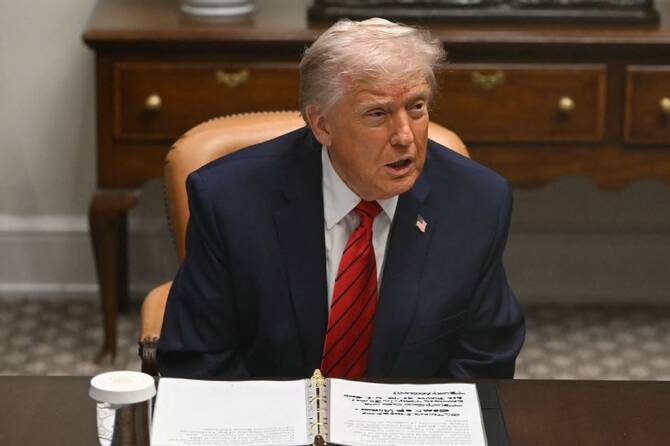
US President Donald Trump speaks during a roundtable discussion in the Roosevelt Room of the White House in Washington, DC, (AFP)
Short Url
Updated 13 December 2025
Follow

Colombia’s ELN guerrillas place communities in lockdown citing Trump ‘intervention’ threats

  • The ELN urged civilians in areas it controls to stay indoors for 72 hours starting at 6:00 am on Sunday, avoiding main roads and rivers

BOGOTA: Colombia’s National Liberation Army (ELN) guerrilla group ordered civilians in areas under its control on Friday to stay home for three days as it carries out military exercises in response to “intervention” threats from US President Donald Trump.
The ELN, the oldest surviving guerrilla group in the Americas, controls key drug-producing regions of Colombia and vowed Friday to fight for the country’s “defense” in the face of Trump’s “threats of imperialist intervention.”
Amid a major US pressure campaign against Venezuela, which many view as an attempt to push out strongman Nicolas Maduro, Trump on Wednesday warned that Colombia’s leftist President Gustavo Petro could “be next” over his country’s mass cocaine production.
“He’s going to have himself some big problems if he doesn’t wise up. Colombia is producing a lot of drugs,” Trump told reporters, when asked if he expected to speak with frequent foe Petro.
“He better wise up, or he’ll be next...I hope he’s listening.”
The ELN urged civilians in areas it controls to stay indoors for 72 hours starting at 6:00 am on Sunday, avoiding main roads and rivers.
“It is necessary for civilians not to mix with fighters to avoid accidents,” the group said in a statement.
Petro criticized the move on social media, saying one “doesn’t protest against anyone by killing peasants and taking away their freedom.”
“You, gentlemen of the ELN, are declaring an armed strike not against Trump, but in favor of the drug traffickers who control you,” he wrote on X.
Colombian Defense Minister Pedro Sanchez dismissed the ELN move as “nothing more than criminal coercion” and vowed the military “will be everywhere — in every mountain, every jungle, every river” to counter its threat.
With a force of about 5,800 combatants, the ELN is present in over a fifth of Colombia’s 1,100-plus municipalities, according to the Insight Crime research center.
The ELN has also taken part in failed peace negotiations with Colombia’s last five governments.
While claiming to be driven by leftist, nationalist ideology, the ELN is deeply rooted in the drug trade and has become one of the region’s most powerful organized crime groups.
It vies for territory and control of lucrative coca plantations and trafficking routes with dissident fighters that refused to lay down arms when the FARC guerrilla army disarmed under a 2016 peace deal.
One ELN stronghold is the Catatumbo region near the Venezuelan border — one of the areas with the most coca crops in the world.
Colombia is the world’s top cocaine producer, according to the UN.

- Souring ties -

Historically strong relations between Bogota and Washington have deeply soured since Trump’s return to office.
Petro, who came to power in 2022 as Colombia’s first-ever leftist president, has openly clashed with Trump calling him “rude and ignorant” and comparing him to Adolf Hitler.
The Colombian leader denounced the Trump administration’s treatment of migrants and what he has termed the “extrajudicial executions” of nearly 90 people in strikes on boats in the Caribbean and Pacific the US claims, without providing evidence, were ferrying drugs.
Petro has also criticized Washington’s military deployment within striking distance of Venezuela, where Maduro fears he is the target of a regime-change plot under the guise of an anti-drug operation.
Washington, in turn, has accused Petro of drug trafficking and imposed sanctions.
Trump removed Bogota from a list of allies in the fight against narco trafficking, but the country has so far escaped harsher punishment.


Cambodia shuts Thailand border crossings over deadly fighting

Updated 13 December 2025
Follow

Cambodia shuts Thailand border crossings over deadly fighting

  • Thai Prime Minister Anutin Charnvirakul said Trump “didn’t mention whether we should make a ceasefire” during their Friday phone call
  • Across the border, a Cambodian evacuee said she was “sad” the fighting hadn’t stopped despite Trump’s intervention

BANGKOK: Cambodia shut its border crossings with Thailand on Saturday, after Bangkok denied US President Donald Trump’s claim that a truce had been agreed to end days of deadly fighting.
Violence between the Southeast Asian neighbors, which stems from a long-running dispute over the colonial-era demarcation of their 800-kilometer (500-mile) border, has displaced around half a million people on both sides.
At least 25 people have died this week, including four Thai soldiers the defense ministry said were killed in the border area on Saturday.
The latest fatalities were followed by Phnom Penh announcing it would immediately “suspend all entry and exit movements at all Cambodia-Thailand border crossings,” the interior ministry said.
Each side blamed the other for reigniting the conflict, before Trump said a truce had been agreed.
Thai Prime Minister Anutin Charnvirakul said Trump “didn’t mention whether we should make a ceasefire” during their Friday phone call.
The two leaders “didn’t discuss” the issue, Anutin told journalists on Saturday.
Trump had hailed his “very good conversation” with Anutin and Cambodian Prime Minister Hun Manet on Friday.
“They have agreed to CEASE all shooting effective this evening, and go back to the original Peace Accord” agreed in July, Trump wrote on his Truth Social platform.
The United States, China and Malaysia, as chair of the regional bloc ASEAN, brokered a ceasefire in July after an initial five-day spate of violence.
In October, Trump backed a follow-on joint declaration between Thailand and Cambodia, touting new trade deals after they agreed to prolong their truce.
But Thailand suspended the agreement the following month after Thai soldiers were wounded by land mines at the border.
In Thailand, evacuee Kanyapat Saopria said she doesn’t “trust Cambodia anymore.”
“The last round of peace efforts didn’t work out... I don’t know if this one will either,” the 39-year-old told AFP.
Across the border, a Cambodian evacuee said she was “sad” the fighting hadn’t stopped despite Trump’s intervention.
“I am not happy with brutal acts,” said Vy Rina, 43.

- Trading blame over civilians -

Bangkok and Phnom Penh have traded accusations of attacks against civilians, with the Thai army reporting six wounded on Saturday by Cambodian rockets.
Cambodia’s information minister, Neth Pheaktra, meanwhile said Thai forces had “expanded their attacks to include civilian infrastructure and Cambodian civilians.”
A Thai navy spokesman said the air force “successfully destroyed” two Cambodian bridges used to transport weapons to the conflict zone.
Malaysian Prime Minister Anwar Ibrahim on Saturday urged both sides to “cease all forms of hostilities and refrain from any further military actions.”
Thailand has reported 14 soldiers killed and seven civilian deaths, while Cambodia said four civilians were killed earlier this week.
At a camp in Thailand’s Buriram, AFP journalists saw displaced residents calling relatives near the border who reported that fighting was ongoing.
Thailand’s prime minister has vowed to “continue to perform military actions until we feel no more harm and threats to our land and people.”
After the call with Trump, Anutin said “the one who violated the agreement needs to fix (the situation).”
Cambodia’s Hun Manet, meanwhile, said his country “has always been adhering to peaceful means for dispute resolutions.”