YEREVAN, Armenia: New clashes erupted Thursday on the border between Azerbaijan and Armenia following a day-long lull, dashing hopes of a rapid end to a flare-up in fighting.
At least 16 people on both sides have been killed since clashes erupted on Sunday between the ex-Soviet republics, who have been locked for decades in a conflict over Azerbaijan’s southwestern separatist region of Nagorny Karabakh.
Ethnic Armenian separatists seized the territory in a 1990s war that claimed 30,000 lives, though the recent fighting broke out on a section of the two countries’ shared border far from Karabakh.
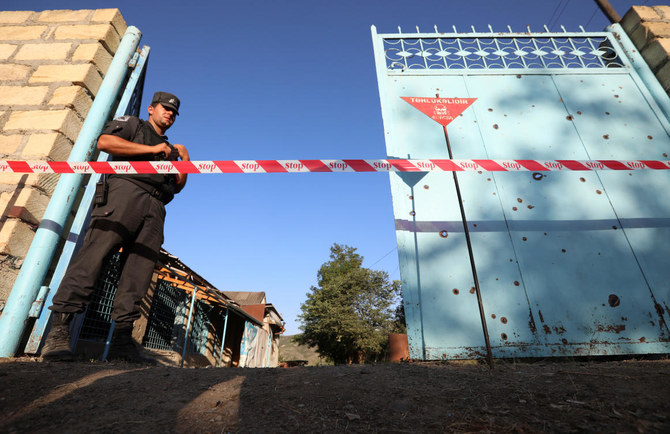
The fighting is centered on the northern regions of Tovuz in Azerbaijan and Tavush in Armenia, and local villagers told AFP they feared for their lives.
“An artillery shell hit our yard, 10 meters from the house,” resident Shain Abiyev said in the Azerbaijani village of Dondar Quscu near the border.
“Fortunately my family was not at home, but if they had been in the house there would have been a tragedy.”
The clashes broke out on Sunday, with the two sides exchanging artillery and mortar fire for three days until a pause on Wednesday after international calls for restraint.
The two countries’ defense ministries said shelling had resumed in the early hours of Thursday, with both sides blaming each other.
Armenian defense ministry spokeswoman Sushan Stepanyan said Azerbaijani forces were “shelling Armenian villages with mortars and howitzers” in Tavush.
Armenian forces responded and “destroyed the enemy’s tank and artillery positions from which they were shelling Armenian villages,” Stepanyan said.
“We are in control of the situation,” Armenian Prime Minister Nikol Pashinyan told a cabinet meeting, saying there were “killed and wounded among the enemy” but “no losses among our servicemen or civilians.”
The defense ministry in Baku blamed Armenian forces for the renewed fighting, saying in a statement that clashes started in the north after “Armenians shelled Azerbaijani villages with large-calibre weapons.”
The fighting that broke out last week has prompted calls for an immediate de-escalation from the United States, the European Union and regional powerbroker Russia. Turkey has spoken out in support of its ally Azerbaijan.
Eleven Azerbaijani troops and one civilian have been killed in the clashes, as well as four Armenian soldiers, according to the two countries.
The last time major fighting erupted between the two was in April 2016, with days of fierce combat in Karabakh that claimed more than 100 lives.
It is unclear what ignited this summer’s flare-up, but analysts say it could have been a small incident like a cross-border shooting that quickly escalated.
Olesya Vartanyan, senior South Caucasus analyst for the International Crisis Group, said a major confrontation would draw in big regional players.
“Any direct attack at the territory of Armenia or Azerbaijan can provoke — with a high probability — an intervention of one of the regional powers, particularly Turkey or Russia,” she told AFP.
But she said it seemed unlikely the crisis would escalate, as neither side has territorial claims on northern border areas and the fighting had not spread to Karabakh itself.
Talks to resolve the Karabakh dispute — one of the worst conflicts to emerge from the 1991 collapse of the Soviet Union — have been largely stalled since a 1994 cease-fire agreement.
France, Russia and the United States have mediated peace efforts as the “Minsk Group,” but the last big push for a peace deal collapsed in 2010.
Flush from years of oil revenues, energy-rich Azerbaijan has invested heavily in its military and repeatedly vowed to retake Karabakh by force. The Turkic-speaking country is firmly backed by main ally Ankara.
Armenia has said it will defend Karabakh, which has declared its independence but relies heavily on Yerevan.
Moscow is also a key military ally of Armenia and has a base in the country, though it has supplied both Baku and Yerevan with sophisticated weapons.


![]()


New clashes dash hopes of end to fighting on Azerbaijan-Armenia border
Short Url
https://arab.news/5dufv
New clashes dash hopes of end to fighting on Azerbaijan-Armenia border
- At least 16 people on both sides have been killed since clashes erupted on Sunday between the ex-Soviet republics
- The fighting is centered on the northern regions of Tovuz in Azerbaijan and Tavush in Armenia


Scores killed in militant attacks in northwest Nigeria
- The attacks came days after the state hosted the UNESCO-listed Argungu fishing festival
- The Lakurawa group has been blamed for many of the attacks on communities
LAGOS: Militant fighters have killed scores of people and destroyed seven villages in raids in northwestern Nigeria’s Kebbi state, the police said Thursday.
Members of the Lakurawa group attacked villages in the Bui district of Arewa northern region at around 1:15 p.m. (1215 GMT) Wednesday, said Kebbi state police spokesman Bashir Usman.
A security report seen by AFP said the militants had killed “more than 30 villagers.”
Usman said: “Scores of people were killed as residents from Mamunu, Awasaka, Tungan Tsoho, Makangara, Kanzo, Gorun Naidal, and Dan Mai Ago mobilized to resist the attackers.”
The attackers had also rustled “some cattle” in the raids, he added. Police, soldiers and local militia were immediately sent to the area.
The attacks came days after the state hosted the UNESCO-listed Argungu fishing festival, about 60 kilometers (38 miles) from the Arewa region, where the attacks took place.
The Lakurawa group has been blamed for many of the attacks on communities in the northern part of the state and in neighboring Sokoto state.
Its members stage deadly attacks from their forest base, rustling livestock and imposing “taxes” on locals.
The Nigerian government said the Christmas day air strikes by the US military in Sokoto had targeted members of the group and “bandit” gangs.
Some researchers have linked the group to the Islamic State Sahel Province, which is active mainly in neighboring Niger and Mali, though others remain doubtful.
The activities of the group have compounded Nigeria’s insecurity.
The West African nation is grappling with a more than 16-year militant insurgency in the northeast, as well as a farmer-herder conflict in the north central region.
They also have to contend with a violent secessionist agitation in the southeast, and kidnappings for ransom plague the northwest.
Nigeria is now looking to the United States for technical and training support for its troops fighting the militants after a resurgence of violence strained relationships between the two countries.
The US Africa Command said 200 troops were expected to join the deployment overall.
US President Donald Trump has said the violence there amounts to the “persecution” of Christians — a framing long used by the US religious and political right wing.
Nigeria’s government and many independent experts say Christians and Muslims alike are the victims of the country’s security crises.
Members of the Lakurawa group attacked villages in the Bui district of Arewa northern region at around 1:15 p.m. (1215 GMT) Wednesday, said Kebbi state police spokesman Bashir Usman.
A security report seen by AFP said the militants had killed “more than 30 villagers.”
Usman said: “Scores of people were killed as residents from Mamunu, Awasaka, Tungan Tsoho, Makangara, Kanzo, Gorun Naidal, and Dan Mai Ago mobilized to resist the attackers.”
The attackers had also rustled “some cattle” in the raids, he added. Police, soldiers and local militia were immediately sent to the area.
The attacks came days after the state hosted the UNESCO-listed Argungu fishing festival, about 60 kilometers (38 miles) from the Arewa region, where the attacks took place.
The Lakurawa group has been blamed for many of the attacks on communities in the northern part of the state and in neighboring Sokoto state.
Its members stage deadly attacks from their forest base, rustling livestock and imposing “taxes” on locals.
The Nigerian government said the Christmas day air strikes by the US military in Sokoto had targeted members of the group and “bandit” gangs.
Some researchers have linked the group to the Islamic State Sahel Province, which is active mainly in neighboring Niger and Mali, though others remain doubtful.
The activities of the group have compounded Nigeria’s insecurity.
The West African nation is grappling with a more than 16-year militant insurgency in the northeast, as well as a farmer-herder conflict in the north central region.
They also have to contend with a violent secessionist agitation in the southeast, and kidnappings for ransom plague the northwest.
Nigeria is now looking to the United States for technical and training support for its troops fighting the militants after a resurgence of violence strained relationships between the two countries.
The US Africa Command said 200 troops were expected to join the deployment overall.
US President Donald Trump has said the violence there amounts to the “persecution” of Christians — a framing long used by the US religious and political right wing.
Nigeria’s government and many independent experts say Christians and Muslims alike are the victims of the country’s security crises.
Latest updates


Recommended


© 2026 SAUDI RESEARCH & PUBLISHING COMPANY, All Rights Reserved And subject to Terms of Use Agreement.