
MOSCOW/BEIRUT: The Russian Reconciliation Center for Syria announced on Friday that an agreement had been reached on “a unilateral cease-fire by Syrian government forces in the Idlib de-escalation zone, from 6 a.m. on Aug. 31.”
The statement said the cease-fire aimed “to stabilize the situation” and urged anti-government fighters to “abandon armed provocations and join the peace process.”
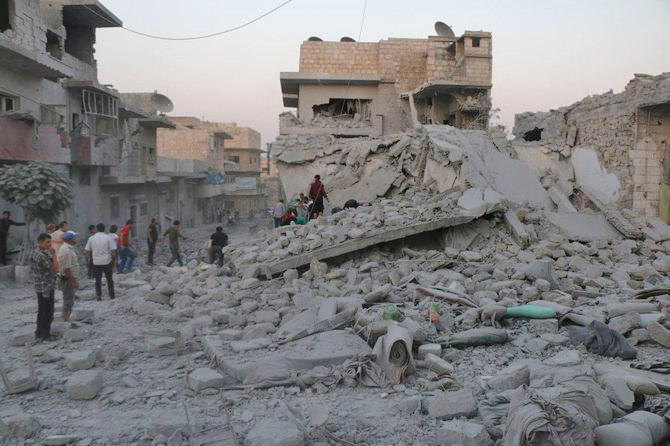
The announcement came after Russian-backed regime forces advanced in the jihadist-held bastion — one of the last holdouts of opposition to President Bashar Assad’s regime — after months of intense bombardment.
Syria’s war has killed more than 370,000 people and displaced millions since it started in 2011. Many of those displaced are currently living in desert camps inside Syria, and on Friday the United Nations announced that it will help evacuate civilians from an “abysmal” Syrian desert camp near the border with Jordan, after a mission last week — sent by the UN and the Syrian Arab Red Crescent — determined who wanted to leave.
“We are ready to facilitate” evacuations from the Rukban camp, said Panos Moumtzis, the UN’s Syria humanitarian chief. “We want to make sure it happens in a voluntary way.”
IN NUMBERS
370,000 - Syria’s war has killed more than 370,000 people and displaced millions since it started in 2011.
According to the UN official, around 12,700 people remain in the isolated Rukban camp near a base used by the US-led coalition fighting the Islamic State (IS) group, and just over one-third of them expressed their desire to leave.
Jordan has largely sealed its border in the area since 2016, after a deadly attack claimed by Daesh on Jordanian soldiers.
The Syrian government and key backer Russia said in February they had opened corridors out of the camp, calling on residents to leave. More than half of the original population has since left, the UN claims.
Conditions inside Rukban are dire, with many surviving on just one simple meal a day, often bread and olive oil or yoghurt, according to one resident. “The situation is desperate,” Moumtzis said, describing Rukban as one of the hardest places to reach in Syria for humanitarian actors. Abu Ahmad Al-Dirbas Khalidi, the head of an opposition-run civil council in the camp, said the UN has vowed to deliver food aid by the first week of September.
Some 47 percent of surveyed camp residents said they wanted to remain in Rukban despite the conditions there, citing reasons including “security concerns” and “fear of detention.” Rights groups have warned that civilians returning to government-held territory have faced detention and conscription.
Although Rukban has not received aid since February, the latest UN mission did not deliver any relief items beyond “a minimal number of health supplies,” Moumtzis said.
But last week’s visit is only the first part of a “two-step” plan — the second of which will involve aid delivery, according to the UN official.
“The next mission — I hope very quickly — will go back and deliver desperately needed assistance,” he said, without providing a specific date.