
ANKARA: Turkish President Recep Tayyip Erdogan told reporters that Turkey would demand a smaller safe zone in Syria.
His comments follow meetings with his Russian counterpart Vladimir Putin in Moscow.
Erdogan said: “I told Defense Minister Hulusi Akar that we should begin to work with what (the Americans had proposed). Then we can do what is necessary in the future. The agreement we have reached with the US is a correct step toward establishing a safe zone and removing the YPG from the east of the Euphrates.”
He also warned that “Turkish personnel and armored carriers are all on the border. We are in a position to do everything at any moment.”
Erdogan recently announced that Turkish troops will soon be deployed in the safe zone, and pledged that he would not let the US delay it being established.
In early August, Ankara and Washington agreed to set up a safe zone between the Turkish border and Syrian land controlled by the US-backed YPG militia. They also established a joint operations center, which has reached full operational capacity.
Joint US-Turkey patrols are also expected to begin soon under the latest deal between the two counties. Akar announced that joint US-Turkey helicopter flights had been launched and destruction of YPG fortifications had started in northern Syria.
US President Donald Trump and Erdogan spoke by phone on Wednesday to discuss trade and the humanitarian situation in Idlib.
Turkey’s state-owned Anadolu news agency said the leaders agreed to cooperate to protect civilians in Idlib after jets believed to be Syrian or Russian struck an opposition-held city in northwest Syria.
According to Oytun Orhan, coordinator of Syria studies at the Ankara-based think tank ORSAM, shortening the safe zone means that Turkey no longer has the upper hand in negotiations with the US.
“Under the current circumstances, Ankara concentrates on getting the maximum gain in Syria’s rebel-held stronghold of Idlib province and the eastern part of the Euphrates. Turkey doesn’t want to pit against the US in this critical region,” he told Arab News.
Orhan added that there are more important dynamics than the depth of the safe zone.
“The role and the responsibilities assigned to Turkish forces, whether they will have an observatory role or not, are of key importance. There would also be other technical details, such as permanent bases or observation points that might be established in the region,” he said.
Orhan said that the depth of safe zone would depend on the population structure and the geographical characteristics of the region.
“It would be deeper along Arab areas like Tal Abyad Ras Al-Ain, and narrower in Kurdish zones,” he said.
FASTFACT
Turkey and US established a joint operations center, which has reached full operational capacity. Joint patrols are also expected to begin soon under the latest deal between the two countries.
According to Nicholas A. Heras, Middle East security analyst at the Washington-based think tank Center for a New American Security, the change in the safe zone depth shows that Ankara understands that there are limits to what it can get from the Americans in northern and eastern Syria.
“Erdogan’s main objective is for Turkish forces to patrol northern and eastern Syria, and the Americans are about to give him that,” he told Arab News. Heras added that Erdogan is under intense domestic political pressure to resolve issues in Syria, and he wants to show that he can ensure Turkey’s national security.
“Turkish forces would participate in patrols with other nations, especially the US. Turkey’s role in northern and eastern Syria would be largely symbolic and intended to satisfy Erdogan,” he said.
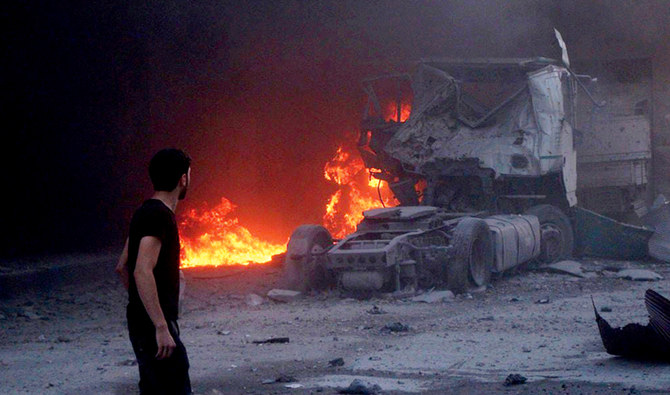
Meanwhile, Syrian regime forces continued their military offensive in Idlib, seizing a cluster of villages on the southeastern edges of the province on Thursday as the civilian death toll rose.
The government-controlled Syrian Central Military Media said troops captured three small villages as they continued their assault. It suggested that the next target will be the opposition-held town of Maaret Al-Numan, which lies near the Damascus-Aleppo highway.
Last week, troops seized the town of Khan Sheikhoun, which sits on the highway.
Idlib is the Syrian opposition’s final stronghold. President Bashar Assad’s forces, backed by Russia, are determined to recapture it. For now, their main aim is to reopen the M5 highway and they have been pounding towns and villages that lie near that route. Opening the highway would shorten travel times between the country’s two largest cities by two hours.
The Syrian Civil Defense group, which opposes the Assad regime, said airstrikes on Maaret Al-Numan on Wednesday killed 12 people and wounded 34. The group, also known as the White Helmets, released a video showing the rescue operations. In the footage, bodies can be seen trapped in a collapsed building after it was targeted by jets.
The Britain-based Syrian Observatory for Human Rights, a war monitoring group, also reported 12 deaths, including two women and six children, and said 30 people were wounded.
The UN said that over 550 civilians had been killed and over 400,000 people displaced from the Hama and Idlib provinces since the offensive began in late April. Almost half of those displaced, some of them multiple times, live in camps and reception centers in the open air or under trees.
UN spokesman Stephane Dujarric said that “satellite imagery shows entire towns and villages have been razed to the ground, while dozens of communities have been emptied.”
He called on the warring parties to ensure the safety of civilians as clashes, shelling and airstrikes escalate.
Dujarric added that three-quarters of the 3 million people being impacted by the violence are women and children.