
Saudi-based Hajj Hackathon makes it to the Guinness Book of Records

1 / 3
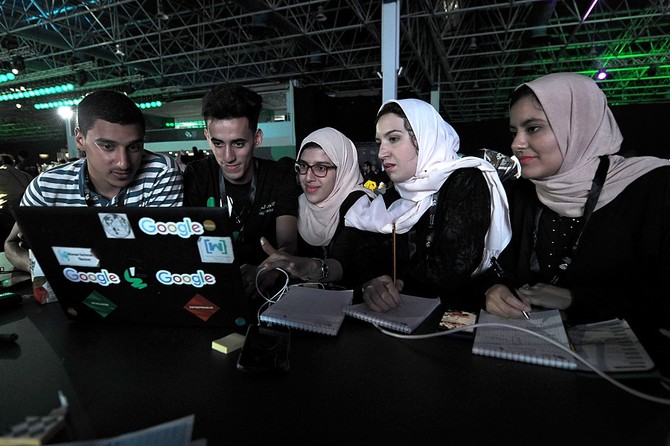
More than 3,000 software developers and 18,000 computer and information-technology enthusiasts from more than 100 countries take part in Hajj hackathon in Jeddah until Aug. 3. (Amer Hilabi/AFP)
2 / 3
Women attended the hackathon in Jeddah. (Amer Hilab/AFP)
3 / 3
Participants also included Saudi women. (Amer Hilab/AFP)
Updated 03 August 2018
Follow

Saudi-based Hajj Hackathon makes it to the Guinness Book of Records

  • Hundreds of people took part in the hackathon event, smashing the previous record
  • A number of Hajj-related service industries were involved in the event

JEDDAH: Saudi Arabia has officially made it to the Guinness Book of Records after carrying out the largest Hajj Hackathon for cyber security, programming and drones.

The event also saw the the largest number of participants in the world with 2950 people taking part.

Royal Court advisor and head of the Saudi Federation for Cyber Security, Programming and Drones, Saud Al-Qahtani said: “The Kingdom’s record in the Guinness Book highlights the aspiration of Saudi youth for their country to be a technology portal in the region,” he said.

He added: “this is in line with the ambitious Kingdom’s 2030 vision that takes the Kingdom to a quantum leap on all levels.”

The record-breaking Hajj Hackathon was announced at 7 a.m. on Wednesday.  

Saud Al-Qahtani, an advisor at the Royal Court and head of Saudi Federation for Cyber Security, Programming and Drones received the Guiness Book confirmation of the record achievement from arbitrator Ahmed Jabr.

The record breaking Hackathon with 2950 participants, smashed the previous event that saw 2577 people registered in India in 2012.

The Kingdom’s entry to the Guinness Book of Records, attracted developers from a variety of countries including Saudi Arabia and other other Gulf states, as well as the wider world.

The hackathon  involved Hajj related sectors, including food and beverages, public health, and accommodation arrangements, as well as waste management, housing and communication solutions.


Klija Festival goes global, celebrates culinary heritage

Updated 7 sec ago
Follow

Klija Festival goes global, celebrates culinary heritage

  • From a local initiative to an international showcase, the festival empowers families and artisans while boosting tourism in Qassim

Riyadh: The 17th Klija Festival in Buraidah, which ended Jan. 17, “reflects a long journey of leadership and cultural development, evolving from a simple initiative to promote a local product into an annual festival that embodies the authenticity and cultural identity of the Qassim region,” the Saudi Press Agency reported on Saturday.

Klija — a popular spiced cookie or pastry — is typically made from ingredients including wheat flour, sugar, lemon, cardamom, cinnamon, ginger, and molasses, with the dough stuffed and baked to a crisp. It has become an “economic symbol, that has empowered productive families, supported artisans, and converted heritage skills into sustainable income,” the SPA stated, adding that the festival has established itself as “a key tourism and cultural event.”

To reflect that transformation, starting from next year, the festival will be called the International Klija Festival, a rebranding approved by Qassim Gov. Prince Faisal bin Mishaal, who said the festival is a “successful model for turning local initiatives into global economic engines.”

This year’s festival, held at the King Khalid Cultural Center, featured international participants from Egypt, Turkiye, and Morocco, signaling its evolution into a cross-cultural platform.

Families in the cottage industry showcased their products, while special pavilions featured popular dishes, sweets, and a variety of handicrafts. Professional chefs presented diverse traditional dishes, complemented by daily activities and competitions for attendees. It “attracted a large turnout of visitors and heritage enthusiasts from across the Kingdom, the Gulf region, and beyond,” according to the SPA.

The festival is adding “international” to its name in the hope of attracting broader global expertise, while continuing to highlight Qassim’s unique cultural identity in line with Saudi Vision 2030.

The Culinary Arts Commission has adopted Klija as Qassim’s signature product, “affirming its cultural value and role in representing the region’s food identity,” the SPA stated.