

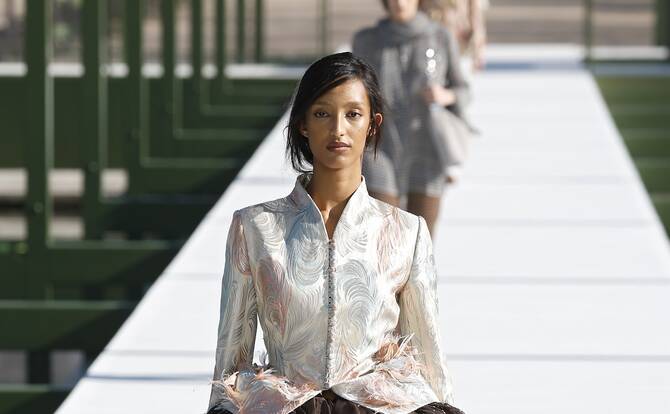
Mona Tougaard takes to Dior runway in Paris

Model Mona Tougaard walked the Dior runway during Paris Fashion Week. (Getty Images)
Short Url
Updated 04 March 2026
Follow

Mona Tougaard takes to Dior runway in Paris

  • Jonathan Anderson’s fall-winter 2026 clothes displayed
  • Anya Taylor-Joy, Charlize Theron among the attendees

PARIS/ DUBAI: Model Mona Tougaard stepped onto the Dior runway at the Tuileries Garden during Paris Fashion Week recently.

The sun was out over the glass-walled runway at the famed Tuileries Garden in the French capital on Tuesday, flooding Jonathan Anderson’s fall-winter 2026 collection for Dior with a golden light that invoked Impressionist paintings.

Among the celebrities at Paris Fashion Week packed into the glass walkways around the park’s octagonal basin — dotted with artificial water lilies in a nod to Monet — were Anya Taylor-Joy, Charlize Theron, Jisoo, Priyanka Chopra, Willow Smith, Emily Ratajkowski and Macaulay Culkin.


Mona Tougaard wore a structured, high-neck jacket in a pale ivory tone. (Getty Images)

It was a fitting mood for a collection steeped in flowers, water and the art of being seen.

For the show Tougaard, who has Danish, Turkish, Somali and Ethiopian ancestry, wore a structured, high-neck jacket in a pale ivory tone with soft pastel feather-like patterns in shades of blue and blush.

The jacket was tailored and fitted through the waist, fastened with small buttons down the front, and finished with delicate feather detailing along the hem.


The show took place at the Tuileries Garden in the French capital. (Getty Images)

It was paired with a dramatic, layered black tulle skirt featuring polka-dot mesh and scalloped lace edges. The skirt was short and voluminous at the front with multiple ruffled tiers, while a sheer asymmetrical train extended from the back, adding movement as she walked.

She completed the look with black-and-white pointed heels, creating a sharp contrast against the airy textures of the outfit.

Besides Tougaard’s look, the runway also featured deconstructed frock coats, peplum jackets and bustle skirts in candied almond shades, Chantilly lace and metallic jacquards. Shrunken blazers sat above lampshade skirts in baby-soft shearling.


A post shared by Dior Official (@dior)

Sculptural knits held their shape like origami.

The floral theme was everywhere — but it was developed through silhouette and fabric rather than slapped on literally.

Crinkled cardigans recalled the corolla of a bloom. Asymmetrically fastened skirts and dresses evoked petals. Even the crystal detailing on embroidered jeans carried a botanical echo.

Anderson reprised his Donegal tweed take on the house’s legendary Bar jacket, but made it longer and looser.

The spiral cage dresses that wowed at his recent couture show returned as clouds of soft pleated fabric.

There were ivory hammered silk track pants with covered bridal buttons, jeans with ribbon embroidery and plain robe coats worn as dresses — garments rarely given the spotlight on a runway.


Mini op-ed: Recognising a shift in how people relate to wellness, self-care

Updated 05 March 2026
Follow

Mini op-ed: Recognising a shift in how people relate to wellness, self-care

DUBAI: I have spent nearly a decade working in the beauty industry in Saudi Arabia and the UAE, and Ramadan always has a way of prompting change; in habits, in priorities, and in the routines people have been carrying without question. Speaking from my own corner of the industry, one of these habits is often hair removal.

Saudi Arabia’s beauty and personal care market was valued at about $7.56 billion in 2025 and is set to grow to an estimated $8.03 billion in 2026. Within that growth, personal care encompassing the daily (sometimes unglamorous) routines hold the largest share. But market size alone does not tell the full story. A study conducted at King Abdulaziz University Hospital, Jeddah, found that three quarters of Saudi women experienced complications from temporary hair removal methods, including skin irritation, in-grown hairs and hyperpigmentation. A separate 2025 study published in the Majmaah Journal of Health Sciences found that laser hair removal was both the most considered and most commonly undergone cosmetic procedure among Saudi respondents, yet dissatisfaction with cosmetic procedure outcomes was reported by nearly half of all participants. The numbers point to a gap not in demand, but in results. 

When I launched a specialized electrolysis practice in the UAE in 2016, it was with a clear gap in mind; safe, regulated, permanent hair removal for the region’s specific needs. The range of hair types here and the prevalence of conditions such as polycystic ovary syndrome, or PCOS, demanded a method that works across all of them.  Electrolysis is the only method recognized by the US Food and Drug Administration and American Marketing Association as achieving true permanent results, regardless of hair color or type. 

Despite this, awareness in Saudi Arabia remains limited. Part of this is familiarity, laser has dominated the conversation for years, and electrolysis, which requires more sessions and a licensed electrologist’s precision, has struggled to break through. Part of it is education. Many clients who come to us have never heard of electrolysis; they come because they have exhausted everything else. 

Right now, Saudi Arabia is in the middle of a genuine transformation in how people relate to wellness and self-care. The beauty market is maturing, consumers are asking harder questions of the brands they choose and Vision 2030 has not just shaped the economy, it has shaped how Saudis are showing up in their own lives. In that context, the idea of choosing permanence over repetition lands differently.
 
Mariela Marcantetti is a beauty industry entrepreneur based between Saudi Arabia and the UAE.