Islamabad hospital says Imran Khan’s vision shows ‘remarkable’ improvement

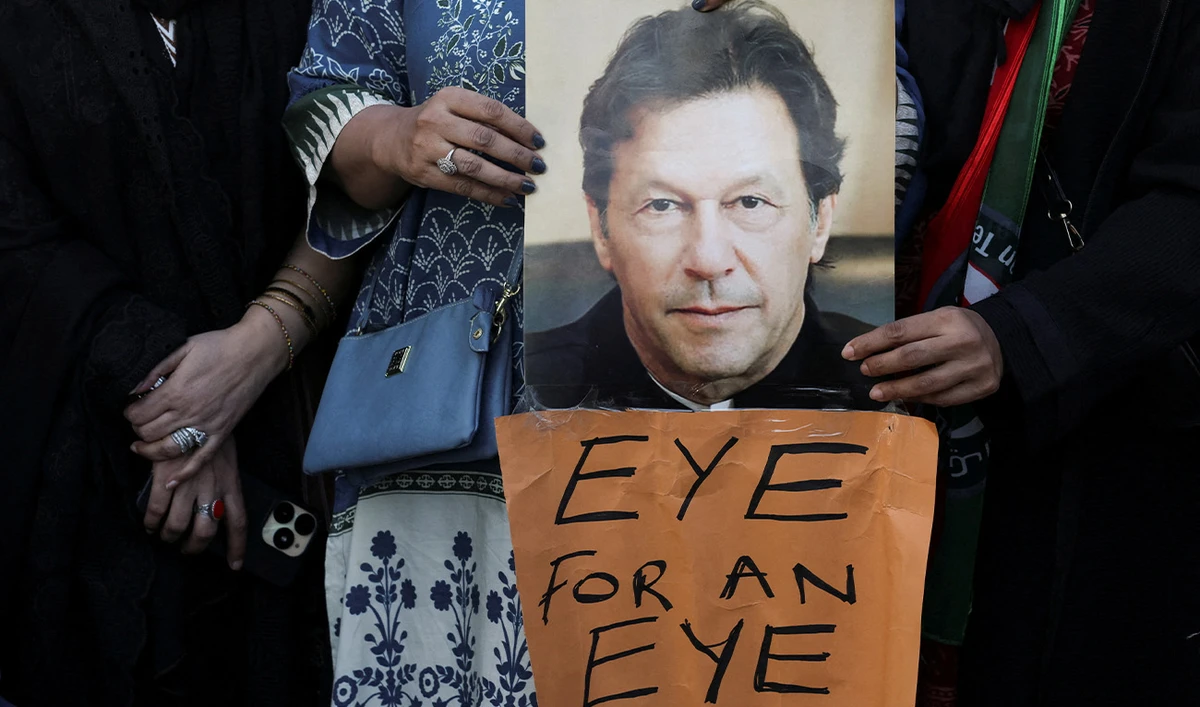
Supporters of jailed former Prime Minister Imran Khan's Pakistan Tehreek-e-Insaf (PTI) party carry a poster of him during a protest over concerns about their leader's health in Karachi, Pakistan, February 13, 2026. (Reuters/File)
Short Url
Updated 04 March 2026
Follow

Islamabad hospital says Imran Khan’s vision shows ‘remarkable’ improvement

  • Doctors from Al-Shifa Trust Eye Hospital and PIMS examine Khan at Adiala Jail amid his declining eyesight
  • Khan’s health has become a sensitive issue, with supporters questioning the transparency of his treatment

ISLAMABAD: Jailed former prime minister Imran Khan’s vision has “improved remarkably,” the Pakistan Institute of Medical Sciences (PIMS) said on Tuesday, following an examination after he received an intravitreal injection amid concerns related to his eyesight.

Khan, 74, has been held at Adiala jail since August 2023 in cases that he and his Pakistan Tehreek-e-Insaf (PTI) party say are politically motivated. His health has become an increasingly sensitive political issue in recent weeks, particularly after a lawyer informed Pakistan’s Supreme Court that his vision in one eye had significantly deteriorated while in custody.

The ex-premier has reportedly been receiving treatment for retinal vein occlusion, a condition caused by blocked veins draining blood from the retina that can lead to vision loss.

In a statement issued last night, PIMS said Khan had been examined at Adiala Prison on Mar. 3 by a medical board comprising two senior doctors, one of them heading its ophthalmology department and the other heading the vitreoretinal department at Al-Shifa Trust Eye Hospital.

“This examination was performed as a follow-up of his second dose of intravitreal injection of anti VEGF,” it added. “The board concluded that his vision has improved remarkably which is substantially good vision at this stage.”

Anti-VEGF injections are commonly used to treat retinal vein occlusion and other retinal vascular disorders by reducing swelling and abnormal blood vessel growth inside the eye.

The statement highlighted that both Khan’s eyes were examined for “visual acuity, fundoscopy, slit lamp examination and Optical coherence tomography” during the examination.

It added that the board recommended continuing care and treatment as previously advised.

Last month, Khan was taken to PIMS for a second eye injection and was discharged in stable condition, while his party questioned the transparency of the medical update and demanded independent access to his care.

Khan was removed from office in April 2022 through a parliamentary vote of no confidence that he says was orchestrated at the behest of the former administration in Washington by his political rivals with backing from the military. His allegation is denied by all parties involved.

Since his imprisonment, Khan has faced multiple convictions and ongoing legal proceedings that authorities say follow due process, while his party describes them as efforts to sideline him from politics.

Pakistan highlights Gwadar transshipment role as shipping routes face disruption over regional tensions

Updated 05 March 2026
Follow

Pakistan highlights Gwadar transshipment role as shipping routes face disruption over regional tensions

  • Pakistani ports possess “untapped potential” to attract global shipping lines for transshipment operations, says minister
  • Pakistan eyes leveraging Gwadar as regional transshipment hub as Iran’s closure of Strait of Hormuz disrupts global maritime trade

KARACHI: Pakistan’s Maritime Affairs Minister Junaid Anwar Chaudhry on Thursday highlighted the importance of the port city of Gwadar’s transshipment role as major shipping routes, including the Strait of Hormuz, face disruption due to Iran’s ongoing conflict with the US and Israel in the Gulf. 

The meeting takes place as Iran has effectively closed the Strait of Hormuz, a strategic waterway that lies between it and Oman. It is one of the world’s most critical oil transit routes, with roughly 20 percent of global oil supplies passing through it. Iran has vowed it will attack any ship that enters the strait, causing energy prices to rise sharply on Monday amid disruptions to tanker traffic in the waterway.

Gwadar is a deep-sea port in Pakistan’s southwestern Balochistan province that lies close to the Strait of Hormuz. Pakistani officials have in the past highlighted Gwadar’s geostrategic position as the shortest trade route to the Gulf and Central Asia, stressing that it has the potential to become a regional transshipment hub.

Chaudhry chaired a high-level meeting of government officials to assess emerging logistical challenges facing Pakistan’s trade, particularly in the energy sector, amid tensions in the Gulf. 

“Special focus was placed on fully leveraging the potential of Gwadar Port as a regional transshipment hub and positioning it as an alternative of regional instability,” Pakistan’s maritime affairs ministry said in a statement. 

The minister said Pakistani ports possessed “significant untapped potential” to attract international shipping lines for transshipment operations, noting that it could also ensure long-term sustainability and growth of the country’s maritime sector.

Participants of the meeting discussed measures to strengthen Pakistan’s position as a viable alternative transit and transshipment destination, as key waterways are affected by the disruption. 

The committee also reviewed proposals to amend relevant rules and regulations to facilitate international transshipment operations through on-dock and off-dock terminals.

The chairmen of the Port Qasim Authority, Karachi Port Trust and Gwadar Port Authority attended the meeting, briefing committee members on the current operational readiness of their ports. They spoke about the available capacity for container transshipment, bulk cargo handling and refueling services at Pakistani ports. 

The port in Gwadar is a central part of the China-Pakistan Economic Corridor (CPEC), under which Beijing has funneled tens of billions of dollars into massive transport, energy and infrastructure projects in Pakistan.

Pakistan has long eyed the deep-sea port as a key asset that can help boost its trade with Central Asian states, the Gulf region and ensure the country earns valuable foreign exchange.