

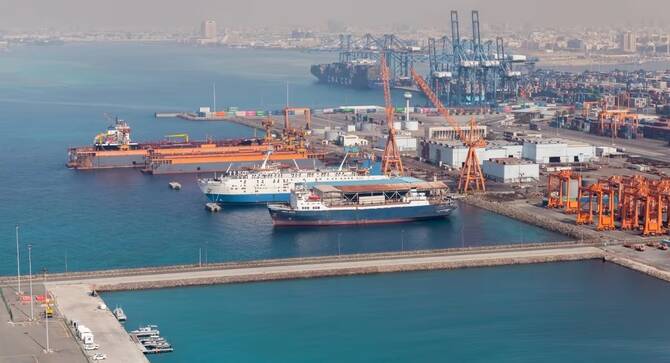

DAMMAM: Saudi Arabia has the full operational capacity to absorb any sudden increase in shipping, particularly if part of Gulf cargo is redirected to the Kingdom’s western ports, most notably Jeddah Islamic Port, as a strategic alternative to the Strait of Hormuz amid US-Israeli strikes on Iran, according to industry experts speaking to Al-Eqtisadiah.
Logistics specialists noted that speed and efficiency in operational management will be critical to the success of such a shift, leveraging the full capacity of road networks and advanced infrastructure.
Abdulaziz Al-Qahtani, a member of the National Logistics Committee, said the highway network, particularly the Jeddah-Riyadh corridor, is designed to handle high volumes of heavy truck traffic.
He added that the national land transport fleet is large and diverse and can be quickly redeployed to support new routes without causing structural bottlenecks, noting that electronic scheduling and round-the-clock operations can absorb sudden spikes in demand.
Jinan Al-Omran, a supply chain and logistics specialist, highlighted that Saudi Arabia’s land infrastructure is highly advanced, with main transport corridors linking Jeddah Islamic Port to domestic consumption hubs and Gulf gateways.
She added that flexible operational measures, including truck scheduling, extended operating hours, and supporting logistics yards, enhance the Kingdom’s ability to manage sudden demand surges efficiently, reinforcing Jeddah’s role as a regional logistics hub.
Regarding the main operational challenges associated with rapid growth, Al-Omran explained that land transport companies may face schedule pressures, trip balancing issues, and the need to speed up procedures.
She emphasized that these challenges can be managed through practical and swift solutions, including enhanced coordination among operators, improved planning and digital tracking, as well as round-the-clock operations, and the expansion of operational partnerships.
She noted that these measures enable the sector to turn challenges into opportunities to boost readiness and strengthen the integration of regional supply chains.
For his part, Abdullah Al-Shihri, a port management specialist, explained that the greatest challenge may arise at land border crossings due to the increased volume of cargo transiting to Gulf countries.
However, he added, solutions are available and can be implemented quickly, including boosting customs staffing, extending operating hours to 24/7, and activating electronic links between relevant authorities to reduce clearance times.
Al-Shihri emphasized that Saudi Arabia’s logistics system has made significant progress in digital transformation, giving it high flexibility in managing peak demand, noting that transport companies have additional operational capacity that can be deployed to the market when needed.
He pointed out that early coordination between exporters, shipping companies, and importers in the Gulf countries will help distribute flows more evenly.
He further noted that any strategic realignment of trade routes presents an opportunity to reinforce the Kingdom’s role as a central logistics hub linking the Red Sea with Gulf markets, rather than serving solely as a short-term response to geopolitical shifts.
The experts concurred that the success of any shift in shipping routes hinges on swift coordination between government authorities and the private sector.
They emphasized that while the necessary infrastructure is already in place, the primary challenge lies in managing demand in an integrated manner during the initial weeks of the transition.


