BEIRUT: Hezbollah leader Hassan Nasrallah threatened Israel’s offshore energy projects Friday as he insisted his armed movement is Lebanon’s “only” source of leverage in an escalating oil and gas dispute.
“The only force you have, oh Lebanese, is the resistance,” Nasrallah said in a televised speech, referring to his powerful faction.
“If Israel threatens you, you can threaten it. If the Americans come tell you that you have to deal with them to hold Israel back, then tell the Americans: respond to our demands so we hold Hezbollah back from Israel,” he said.
Lebanon last week signed its first contract to drill for oil and gas in a pair of offshore zones, including one that its southern neighbor Israel says belongs to it.
The United States has sought to mediate the disagreement, with Acting Assistant Secretary of State David Satterfield meeting with top officials in Lebanon since February 6.
On Friday, Nasrallah said the US was not an “honest mediator.”
“They came to inform, dictate, and threaten,” he said.
Nasrallah’s comments come a day after US Secretary of State Rex Tillerson visited Beirut and blasted Hezbollah’s “destabilising” role in the region.
Tillerson said the US was “committed to helping Lebanon and the Lebanese people prosper through the development of their natural resources in agreement with all of their neighbors.”
A consortium comprising energy giants Total, ENI, and Novatek has pledged to begin drilling off of Lebanon’s coast by 2019.
Total has said that the dispute between Lebanon and Israel over “block nine” only covers eight percent of its surface area.
But Lebanese officials have said the whole zone belongs to Beirut, and Israeli Defense Minizer Avigdor Lieberman has insisted it is solidly in Israeli territory.
“The whole region has now openly entered into an oil and gas war, and our issue is not separate,” Nasrallah said on Friday.
“This is Lebanon’s wealth and hope... We are strong, and we must negotiate as such,” he said, stressing that any discoveries could usher in a “promising and different” future for Lebanese.
“If Lebanon’s Council of Defense takes a decision that oil platforms in Palestine should stop working, then in just a few hours, I promise you, they will stop working,” he threatened.
Hezbollah clashed with Israel in a month-long war in 2006 and is currently fighting alongside President Bashar Assad’s forces in neighboring Syria.
Syria’s protracted conflict has drawn in other world powers, including the United States, which has deployed boots on the ground as part of an international coalition fighting jihadists.
But Nasrallah criticized the US-led alliance on Friday, saying it was stationed in Syria to poach its oil wealth.
“They are staying at the Al-Tanf base east of the Euphrates River — why? Because the most important oil wells and gas (resources) in Syria are east of the Euphrates,” he said.
And US President Donald “Trump’s administation has oil in their eyes when they look” at neighboring Iraq, Nasrallah added.


![]()
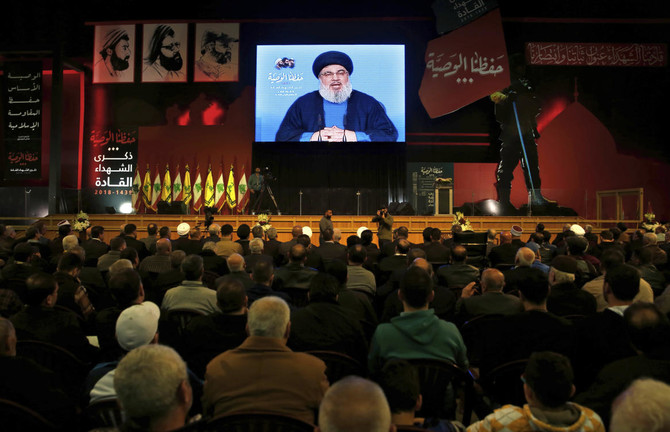
Hezbollah says it is Lebanon’s ‘only’ tool in Israel gas dispute
Hezbollah says it is Lebanon’s ‘only’ tool in Israel gas dispute

Latest updates


© 2026 SAUDI RESEARCH & PUBLISHING COMPANY, All Rights Reserved And subject to Terms of Use Agreement.