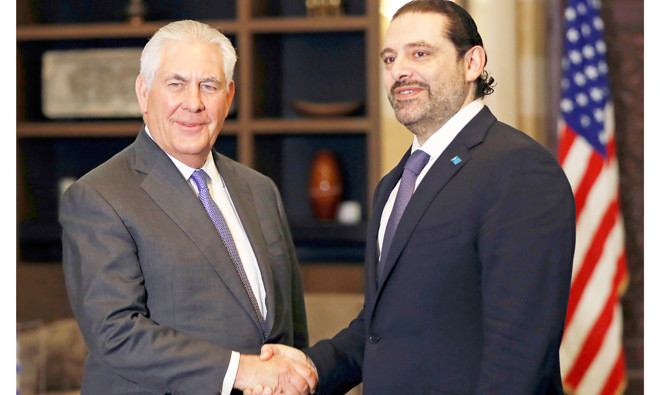
BEIRUT: American Secretary of State Rex Tillerson said on Thursday that the US regarded Hezbollah as a terrorist organization and “we do not differentiate between its military and political arms, and it is unacceptable for militias like Hezbollah to act outside the rule of law.”
Tillerson added in a press conference with the Lebanese Prime Minister Saad Hariri in Beirut that “the Lebanese army is the only defender of the Lebanese State.”
“The people of Lebanon should also be concerned about how Hezbollah’s actions and its growing arsenal bring unwanted and unhelpful scrutiny on Lebanon,” Tillerson said. “Hezbollah’s presence in Syria has only perpetuated the bloodshed, increased the displacement of innocent people and propped up the barbaric Assad regime.”
“The Lebanese government must distance itself from external conflicts and Hezbollah must stop its activities abroad,” he said.
Tillerson held talks with Lebanese President Michel Aoun. The presidential palace press office said that Aoun asked that the US “work on preventing Israel from continuing its assaults on Lebanese sovereignty” by land and sea and to abide by the implementation of Resolution 1701 (guaranteeing Lebanon's territorial sovereignty) to preserve the stability that South Lebanon has enjoyed since 2006.”
Lebanon “can no longer bear the repercussions of Syrian refugees on its security, stability and economy, especially as international aid is insufficient,” the statement said.
It called for “a secure and gradual return of the Syrians to their country and a peaceful solution to the Syrian crisis,” noting that “the decision of the United States to reduce its contribution to the UNRWA (United Nations Relief and Works Agency for Palestine Refugees) will add to the burden placed on Lebanon in caring for these refugees.”
Aoun said: “Lebanon is fully committed to the self-distancing policy, but is not responsible for what happens because of the interventions from abroad due to its inability to influence that.”
Tillerson also held talks with Lebanese Parliament Speaker Nabih Berri. A statement later said that Berri talked about “the daily Israeli violations, the construction of the concrete wall at points inside Lebanese territory, and Israel’s claims to the special economic zone (of Lebanon).”
Tillerson and the delegation then held talks with Prime Minister Saad Hariri. During a joint press conference Hariri stressed Lebanon’s “commitment to the self-distancing policy” and Lebanon’s interest in “maintaining the best relations with Arab countries and the international community.”
Hariri said that he “assured secretary Tillerson of Lebanon’s right to explore, invest and develop our natural resources in our territorial waters. We also agreed that the Lebanese banking sector is the cornerstone of our economy, and I reiterated that this sector is solid and sound … and in full compliance with international laws and regulations.”
Hariri noted that “Lebanon is committed to Resolutions 1701 and 2373 (renewing the mandate of the UN interim force in Lebanon) and we want to move to a permanent cease-fire with Israel, but the Israeli violations of our sovereignty are hampering this process, let alone the Israeli rhetoric.”
Secretary Tillerson said that the US stands by the Lebanese people and its legitimate institutions against regional challenges and threats. He also praised the American partnership with the Lebanese military and the internal security forces in the fight against Daesh and Al-Qaeda.
On Syrian refugees, Tillerson said that “the United States has provided $1.6 billion to help with refugee affairs and host Lebanese communities. The United States stands side by side with the Lebanese people in confronting these challenges that threaten Lebanon’s stability, independence and sovereignty.”
On the Iranian nuclear agreement, Tillerson said that President Trump had indicated that he wanted the flaws in this agreement to be addressed. “We are working with the other signatories to this agreement and with European partners to move forward to deal with the imbalances in the agreement.”
On the recent escalation between Israel on one side and Iran and Syria on the other, Hariri said: “We are with all its types of pacification because the region is not lacking additional tensions and wars.”
Asked about the situation between Turkey and the US over Syria, Tillerson said: “Turkey is an important ally to us in the battle against Daesh and has always been supportive of all efforts. The relationship is very positive and we intend to build on the important aspects that we share. There may be tactical differences about achieving the goals, but the main goal is to eliminate incitement, terrorism, reduce violence, protect the innocent and reach a peaceful settlement of the conflict in Syria.”
On Turkey’s demand that the US take back heavy weapons from the Kurdish YPG, Tillerson said: “We have never given heavy arms to the YPG so there is none to take back.”


![]()
Hezbollah is destabilizing Lebanon, region: Tillerson
Hezbollah is destabilizing Lebanon, region: Tillerson


Latest updates




© 2026 SAUDI RESEARCH & PUBLISHING COMPANY, All Rights Reserved And subject to Terms of Use Agreement.