LONDON: Former Islamic State hostages and families of the group’s victims are urging Britain and the United States to put two recently captured extremists on trial, arguing that denying them justice will simply give oxygen to the hatred and violence they supported.
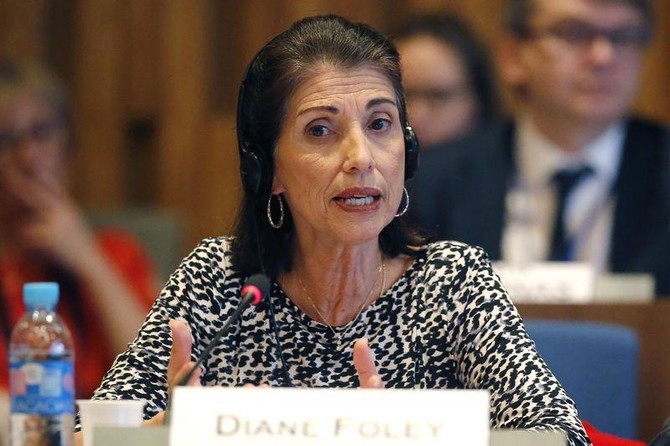
Diane Foley, the mother of slain American journalist James Foley, said El Shafee Elsheikh’s and Alexanda Amon Kotey’s crimes are “beyond imagination” and they should spend the rest of their lives in prison.
“I’d like them to be brought to trial in the US, but as long as they’re brought to fair trial and detained and justice is served I would be most grateful,” she told the BBC.
French journalist Nicolas Henin, who was held by the men and their comrades for 10 months, said he wants justice following the arrest of the two Britons, who were part of the notorious cell dubbed “The Beatles.” Henin told the BBC that the men should be tried in the UK, not shipped to Guantanamo Bay, because revenge will just breed more violence.
“I will be extremely frustrated if they were not offered a fair trial,” Henin said. “The worst thing we can do with the terrorist is to deprive him from his rights, because then you make a terrorist become a victim, and if you victimize someone then you just fuel his narrative and you just confirm his narrative.”
The comments came after US officials confirmed that El Shafee Elsheikh and Alexanda Amon Kotey, who grew up in London before traveling to the Middle East to join the Daesh group, were captured in early January in eastern Syria. US officials have since interrogated the men, who were part of the IS cell that captured, tortured and beheaded more than two dozen hostages, including American journalists James Foley and Steven Sotloff, and aid worker Peter Kassig.
Hundreds of foreign nationals fought alongside IS as it took control of large parts of Syria, raising concerns that they will bring terrorism with them if they ever return home. The capture of Elsheikh and Kotey could yield precious intelligence about what happened to those fighters as IS was defeated on the battlefield, and information about the fate of their hostages, said Shiraz Maher, a senior research fellow at the International Center for the Study of Radicalization and Political Violence at King’s College London.
“It’s hugely significant for a lot of the western countries who had hostages who were captured by Islamic State,” he said. “I think it demonstrates that there remain high-value, significant players at large.”
Maher agreed that Elsheikh and Kotey should be brought to trial because it will help bring closure to their victims and send a message to anyone else who considers joining IS or other extremist groups.
“These guys had an absolute sense of their own invincibility,” he said. “They were filled with euphoria. (Trials) will make people think twice.”
The two are believed to be linked to Mohammed Emwazi, the masked British insurgent known as Jihadi John who appeared in several videos that showed the beheading of Western hostages. The cell was nicknamed “The Beatles” because all four members had English accents.
The American-backed Syrian Democratic Forces captured the two men last month, and the US helped identify them with biometric data and other tools. Their capture was first reported by the New York Times.
The US has been training the SDF in border and internal security, including how to screen individuals and determine if they are foreign fighters or other enemies hiding in the general population.
Elsheikh a former child refugee, was a mechanic from White City in west London. Kotey from the city’s Paddington neighborhood. Kotey’s family issued a statement saying they were aware of the arrest and asking that their privacy be respected.
The US State Department last year imposed sanctions on the two men after declaring they were terrorists.
Elsheikh traveled to Syria in 2012, initially joining Al-Qaeda’s branch in the country before moving on to IS, the State Department said when announcing the sanctions. Kotey served as a guard for the execution cell.
Elsheikh, it said, “was said to have earned a reputation for waterboarding, mock executions, and crucifixions while serving as an (IS) jailer.”
“As a guard for the cell, Kotey likely engaged in the group’s executions and exceptionally cruel torture methods, including electronic shock and waterboarding,” the State Department said.
Emwazi, died in a US air strike in 2015. The fourth member of the cell, Aine Lesley Davis, was convicted of being a member of a terrorist organization and jailed for seven-and-a-half years by a court in Silivri, Turkey, in May 2017.


![]()
Former hostages and victims’ families want Daesh kidnappers held accountable
Former hostages and victims’ families want Daesh kidnappers held accountable

Latest updates


© 2026 SAUDI RESEARCH & PUBLISHING COMPANY, All Rights Reserved And subject to Terms of Use Agreement.