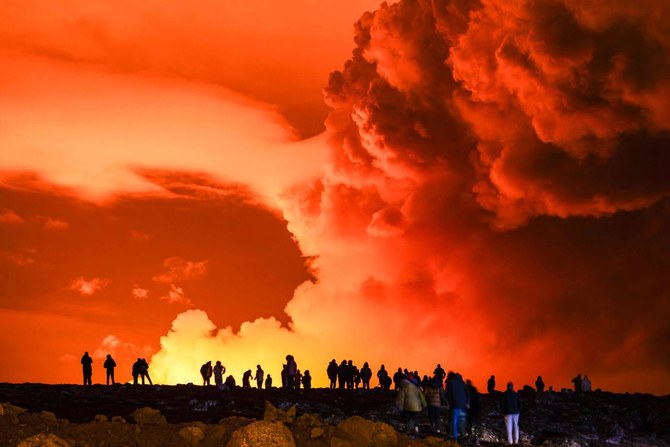
Volcano in Iceland erupts again

Icelanders often refer to their country as the ‘Land of Fire and Ice’ as a tribute to its otherworldly landscape forged by glaciers and volcanoes. (AFP)
Short Url
Updated 29 May 2024
Follow

Volcano in Iceland erupts again

  • Authorities had warned of the risk of renewed volcanic activity in the area just south of the capital Reykjavik

COPENHAGEN: A volcano in southwestern Iceland erupted on Wednesday, live video from the area showed, making it the fifth outbreak since December.
The new outburst happened as another eruption on the Reykjanes peninsula recently ended after spewing fountains of molten rock for almost eight weeks.
Authorities had warned of the risk of renewed volcanic activity in the area just south of the capital Reykjavik as studies showed magma accumulated underground.
The fiery spectacle underlines the challenges the island nation of almost 400,000 people face as scientists have warned eruptions could happen over and over in Reykjanes for decades or even centuries.
The eruption was the eighth on the peninsula, home to some 30,000 people, since 2021 when geological systems that were dormant for some 800 years again became active.
Previous incidents had disrupted district heating, closed key roads and even razed several houses in the Grindavik fishing town, where only a few residents have since returned.
In an attempt to prevent further damage man-made barriers have been built to steer lava away from infrastructure including the Svartsengi geothermal power plant, the Blue Lagoon outdoor spa and Grindavik.
Icelanders often refer to their country as the “Land of Fire and Ice” as a tribute to its otherworldly landscape forged by glaciers and volcanoes which is positioned between the Eurasian and North American tectonic plates, making it a seismic hotbed.
While a 2010 eruption in a different part of Iceland grounded some 100,000 flights internationally due to huge ash clouds, Reykjanes is typically home to fissure outbreaks which do not reach into the stratosphere.


Eritrea withdraws from regional bloc as UN expresses concern over tensions with Ethiopia

Updated 1 sec ago
Follow

Eritrea withdraws from regional bloc as UN expresses concern over tensions with Ethiopia

NAIROBI: Eritrea on Friday withdrew from the Intergovernmental Authority on Development, accusing the East African regional bloc of nations of acting against the country’s interests.
At the same time, the United Nations expressed concern over renewed tensions between Eritrea and neighboring Ethiopia, which signed a peace agreement 25 years ago.
Eritrea’s foreign ministry said in a statement Friday it was withdrawing “from an organization that has forfeited its legal mandate and authority; offering no discernible strategic benefit to all its constituencies and failing to contribute substantively to the stability of the region.”
Eritrea quit IGAD in 2003 and rejoined two years ago, but said Friday that the bloc had failed to contribute to regional stability. IGAD responded by saying Eritrea had not participated in regional activities since it rejoined.
In addition to Eritrea and Ethiopia, IGAD includes Djibouti, Kenya, Somalia, South Sudan, Sudan and Uganda. The organization works on regional policies concerning trade, customs, transport, communications, agriculture, natural resources and the environment, according to its website.
Eritrea and Ethiopia have in recent months accused each other of interference, sparking concerns over the possibility of a return to hostilities.
Ethiopia said it wants to peacefully gain Red Sea access through Eritrea, which it relied on heavily for trade before the secession. Ethiopian Prime Minister Abiy Ahmed said in September it was a “mistake” to lose access to the sea when Eritrea gained independence in 1993 by seceding from Ethiopia to form a separate nation. Abiy’s rhetoric has been seen as provocative by Eritrea.
The office of UN Secretary-General Antonio Guterres on Friday urged the two countries to “recommit to the vision of lasting peace and the respect for sovereignty and territorial integrity.”
The UN cited the Algiers Agreement signed in 2000, which ended nearly three decades of border war between Eritrea and Ethiopia. The UN called for a recommitment to the agreement, which it described as a “crucial framework” for peace.
Eritrea accused Ethiopia in June of having a “long-brewing war agenda” aimed at seizing its Red Sea ports. Ethiopia recently claimed Eritrea was “actively preparing to wage war against it,” as well as supporting Ethiopian rebel groups.