Heatstroke killed 33 Indian polling staff on last voting day— state election chief

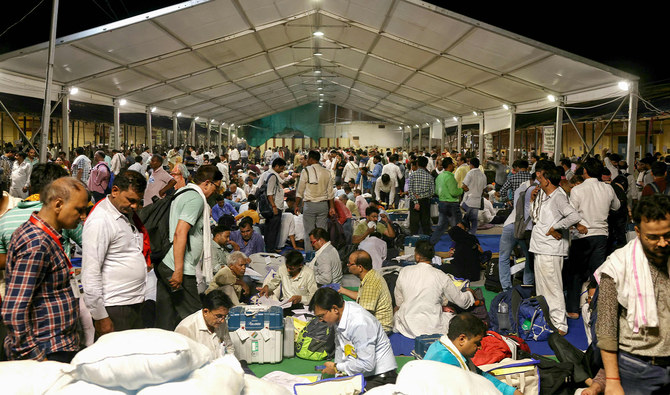
Polling officials gather to submit electronic voting machines (EVMs) and other polling materials at a collection centre in Varanasi on June 1, 2024, at the end of the seventh and final phase of voting in India's general election. (AFP)
Short Url
Updated 02 June 2024
Follow

Heatstroke killed 33 Indian polling staff on last voting day— state election chief

  • Security guards, sanitation staff included among 33 Indian polling staff who died from heat
  • Indian PM Modi expected to win third successive landslide election after results are announced 

Lucknow, INDIA: At least 33 Indian polling staff died on the last day of voting from heatstroke in just one state, a top election official said Sunday, after scorching temperatures gripped swathes of the country.

While there have been reports of multiple deaths from the intense heatwave — with temperatures above 45 degrees Celsius (113 degrees Fahrenheit) in many places — the dozens of staff dying in one day marks an especially grim toll.

The India Meteorological Department (IMD) said temperatures at Jhansi in Uttar Pradesh reached 46.9 degrees Celsius (116 Fahrenheit).

Navdeep Rinwa, chief electoral officer for the northern state of Uttar Pradesh, where voting in the seventh and final stage of elections ended Saturday, said 33 polling personnel died due to the heat.

The figure included security guards and sanitation staff.

“A monetary compensation of 1.5 million rupees ($18,000) will be provided to the families of the deceased,” Rinwa told reporters.

Experts say that when a person is dehydrated, extreme heat exposure thickens their blood and causes organs to shut down.

Rinwa reported a separate incident in which a man queueing to vote in the city of Ballia lost consciousness while waiting in line.

“The voter was transported to a health facility, where he was pronounced dead upon arrival,” Rinwa said.

India is no stranger to searing summer temperatures.

But years of scientific research have found climate change is causing heatwaves to become longer, more frequent and more intense.

Hindu-nationalist Prime Minister Narendra Modi looks set to win a third straight landslide election victory after voting ended on Saturday.

Exit polls showed he was well on track to triumph and Modi himself was certain he had prevailed.

The results will be formally announced on Tuesday.


Venezuela advances amnesty bill that could lead to mass release of political prisoners

Updated 06 February 2026
Follow

Venezuela advances amnesty bill that could lead to mass release of political prisoners

  • Such an amnesty is a central demand of the country’s opposition and human rights organizations with backing from the United States

CARACAS: Venezuela’s legislature on Thursday advanced an amnesty bill proposed by acting President Delcy Rodríguez that could lead to the release of hundreds of opposition leaders, journalists and human rights activists detained for political reasons.
Such an amnesty is a central demand of the country’s opposition and human rights organizations with backing from the United States. But the contents of the bill have not been released publicly, and rights groups have so far reacted with cautious optimism — and with demands for more information.
The bill, introduced just weeks after the US military captured then-President Nicolás Maduro, still requires a second debate that has yet to be scheduled. Once approved, it must be signed by Rodríguez before it can go into effect.
In announcing the bill late last month, Rodríguez told a gathering of justices, magistrates, ministers, military brass and other government leaders that the ruling party-controlled National Assembly would take up the legislation with urgency.
“May this law serve to heal the wounds left by the political confrontation fueled by violence and extremism,” she said in a pre-taped televised event. “May it serve to redirect justice in our country, and may it serve to redirect coexistence among Venezuelans.”
Rights groups, fearing some political detainees will be excluded, want more details about the requirements for amnesty before any final vote.
The Venezuelan Program for Education-Action in Human Rights, or PROVEA, issued a statement emphasizing that the bill must be made public urgently due to its potential impact on victims’ rights and broader Venezuelan society.
Based on what is known so far about the legislation, the amnesty would cover a broad timeline, spanning the administration of the late Hugo Chávez from 1999 to 2013 and that of his political heir, Maduro, until this year. It would exclude people convicted of murder, drug trafficking, and serious human rights violations, reports indicate.