Businesswoman set to become Iceland’s next president

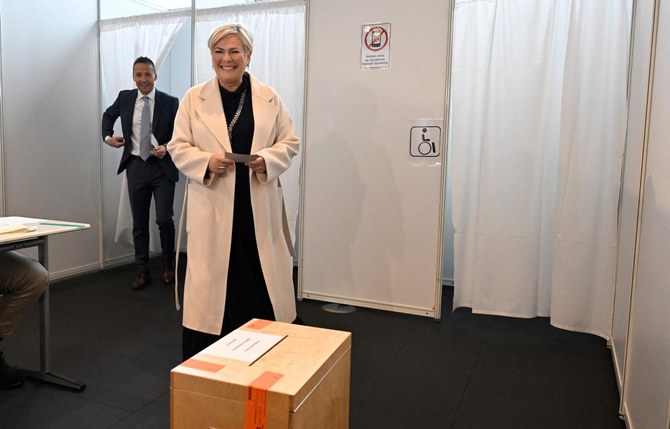
Presidential candidate Halla Tomasdottir casts the ballot at a polling station in Reykjavik, on June 1, 2024. The businesswoman is set become Iceland’s new president, election results show. (AFP)
Short Url
Updated 02 June 2024
Follow

Businesswoman set to become Iceland’s next president

  • Halla Tomasdottir was officially credited with 34.6% of votes, after 71.6% of ballot papers had been counted
  • Iceland’s president holds a largely ceremonial position in the parliamentary republic

REYKJAVIK: Businesswoman Halla Tomasdottir was set on Sunday to become Iceland’s new president, election results showed, beating former prime minister Katrin Jakobsdottir, who critics said was too political for the post.
Jakobsdottir conceded defeat early on Sunday and congratulated Tomasdottir, the CEO of The B Team, a global non-profit co-founded by UK business tycoon Richard Branson to promote business practices focused on humanity and the climate.
Iceland’s president holds a largely ceremonial position in the parliamentary republic, acting as a guarantor of the constitution and national unity.
He or she does however have the power to veto legislation or submit it to a referendum.
Tomasdottir, 55, was officially credited with 34.6 percent of votes, after 71.6 percent of ballot papers had been counted on Sunday.
The 48-year-old Jakobsdottir, who stepped down as prime minister of a left-right government in April to run in Saturday’s election, garnered 25 percent.
The results showed Tomasdottir with much stronger support than opinion polls had suggested in the run-up to the election, where the two candidates had been seen running neck-and-neck.
The final results were likely to change somewhat but Jakobsdottir conceded defeat in the early hours of Sunday before the last votes were in.
“It seems to me that Halla Tomasdottir is quickly heading toward becoming the next president of Iceland.
“I congratulate her on that and know that she will be a good president,” Jakobsdottir told national broadcaster RUV at an election night rally.
Tomasdottir meanwhile told daily Morgunbladid during her election rally she was “just trying to breathe.”
“I feel incredibly good. I know it’s not over until it’s over. So I’m also just trying to stay calm and breathe,” she said.
Tomasdottir is also the founder of Audur Capital, an investment firm created in 2007 aimed at promoting feminine values in the financial sector.
No one central issue dominated the campaign, where candidates traditionally run as independents without party affiliations.
In the country of 380,000 people, any citizen gathering 1,500 signatures can run for office.
While Jakobsdottir was at times seen as the favorite, political observers had suggested that her background as prime minister could weigh against her.
Among the other main candidates in the field of 13 were a political science professor, a comedian, and an Arctic and energy scholar.
Tomasdottir is set to be the second woman to serve as Iceland’s president.
In 1980, Vigdis Finnbogadottir became the world’s first woman democratically elected as head of state.
The businesswoman is set to succeed the hugely popular Gudni Johannesson, who has held the job since 2016.
He announced earlier this year that he would not seek re-election.
Jakobsdottir, party leader for the Left Green Movement from 2013 until her presidential bid, has been hailed for her handling of the resurgence in volcanic eruptions on the Reykjanes peninsula since December.
The five eruptions, including one last week, have sparked a series of evacuations as well as the state’s acquisition of homes from residents evacuated from the threatened fishing town of Grindavik.


Afghan polio survivor’s sock factory provides hope by employing disabled workers

Updated 6 sec ago
Follow

Afghan polio survivor’s sock factory provides hope by employing disabled workers

HERAT: In a tiny room in the center of Herat, Afghanistan’s westernmost city, Shahabuddin uses his hands to propel himself along the floor to a freshly-made pile of socks waiting to be sorted and packaged.
A double amputee since a roadside bomb took both his legs a decade ago, when Afghanistan was mired in conflict between US-led forces and Taliban insurgents, the 36-year-old father of four had struggled to find work. Unemployed for the last decade, he had been forced to rely on relatives for his family’s survival.
But a new sock production workshop in Herat employing only disabled workers has given him new hope.
“I became disabled due to the explosion. Both my legs were amputated,” Shahabuddin, who like many Afghans goes by only one name, said during a brief pause in his work in early December. “Now I work here in a sock factory, and I am very happy that I have been given a job here.”
The workshop is the brainchild of Mohammad Amiri, 35, a former grocery shop worker who started the business about a month ago. Amiri, himself disabled by childhood polio, wanted to create jobs and help provide income for other people with disabilities, particularly as many of them were injured during the conflict and have no other means of income.
He teamed up with another polio survivor to start the sock factory with a workforce of men disabled either through traumatic injuries or because of congenital issues or other reasons. They make four types of socks: long and short, for winter and summer.
“The factory, which is funded and supported by people with disabilities, began operations last month and currently employs around 50 people with disabilities,” Amiri said. “They are busy in the production, packaging and sale of socks in the city.”
A combination of decades of conflict, a weak health care system and struggling economy have contributed to high levels of disability in Afghanistan. Data from a 2019 Model Disability Survey conducted by The Asia Foundation nonprofit organization indicates that nearly 25 percent of adults live with a mild disability, while 40 percent have moderate and about 14 percent have severe disabilities.
“These figures compel us to act with greater urgency and commitment,” the UN Assistance Mission in Afghanistan said in a statement released on the International Day of Persons with Disabilities on Dec. 3, quoting the same figures. “Persons with disabilities must not be treated as an afterthought; they must be fully integrated into every stage of planning, decision-making, and service delivery.”
Meanwhile, Afghanistan is one of only two countries — along with neighboring Pakistan — where wild poliovirus remains endemic. The infectious disease can cause flu-like symptoms, but can also cause severe reactions, including paralysis, disability and death.
The Afghan Ministry of Martyrs and Disabled Affairs says 189,635 disabled people across the country are registered and receiving financial support from the government.
Amiri said his business faces serious competition from cheap imports of textiles, and expressed the hope that the government would stop imports from abroad. He has hopes of getting a contract to provide the Afghan security forces with socks, and wants to expand his workforce to 2,000 people.
His current employees include former refugees who have recently returned to Afghanistan after spending years abroad.
One such man is Mohammad Arif Jafari, 40, an economics graduate and polio survivor who lived in Iran for years. Returning to Afghanistan has been hard, he said.
“I suffered a lot due to unemployment. But fortunately, now I produce several types of socks,” he said while selling his wares from a stall on the streets of Herat. “I am happy that I am working here and earning an income.”