Businesswoman set to become Iceland’s next president

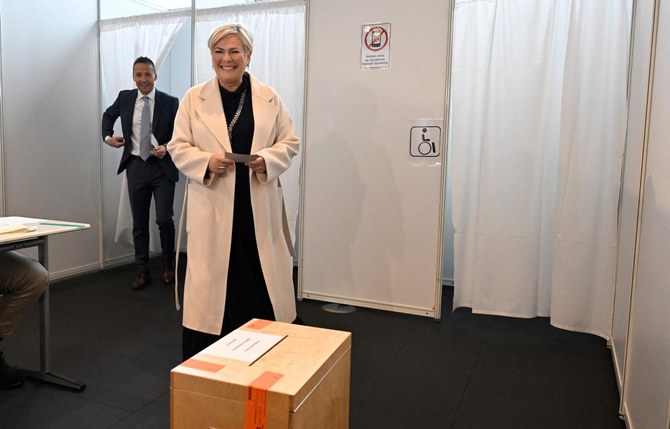
Presidential candidate Halla Tomasdottir casts the ballot at a polling station in Reykjavik, on June 1, 2024. The businesswoman is set become Iceland’s new president, election results show. (AFP)
Short Url
Updated 02 June 2024
Follow

Businesswoman set to become Iceland’s next president

  • Halla Tomasdottir was officially credited with 34.6% of votes, after 71.6% of ballot papers had been counted
  • Iceland’s president holds a largely ceremonial position in the parliamentary republic

REYKJAVIK: Businesswoman Halla Tomasdottir was set on Sunday to become Iceland’s new president, election results showed, beating former prime minister Katrin Jakobsdottir, who critics said was too political for the post.
Jakobsdottir conceded defeat early on Sunday and congratulated Tomasdottir, the CEO of The B Team, a global non-profit co-founded by UK business tycoon Richard Branson to promote business practices focused on humanity and the climate.
Iceland’s president holds a largely ceremonial position in the parliamentary republic, acting as a guarantor of the constitution and national unity.
He or she does however have the power to veto legislation or submit it to a referendum.
Tomasdottir, 55, was officially credited with 34.6 percent of votes, after 71.6 percent of ballot papers had been counted on Sunday.
The 48-year-old Jakobsdottir, who stepped down as prime minister of a left-right government in April to run in Saturday’s election, garnered 25 percent.
The results showed Tomasdottir with much stronger support than opinion polls had suggested in the run-up to the election, where the two candidates had been seen running neck-and-neck.
The final results were likely to change somewhat but Jakobsdottir conceded defeat in the early hours of Sunday before the last votes were in.
“It seems to me that Halla Tomasdottir is quickly heading toward becoming the next president of Iceland.
“I congratulate her on that and know that she will be a good president,” Jakobsdottir told national broadcaster RUV at an election night rally.
Tomasdottir meanwhile told daily Morgunbladid during her election rally she was “just trying to breathe.”
“I feel incredibly good. I know it’s not over until it’s over. So I’m also just trying to stay calm and breathe,” she said.
Tomasdottir is also the founder of Audur Capital, an investment firm created in 2007 aimed at promoting feminine values in the financial sector.
No one central issue dominated the campaign, where candidates traditionally run as independents without party affiliations.
In the country of 380,000 people, any citizen gathering 1,500 signatures can run for office.
While Jakobsdottir was at times seen as the favorite, political observers had suggested that her background as prime minister could weigh against her.
Among the other main candidates in the field of 13 were a political science professor, a comedian, and an Arctic and energy scholar.
Tomasdottir is set to be the second woman to serve as Iceland’s president.
In 1980, Vigdis Finnbogadottir became the world’s first woman democratically elected as head of state.
The businesswoman is set to succeed the hugely popular Gudni Johannesson, who has held the job since 2016.
He announced earlier this year that he would not seek re-election.
Jakobsdottir, party leader for the Left Green Movement from 2013 until her presidential bid, has been hailed for her handling of the resurgence in volcanic eruptions on the Reykjanes peninsula since December.
The five eruptions, including one last week, have sparked a series of evacuations as well as the state’s acquisition of homes from residents evacuated from the threatened fishing town of Grindavik.


India rolls out strictest anti-pollution curbs as toxic smog engulfs Delhi

Demonstrator wearing an oxygen mask and holding oxygen tanks takes part in protest.
Updated 14 December 2025
Follow

India rolls out strictest anti-pollution curbs as toxic smog engulfs Delhi

  • Private monitors in several parts of northern Delhi recorded AQI spikes between 550 and 700s
  • Authorities invoked stage four of the capital region’s emergency pollution-control framework

NEW DELHI: India’s capital choked under a thick blanket of smog on Sunday, with the government imposing anti-pollution curbs after monitoring stations in some areas recorded extremely hazardous air quality.

Home to 30 million people, Delhi has not recorded a single “clean air” day in 2025, with Air Quality Index readings hitting high above the 50 score throughout the year.

On the AQI scale from 0 to 500, good air quality is represented by levels below 50, while levels above 300 are dangerous.

Worsening since late October, official records over the weekend were in the severe to severe-plus range of 400–500, but as 24-hour averages, they did not capture the peaks. Private monitors in several parts of North and North West Delhi recorded AQI spikes above 550 and even into the 700s in real-time.

On Saturday evening, the Ministry of Environment’s Commission for Air Quality Management invoked stage four — the highest level — of the Graded Response Action Plan for Delhi and surrounding areas.

To “prevent further deterioration of air quality in the region,” the commission suspended all non-essential construction, shut stone crushers and mining operations, stopped entry of trucks into the capital region, and ordered schools to shift to hybrid classes or online, where possible.

While authorities blamed the pollution on “adverse meteorological conditions,” residents have been demanding more government action.

“The situation is so bad in Delhi that we don’t have any option but to force kids to do online classes. The government has failed us; it has not done anything to address the issue,” said Nabanita Nayak, who decided for her teenage children to attend school online only, despite concerns over their screen addiction.

“If the kids are too much in front of laptops, that’s also an issue. As a mother, I am worried.” 

Delhi’s pollution has been worsening since Diwali in late October, when the average AQI has been above 370, or “very poor.” Since mid-November, it has been over 400, which means “severe” air quality, with certain areas recording 500 and above, which is classified as a “hazardous” level.

“I don’t feel proud living in Delhi. It’s the capital city of the country … We talk about being a developed nation by 2047 — we have deadlines,” said Jagriti Arora, who is keeping her 7-year-old daughter at home to prevent allergy flare-ups caused by air pollution.

“The government has to do something … China had a big problem with pollution, but now they’ve managed to bring it down.”

Delhi’s air quality deteriorates in winter due to local emissions and seasonal weather conditions. Cold temperatures and low wind speeds result in a temperature inversion, which traps pollutants close to the ground instead of letting them disperse. This allows emissions from millions of vehicles, ongoing construction, and nearby industrial activity to accumulate in the air. Urban waste burning and dust from construction sites further add to it.

“This is not a new thing. This has been happening now for over 10 years,” Arora said. “You can see it. You don’t need to actually look at an AQI meter to see how bad the pollution is these days.”