DUBAI: Since Dec. 28, tens of thousands of Iranians have protested in what is already the most serious domestic crisis the country has faced since the 2009 Green Movement.
A small anti-government protest organized in Mashhad — to capitalize on growing frustration, and denounce the recent 40 percent increase in the price of eggs and chicken — quickly spiraled out of control when it found an echo chamber among young and disheartened Iranians. Though the government was the initial target of many long-standing grievances, protesters soon focused their anger on Iran’s foreign policy.
Slogans such as “not Gaza, not Lebanon, I give my life for Iran,” “forget Palestine,” and “forget Syria and think about us” were often heard throughout the country. But contrary to what they suggest, these slogans do not target the government, but Iran’s Revolutionary Guard Corps (IRGC) which is solely responsible for the country’s foreign policy in its immediate periphery.
As Iranians all know, Foreign Minister Mohammad Javad Zarif does not decide Tehran’s policy toward Syria and President Bashar Assad; it is the domain of Maj. Gen. Mohammad Ali Jafari, the commander of the IRGC.
The IRGC was created in 1979 to protect the new Islamic Republic from a counter-revolution. While the then Supreme Leader Ayatollah Ruhollah Khomeini appeared to have his eyes on the US and the UK, his primary concern was the Artesh — the regular army — that for decades received training and support from those same countries. The IRGC, set up as a counterweight against the less ideological Artesh, has been favored since then. It rapidly became Iran’s most crucial military actor as it runs the country’s ballistic missile program, and also progressively gained a prominent role in the economy.
The IRGC has often been accused of preventing the development of the Iranian private sector. Its omnipresence hampered the emergence of medium-size companies and the influx of foreign direct investments. Even President Hassan Rouhani criticized what he called the “government with a gun” and tried to limit its influence by diminishing the budget of the organization. But the supreme leader’s support and its other revenues drawn from the Iranian economy have thwarted Rouhani’s repeated attempts.
On numerous occasions, Iranians have voiced their frustration toward the IRGC’s foreign policy. While the organization considers Syria and Lebanon of paramount importance to the country’s strategic interests, it realized long ago it will not gain the support of the Iranian population for these distant causes.
The IRGC tried to win Iran’s hearts and minds. With relative success, it created the charismatic and romantic figure of the commander of Al-Quds Force Gen. Qassem Soleimani to attract young Iranians. The force is responsible for operations outside of Iran and is designated as a supporter of terrorist organizations by the US.
The IRGC also used its network of military bases to provide support after natural catastrophes, such as the recent earthquake which struck the western part of the country.
However, it did not prevent a growing frustration: The benefits of the nuclear deal that Iranians massively supported are not trickling down to the most impoverished fringe of the population. Despite hard-liners’ attempts to blame foreign powers, Iranians believe a corrupted minority is confiscating these benefits.
Beyond the IRGC, it is the regime it supports that is being criticized. The protests are revealing once again the fracture between the theocracy and a significant portion of Iranians. Slogans such as “you made Islam alive, but you made people poor” and “we don’t want the Islamic Republic, we don’t want it, we don’t want it” are a blow to the religious establishment. However, the Iranian institutions are resilient and Ayatollah Ali Khamenei, the current supreme leader, is impervious to criticism. More importantly, a majority of Iranians do not want the country to disintegrate into anarchy and follow the path of Syria, Iraq, and Libya.
The future of the protests is uncertain. Leaderless and disorganized, it does not yet represent a severe risk to the theocratic regime. The protests could, however, weaken president Rouhani’s position and his ability to deliver on the promises he made during his re-election campaign to revive the economy and decrease the unemployment rate.
The protests already have severe consequences for the Iranian government, and Rouhani’s embarrassment is palpable. While he attempts to manage popular expectations and conservatives’ red lines, the recent events might endanger the only thing Iranians expect from him: The revival of the economy.
France’s decision to postpone the upcoming trip to Tehran of its Foreign Minister Jean-Yves Le Drian is, therefore, a massive blow to the Iranian government as it was scheduled to organize the visit of the President Emmanuel Macron and the signing of many contracts with French companies. The protests will shake the resolve of other foreign investors; it might even succeed where Donald Trump has so far failed, in killing the nuclear agreement.
— Marc Martinez is an independent country risk analyst based in Dubai


![]()
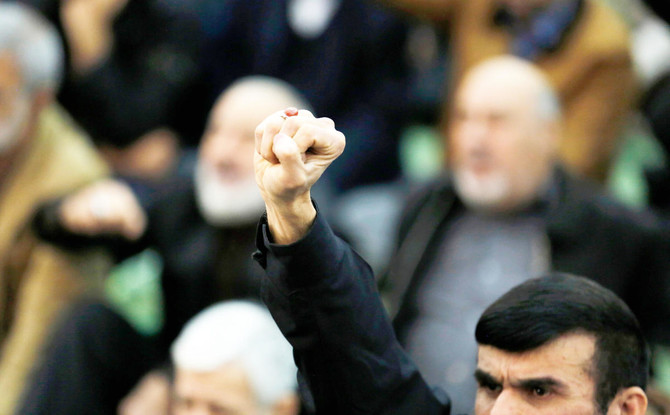
IRGC is at the heart of protesters’ anger
IRGC is at the heart of protesters’ anger



Latest updates




© 2026 SAUDI RESEARCH & PUBLISHING COMPANY, All Rights Reserved And subject to Terms of Use Agreement.