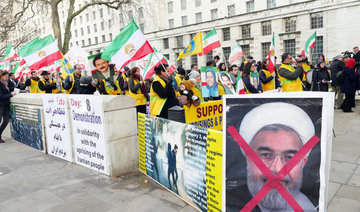
DUBAI: A hard-line Iranian cleric has called on Iran to create its own indigenous social media apps, blaming them for the unrest that followed days of protest in the Islamic Republic over its economy.
Ayatollah Ahmad Khatami made the comments while leading Friday prayers in Tehran. He said that when the country blocked social media “the riots stopped.”
Khatami says that “the nation does not support a social network that its key is in the hand of the United States.” He also said he believed anyone who burned Iran’s flag should be sentenced to death.
Meanwhile, activists have posted new videos purporting to show protests challenging the Islamic Republic’s government.
Activists describe the protest videos, obtained by The Associated Press outside of Iran, as showing demonstrations in Tehran on Thursday night, including chants against Supreme Leader Ayatollah Ali Khamenei.
In Tehran on Friday morning, streets appeared calm ahead of noon prayers.
An emergency meeting of the UN Security Council, called for by the United States, is to discuss the ongoing unrest later Friday.
At least 21 people have been killed in the unrest surrounding the protests, which began last week over rising food prices and Iran’s flagging economy before spreading to cities across nearly all of Iran’s provinces. Authorities have said the protests are waning.

Iran cleric blames social media for anti-regime protests
Foreign press group welcomes Israel court deadline on Gaza access
- Supreme Court set deadline for responding to petition filed by the Foreign Press Association to Jan. 4
- Since the start of the Gaza war in October 2023, Israeli authorities have prevented foreign journalists from independently entering the Strip
JERUSALEM: The Foreign Press Association in Jerusalem on Sunday welcomed the Israeli Supreme Court’s decision to set January 4 as the deadline for Israel to respond to its petition seeking media access to Gaza.
Since the start of the Gaza war in October 2023, sparked by Palestinian militant group Hamas’s attack on Israel, Israeli authorities have prevented foreign journalists from independently entering the devastated territory.
Israel has instead allowed, on a case-by-case basis, a handful of reporters to accompany its troops into the blockaded Palestinian territory.
The Foreign Press Association (FPA), which represents hundreds of foreign journalists in Israel and the Palestinian territories, filed a petition to the supreme court last year, seeking immediate access for international journalists to the Gaza Strip.
On October 23, the court held a first hearing on the case, and decided to give Israeli authorities one month to develop a plan for granting access.
Since then the court has given several extensions to the Israeli authorities to come up with their plan, but on Saturday it set January 4 as a final deadline.
“If the respondents (Israeli authorities) do not inform us of their position by that date, a decision on the request for a conditional order will be made on the basis of the material in the case file,” the court said.
The FPA welcomed the court’s latest directive.
“After two years of the state’s delay tactics, we are pleased that the court’s patience has finally run out,” the association said in a statement.
“We renew our call for the state of Israel to immediately grant journalists free and unfettered access to the Gaza Strip.
“And should the government continue to obstruct press freedoms, we hope that the supreme court will recognize and uphold those freedoms,” it added.
An AFP journalist sits on the board of the FPA.