RIYADH: The Saudi Commission of Tourism and National Heritage (SCTH) announced on Saturday that more than 200,000 visitors enjoyed 42 various tourist activities and functions in the Riyadh region in 2017, while some 40,000 students took part in 33 school trips.
Abdul Aziz Al-Hasan, director of SCTH, Riyadh region, said his office issued licenses to 975 travel offices and 1,407 accommodation facilities, including hotels and furnished apartments, this year.
Aside from tourism, Al-Hasan said the Riyadh region had also hosted six Saudi and international scientific missions in 2017.
Al-Hasan also highlighted the SCTH’s renovation and development work: 2017 saw the SCTH carry out work on the National Museum in Riyadh, the Visitors Center in Faw, the Urban Heritage Administration Center in Diriyah, the Heritage Project in Al-Ghat, King Abdul Aziz Palace in Al-Kharj, and 45 other “heritage locations” in the Riyadh region, in addition to “some historic mosques.”
The efforts of SCTH, headed by Prince Sultan bin Salman, in the development of the tourism and heritage sector and in highlighting the Kingdom’s cultural wealth are in line with Vision 2030, Al-Hasan said.
He pointed out that the National Transformation Program (NTP) 2020 has established 13 initiatives to develop the tourism and heritage sector, attract investors, and bolster in-land tourism.
SCTH is also doing its part in the drive for Saudization, intensifying its efforts through inspection campaigns in tourist establishments and travel agencies.
Al-Hasan concluded by saying that the Kingdom’s rich archaeological, tourist and heritage locations will provide new job opportunities in the future, and have a positive impact on local communities.
The Riyadh region in particular, he suggested, is an attractive destination for visitors, with major shopping malls, amusement parks and its wide variety of events.


Riyadh tourism events attract over 200,000 visitors in 2017
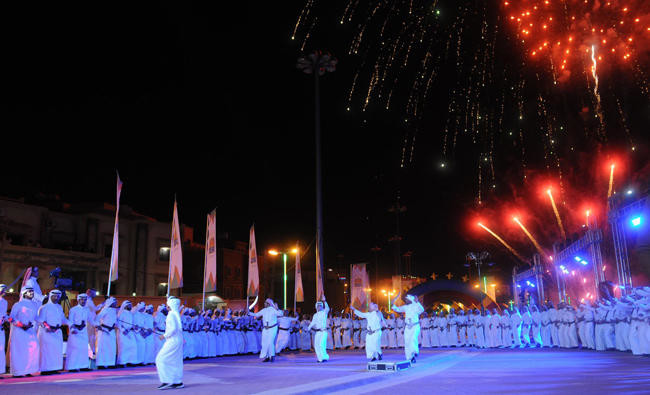
Riyadh tourism events attract over 200,000 visitors in 2017
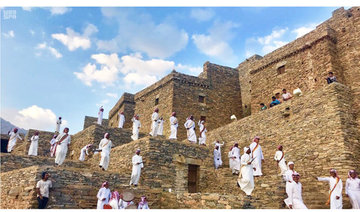



Saudi photographer brings Madinah into focus
- Shaker Samargandi’s work captures the city’s layered identity in intimate detail
- Approach has allowed architecture to be presented as a living element, one that interacts with light and the passage of time
MAKKAH: Through a deeply personal lens, Saudi Arabia photographer Shaker Samargandi is presenting a contemporary vision of Madinah.
Born and raised in Madinah, he says his familiarity with the city’s rhythms and spaces has shaped his artistic vision.
Rather than treating the holy city as a staged subject, Samargandi approaches it as “a living memory.” Through his lens, streets, courtyards and architecture become narrative elements revealing the city’s layered identity.
Samargandi told Arab News that Islamic architecture, especially that associated with the Prophet’s Mosque, has been a central focus of his visual interest, given its spiritual and aesthetic values deeply rooted in history.
He says his focus is not directed toward the overall scene, but the fine details that reflect the philosophy and aesthetics of the structure, allowing the viewer to contemplate the relationship between form and meaning.
This approach has allowed architecture to be presented as a living element, one that interacts with light and the passage of time.
Madinah’s geography plays a role, Samargandi explained. Mountains and harrat lava fields meet farms and palm groves within the urban fabric, creating a distinctive interplay between nature and urban life.
For the photographer, this relationship underscores how place is formed through constant interaction between landscape and people.
He says residents have often responded to his work by seeing their city from unfamiliar angles, prompting renewed reflection on their everyday surroundings.
Samargandi is now developing long-term projects, including a photo book documenting Madinah. For him, visual documentation carries cultural responsibility, particularly as the city undergoes rapid urban and social transformation.
Photography, he says, is not merely archival, it preserves daily details and aesthetic character for future generations while offering a tool to understand and rediscover place.
He further explained that working on long-term projects allows for a deeper understanding of a place, away from the fast pace of visual consumption.
Samargandi believes Madinah still holds, for the artist, vast territories and stories to be explored, that engage the present and honor the city’s roots.


