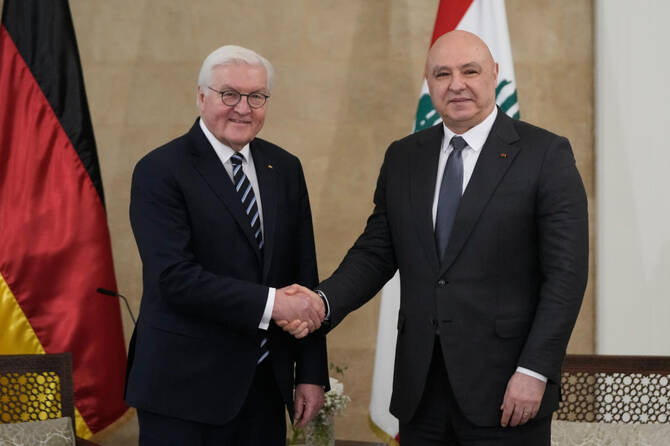


BEIRUT: Germany would continue to support Lebanon’s armed forces and state institutions even after the planned withdrawal of UN peacekeepers in 2027, President Frank-Walter Steinmeier said on Monday, reaffirming Berlin’s long-term commitment to boost state authority and security in the country’s south.
Speaking after talks with Lebanon’s President Joseph Aoun at the presidential palace in Baabda, Steinmeier said Germany would “stay by Lebanon’s side” beyond the end of the UN Interim Force in Lebanon’s mandate.
“The ceasefire between Israel and Hezbollah is an opportunity to achieve stability in the region, and we call for adherence to it,” Steinmeier said.
He stressed that “the disarmament of Hezbollah must proceed apace, and Israeli forces must withdraw from southern Lebanon,” reiterating Berlin’s position that Israel’s “permanent occupation of Lebanese territories is unacceptable and must be ended.”
His remarks come amid ongoing diplomatic efforts to reinforce the Nov. 24 ceasefire agreement and expand the Lebanese army’s deployment in the south, as well as growing international discussion over UNIFIL’s future role.
In response to questions, the German president described the Lebanese Armed Forces as the “backbone of stability” in Lebanon.
“When UNIFIL’s mission comes to an end, we will need to determine how best to reinforce that backbone.”
Steinmeier, who began a three-day official visit to Lebanon, is scheduled to inspect a German frigate serving within UNIFIL’s maritime task force, and inaugurate, alongside Aoun, the naval academy where Lebanese and German forces cooperate on training programs.
According to the Lebanese presidency, Aoun told Steinmeier that Germany’s contribution to training Lebanon’s naval personnel has been “fundamental” in strengthening operational capacity and professional expertise.
He described the German president’s visit as “a message of hope for the Lebanese” at a time of mounting regional uncertainty.
The two leaders first held a 20-minute one-on-one meeting before being joined by senior Lebanese and German officials.
This marks Steinmeier’s second visit to Lebanon, following his 2018 trip — the first by a German president in nearly 120 years — underscoring Berlin’s sustained diplomatic and military engagement in the country.
Aoun said Israel’s continued presence in occupied positions in southern Lebanon has so far prevented the Lebanese army from fully deploying up to the internationally recognized borders.
He noted that the potential continued presence of German and other European forces in the south following UNIFIL’s withdrawal could help reinforce security and provide social and humanitarian support to local communities.
Contacts, he added, would be established with European countries willing to maintain part of their contingents in order to agree on an appropriate framework for their role.
Aoun emphasized that the state’s decision to establish a monopoly over weapons stems from a domestic Lebanese need rather than external pressure. He said authorities would continue implementing the policy in coordination with relevant parties, while safeguarding stability and civil peace.
At a joint press conference, Steinmeier reaffirmed Germany’s long-term backing for Lebanon, stressing Berlin’s support for state institutions, particularly the security agencies. He also praised Lebanon for hosting large numbers of Syrian and Palestinian refugees despite its economic strain.
Steinmeier pointed to what he described as a moment of fragile transition in the region, including a delicate ceasefire in Gaza, the release of hostages by Hamas, and political shifts in neighboring Syria, saying both Germany and Lebanon share an interest in achieving lasting peace and stability.
He also thanked Lebanon for pursuing diplomatic channels to secure and maintain the ceasefire between Hezbollah and Israel, urging all sides to adhere to the agreement.
For his part, Aoun stressed Lebanon’s role as a “platform for dialogue,” reaffirming the country’s commitment to “absolute peace.”
“On behalf of all Lebanese, we can no longer bear the conflicts of others. We seek nothing but the well-being of our people, the prosperity of our nation, and a secure future for our children,” he stated.
Disarmament plan
Lebanon’s cabinet on Monday reviewed a monthly report by Army Commander Gen. Rodolphe Haykal outlining the next phases of the plan to place weapons under exclusive state control north of the Litani River.
A ministerial source told Arab News that Haykal confirmed that operations are continuing both south and north of the Litani, but said there is no fixed timetable for completing the mission due to the vast geographical scope and the scale of work and equipment required.
The army chief detailed the challenges facing the operation, particularly in the south, citing continued Israeli attacks, the occupation of certain areas, and limited financial and logistical resources. Political constraints were also highlighted as complicating factors.
The source added that the army’s roadmap for the next phase follows a gradual approach designed to avoid direct confrontation with Hezbollah, focusing instead on containing and collecting weapons and ammunition in stages.
Speaking from Munich on the sidelines of the recent security conference, Lebanon’s Prime Minister Nawaf Salam reiterated that the government “is not seeking confrontation with Hezbollah, but we will not be intimidated by any party.”
Earlier this month, the Lebanese army uncovered a large Hezbollah tunnel in the town of Al-Halousiya in Tyre district, south of the Litani River. A military source told Arab News that troops are still working to remove significant quantities of weapons, mostly shells, found inside the tunnel.
In parallel, the army reinforced its presence along the border, establishing four new posts in the town of Kfarkela.
Israeli strikes meanwhile have continued. On Monday, a drone strike killed a school bus driver, Mohammad Tahsin Hussein Qashqash, outside his home in Hanine in the Bint Jbeil district.
A day earlier, another drone strike targeted a taxi near the Lebanese-Syrian border on the road to the Al-Masnaa crossing, killing four passengers, including a Syrian national identified as Khaled Mohammad Al-Ahmad.